Control Resonant’s Pivot to Melee Action Is a Terrible Waste of Remedy’s Talents (Review)
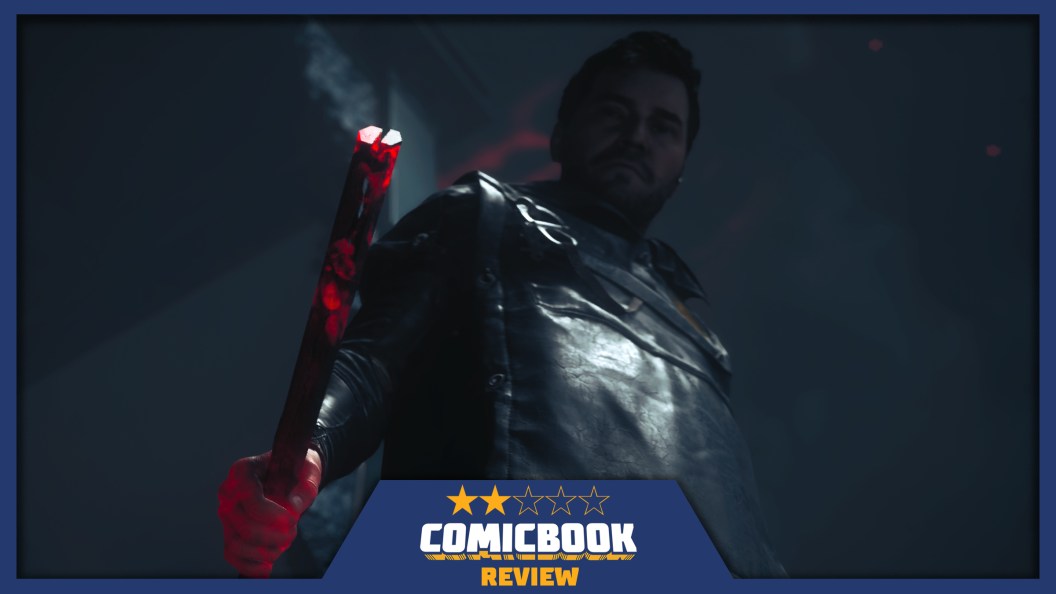
The streets of Manhattan are bleeding in Control Resonant. It’s not because of a swarm of mangy rats or lingering rot from Mayor Eric Adams’ administration but from an aberrant, otherworldly force. The Hiss forces have escaped the infinite confines of the Oldest House and spilled out over the most densely populated borough, corrupting every street light and bus stop. These demonic monstrosities seem out of place when not floating in that Brutalist enigma of a building, as if this kind of wickedness needs to be sheltered from the public. But, if anything, this disconnect is apt for Resonant as a whole, since it mimics how Remedy Entertainment is ill-suited to make quality melee-focused action games.
Resonant‘s numerous flaws aren’t evident from the jump. Dylan Faden, Jesse’s tortured brother from the first game, moves swiftly. His dodge covers a lot of ground and is full of precious invulnerability frames (perhaps too many). He even swings his trusty Aberrant weapon with haste. Training for years in captivity may have whittled his social skills down to a nub and left permanent emotional scars, but it has also sharpened his aggression and agility.
Rating: 2 out of 5
| Pros | Cons |
|---|---|
| Some of the trippier vistas and set pieces are beautiful | Combat is mindless, repetitive, shallow, and terribly balanced |
| Its upgrade system is unfulfilling and poorly managed | |
| The story has little to say and often uses hollow jargon to further its plot | |
| Very few of its ideas are interesting and match the standard set by the first game |
Control Resonant’s Combat Is Thoroughly Unsatisfying
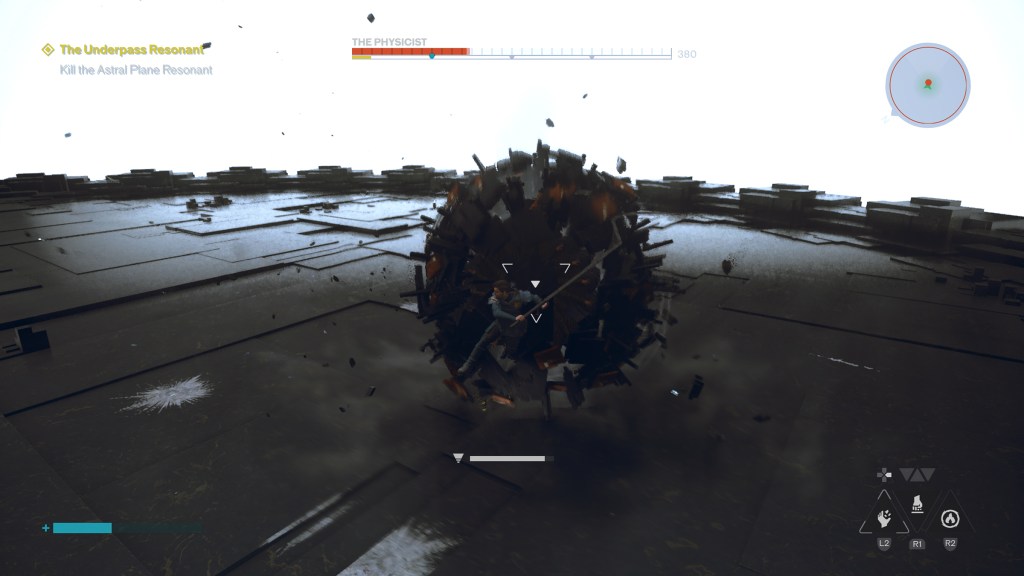
But just as its responsiveness becomes clear right off the bat, it’s also almost immediately evident how shallow it all is. Just about every weapon has only one attack string, and, despite the shapeshifting nature of the Aberrant and its ability to bend reality, there’s no way to switch armaments in the middle of a combo.
These two pivotal limitations hamstring Resonant‘s combat, since they dramatically shrink the possibility space. Any dreams of popping up one possessed soldier with the scythe, bouncing them off the ground with the hammer, and then performing a different combo with the scythe are shattered once they butt up against the reality of each weapon’s singular attack string and limited purpose. It’s not even possible to perform an aerial juggle at will since that almost exclusively happens at the end of a string and only if a certain secondary weapon is equipped.
To say Resonant is restrictive is a massive understatement. There’s no creative thinking when it comes to combos, movement tech that requires expertise to master, or clever ways to combine its tools; it’s all just mashing, mashing, mashing. Thoughtlessly pounding on the same button is at odds with the freedom of expression present in the genre’s best. The Devil May Cry, God of War, and Bayonetta franchises and even the relative newcomer Hi-Fi Rush — while of different complexities — all revolve around giving players a sandbox to explore and are genre heavyweights as a result. Resonant fails to grasp that fundamental concept and suffers immensely because of it.
New powers become available at a steady clip, but they’re almost all based around status effects and, crucially, don’t interact with each other. Being able to coat the Aberrant with fire may drain health bars a little faster, however, it doesn’t truly add anything notable to the player’s repertoire. The same goes for the ground pound that just does damage and the cement chunks players can toss at distance. In more astute hands, the ground pound could pop up enemies and the concrete projectiles would sustain an aerial juggle. The surprisingly lengthy upgrade tree and handful of perks do almost nothing to make any of the combat more thoughtful, either, as they mostly just add stat bonuses that are too miniscule to notice.
With a narrow and disjointed tool set, Resonant is a sauceless action game on a mechanical level, and it only gets worse when looking at the broader game that surrounds said mechanics. The camera is zoomed so far out and distances the player even more from the impact that makes the best character action games tick (and doesn’t do it for the sake of impressive scale, either).
The distant camera is a byproduct of the deluge of enemy reinforcements that require a wider angle in order to fit on the screen. Hiss grunts often pour into arenas in ridiculous numbers, which can lead to irritating scenarios where off-screen attacks, debris, and lasers — and there are an outsized amount of lasers — continually take cheap shots at the player. It’s rarely difficult, yet it’s often hectic, illustrating how chaos can be bastardized in an attempt to mask lackluster enemy AI.
Inflated health values are the actual root problem here, though. Every single opponent in the game, from the lowest Hiss creatures to the titanic Resonant freaks, has an outrageously large health pool that can sometimes take multiple minutes of sustained hacking to trim down. It’s an exhausting process that only further highlights how thin Dylan’s move set is; every battle across its bloated runtime is a looping nightmare of the same three-hit combo that hardly does any damage.
It’s a war of attrition where each one of said battles gradually needles the players to cave and go into the accessibility settings to tweak the values in order to avoid crashing out. Having an admittedly wide set of knobs to fiddle with will undoubtedly lower the barrier to entry here, but, pessimistically, it just meant Remedy didn’t have to balance the game well. Cranking up Dylan’s damage can cause some lesser goons to die in four hits but have a laughably minimal effect on bosses. There’s no consistency and makes this abdication of responsibility on Remedy’s part even more frustrating. It’s just not possible to micromanage the settings in a way that makes Resonant a balanced action game, and no amount of value tuning could turn it into a great one.
Control Resonant’s Story Can’t Pick Up the Slack, Either

Remedy is more renowned for its narrative chops, but Resonant falters here, too. Dylan’s role as the protagonist is a novel idea. While used as the Hiss’ gifted meat puppet and a victim of Dr. Darling’s insidious tests, there is blood on Dylan’s hands. This dark past puts this Faden sibling in interesting position, because it gives him a natural and compelling arc of wanting to atone. His attempts to repent add welcome friction to many interactions. FBC lackeys often scoff when he walks by and aren’t afraid to disregard his words, despite his gentle, apologetic tone. It seems as though some would prefer seeing the Hiss corrupt all of New York City over trusting Dylan with anything sharper than a spoon.
It thematically contextualizes the player’s drive to complete missions and do good whenever possible, but this central theme isn’t explored as well as it should be. Instead of being central to the plot, it’s merely something the game occasionally picks at on the side. There’s only one line about Resonants once being human, but that thought-provoking parallel to Dylan is not brought up again. Even then, it’s only sporadically mentioned when it’s convenient and doesn’t directly intertwine with the other threads. And when it’s time for the game to make good on this theme of rehabilitation, it balks at the last moment and goes down the safer, less interesting path instead.
There’s not much else to latch on to aside from its haphazard commitment to the concept of self-improvement, too. Dylan’s main goal at the beginning of stopping the Hiss and saving Jesse doesn’t evolve much, and most new developments are at the behest of sci-fi mumbo jumbo. Essentially, it is either stagnant or inscrutable.
Remedy’s Lynchian style of storytelling means not everything needs to be comprehensively explained, but not even the unexplainable is intriguing enough. Much of the strange SCP-adjacent lore bits are fine yet significantly less awe-inspiring; there’s nothing that reaches the heights of stepping foot into the Quarry Threshold or Foundation for the first time, finally getting to go through the Ashtray Maze, or witnessing the collection of Altered Items in the Containment Sector. Most of Resonant‘s new bits of lore are tame in comparison and primarily read about in its various notes and not actualized inside the game. Some of the M.C. Escher-esque interpretations of New York City can create some stunning vistas where reality folding in on itself looks like a work of beauty — a photo mode would suit this game well — but these twisty landscapes don’t come close to matching the impressive heights seen in the first Control.
Whereas that 2019 title was a splendid synthesis of Remedy’s signature strengths, Control Resonant‘s many failures make it seem as though it came from a different studio altogether. Its melee combat is bafflingly hollow, relentlessly repetitive, and poorly balanced across the board. Dylan’s quest to save the day lacks inventive concepts that stretch the mind and ends up being a fairly one-note story with an unearned ending. By failing to engage the fingers or brain, Resonant is not just a disappointing sequel; it betrays the very notion of what it means to be a Remedy game.
A PS5 copy of Control Resonant was provided by the publisher for the purpose of this review.
What do you think? Leave a comment below and join the conversation now in the ComicBook Forum!