The Blood of Dawnwalker’s Clever 30-Day Clock Mechanic Makes It One of the Most Unique RPGs in Years

Bandai Namco and Rebel Wolves’ new fantasy action role-playing game The Blood of Dawnwalker has been garnering plenty of positive buzz since its launch last week. But in addition to earning praise from players and critics, the title has also spawned a good deal of curiosity, questions, and even some confusion due to its unique 30-day time mechanic.
Unfolding in the 14th-century, among the picturesque Carpathian Mountains, the dark fantasy puts players behind the blades, spells, and fangs of half-human/half-vampire Coen. As the set-up goes, the titular protagonist and his family were living a pretty peaceful life in the fictional Kingdom of Vale Sangora… until a vampire lord and his lieutenants took over his village.
Lead bloodsucker Brencis allows Coen and his community to live under his rule on the condition they pay him a monthly tax. The tariff, however, is their literal blood, sacrificed in a creepy ritual aptly dubbed a “Blood Mass.” When one of these gatherings goes sideways during the game’s prologue, Brencis kidnaps Coen’s family with the intention of killing them at the next ceremony.
The 30 Days To Go Mechanic Explained

And it’s this twisted turn of events that introduces Dawnwalker‘s clever, clock-ticking system. Coen has just 30 days and 30 nights to defeat Brencis and rescue his family, a daunting deadline players can approach however they like. Unlike many similar genre entries, Dawnwalker doesn’t follow a long series of linear story objectives that ultimately cue up the end credits. Instead, it has just one primary objective: Save your family before the calendar page turns.
This unique approach to time progression heavily informs both the storytelling and gameplay. For many invested players, it’s been the title’s standout feature, a smart, imaginative mechanic that not only ensures their choices matter, but that every quest, activity, and interaction feels meaningful. Where similar games might see you slogging through checklist-like side objectives and optional distractions between tackling meatier missions, Dawnwalker‘s freeform quest structure and 30-day limit make for a more organic path to your ultimate goal.
Understandably, however, this subversion of the formula also has some budding bloodsuckers wondering what exactly happens when Coen’s 30 days are up. Other questions, like what specifically causes time to tick forward, also has some players wandering Vale Sangora more worried about the clock than the creatures lurking around every corner.
What Happens When the 30-Day Clock Runs Out

But while the 30-day limit is just that, an allotted amount of time to complete your main objective, it’s far less frightening than the fanged foes you’ll actually face when busting your family out of Brencis’ castle. First and foremost, the game does not end when the deadline passes, unless you do succeed in completing that single primary objective. Save your family, finish the game. But fail to rescue them, and your journey continues.
Aside from the emotional weight you’ll carry for failing to spare your loved ones a gruesome demise, you’re free to continue forging your own path – completing objectives, growing more powerful, and exploring every last nook and cranny of the sprawling open-world. Only now, the time mechanic isn’t hanging over your head. It’s that simple.
Where it becomes slightly more complex is in the specifics of how time is counted and how it progresses. The 30-day counter is broken into 16 daily segments – eight when the sun is up, followed by eight more when it sets – represented as individual chunks on a meter located in the display’s upper-right corner.
Dawnwalker, indeed, includes a day/night cycle – which introduces plenty of other changes to the gameplay, like Coen relying on vampiric abilities under the moonlight – but as far as time progression, day and night are the same. Whether it’s a sun-soaked afternoon or storm-ravaged evening, the segments turn yellow when used. And, when all eight are yellow, day will turn to night and vice versa.
The display also communicates how how many days remain, i.e. “Rescue your family 24 – days left.” Those seeking a broader picture of where they stand can check the journal, where a meter running along the screen’s bottom provides more details. This visualization shows the status of your current day/night – including the progress of all 16 segments – as well as the chunks for the preceding and succeeding days.
Time Is On Your Side

Of course, knowing how to follow the progression of time isn’t especially helpful if you don’t understand what actually makes it move forward. Crucially, the clock doesn’t move at all most of the time. That’s right, unless you’re doing a few very specific things that cause those segments to turn yellow, you’re not eating into your 30 days. There’s tons of optional quests, activities, exploration, and more you can tackle that will not only progress the story and make Coen more powerful, but also won’t nudge the calendar forward.
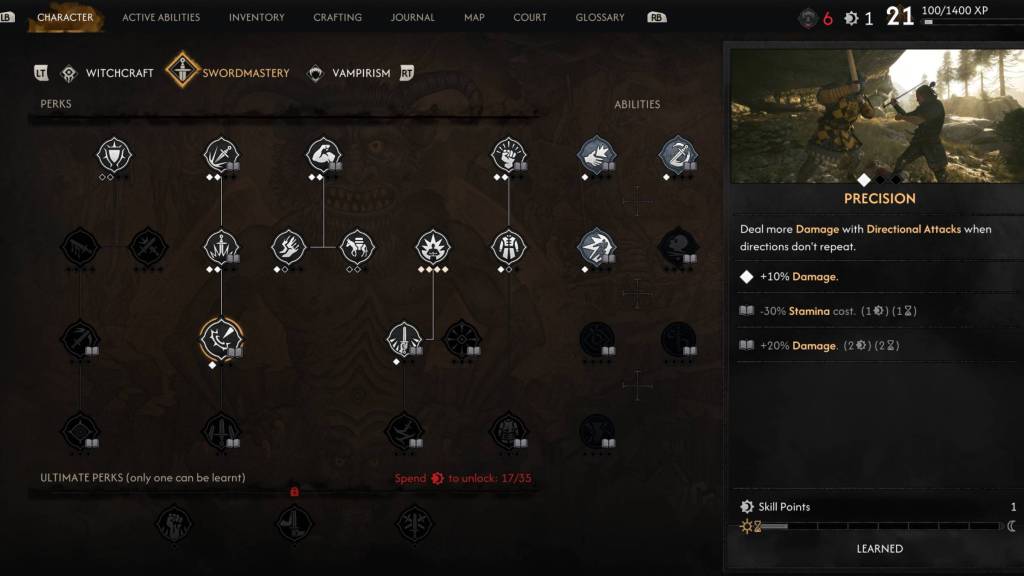
Dawnwalker liberally uses a small, yellow hourglass icon, a visual cue meant to inform you of what objectives and activities make the minutes creep forward. You’ll see the hourglass on the aforementioned time-tracking meters, near objective descriptions in the journal, within the character skill trees, and other places where your precious time could be potentially consumed.
On the various time-tracking displays, the icon will be followed by grayed out segments, signaling how many units will turn yellow/be consumed if you complete the associated activity or objective. The hourglasses adjacent to objective descriptions will also have a numbers next to them, indicating how many coveted slots will be used for that particular task. And occasionally, if you’re approaching a situation or interaction that will auto-trigger time consumption, the on-screen meter will repeatedly flash to offer a heads-up.
The best way to leverage the 30-day limit – while also appreciating how it can shape a more flexible, meaningful playthrough – is to treat time as any other precious currency or resource. While 30 days doesn’t sound like much, it actually breaks down to 16 segments a day, which is a whopping 480 in total.
If you’re intent on saving your family, you’ll want to be conscious of how you decide to turn those coveted blocks yellow. You may want to focus on time-eating activities that help you grow an army of allies to aid you in overthrowing Brencis’ stronghold. Or, you could focus on hunting and killing his lieutenants, using the clock to ultimately weaken his considerable forces. If building the most badass character is preferred, you could focus on progressing Coen, aggressively pushing the hours forward by unlocking the best perks and abilities.
The beauty of Dawnwalker, and its ambitious approach to redefining the genre, is that it gives you the freedom to invest your 480 chunks of time as you see fit. Hell, if you’re not all that concerned about saving Coen’s family, you can ignore the clock completely and do whatever your half-human/half-vampire heart desires. Oh, and there’s no risk of being burdened by regret, as you can always try save them on a second playthrough.