Dice Throne Co-Founder Breaks Down Benefits and Challenges of Digital, Free-To-Play Approach, And More (Exclusive)
The Dice Throne universe has expanded quite a bit since the game first hit tabletops in 2018, as that world now includes around 45 characters, multiple expansions, and several unique ways to play. Now the game is taking its next leap with Dice Throne Digital, which brings the gameplay you know and love with a few welcome updates to mobile devices, Steam, and Meta Quest. That sort of undertaking is not easy, and ComicBook had the chance to speak with Dice Throne Co-Founder and Lead Game Designer Nate Chatellier all about that unique journey, including how it actually started with video games first, the benefits and challenges of a digital Dice Throne, the critical approach to free-to-play, and more.
While Dice Throne was a hit in tabletop form first, it was first envisioned as a video game, but it ended up making more sense to launch as a tabletop game first. Now, years later, the game is finally entering the digital realm, and it’s quite the full-circle moment.

“I mean, it really is a dream come true, to be honest. So I’m a video game developer and designer by career. That’s what I’ve done my whole career, and so this foray into board games was because I love to play board games,” Chatellier said. “I knew nothing about being in the industry, you know, for board games. So as someone who plays a lot of video games in my life, still do, and owns a video game studio, to be able to finally do this, it truly is a dream come true.”
Dice Throne Might Be Digital Now, But It’s Still The Game You Love
Adaptations as a whole can be a mixed bag, and the same goes for adapting a physical board to a digital environment. The ones that shine brightest though are able to capture what’s great about the original game while also utilizing the advantages that digital brings, and that’s why Chatellier didn’t just want to port Dice Throne, but digitize it.
“Have you played a crappy digital version of a board game? Yeah, most of them are, to be honest, right? And it’s sad, and I think it’s because a lot of people just try to say like, let’s make it feel exactly like the board game, and we’ll just port it. That was not our goal,” Chatellier said. “So there were some like non-negotiables that we didn’t want to miss. The rules of the game must stay the same. Keeping the familiar turn-based flow, the core mechanics of dice rolling and card interaction, that cannot change. The iconic heroes, like it’s hero versus hero combat, their play, their feel, all that has to stay the same, and then really the emotions of it all, right?
“Dice Throne is kind of a slot machine game. Like, you never know when you roll those dice: am I gonna hit the jackpot? Did I get my ultimate? What did I do? You know, and that tension and feeling is really important,” Chatellier said. “So, for example, we had a lot of debate internally. There are some of my engineers on my team that said, just push the button and show me the dice instantly, and I was like, no, no, you need the emotional tension of as the dice are rolling and what happens and everything else.”
Augmented Reality Raises The Dice Throne Immersion Level 10-Fold

Dice Throne will be playable across mobile, Steam, and Meta Quest, and while the core gameplay remains consistent across all of those platforms, there’s something even more immersive about Dice Throne in Augmented Reality.
“That’s correct, and it’s cross-platform, right? So I could be in mixed reality, you could be on your phone, we can play against each other. Our tagline is become your hero. I mean, in mixed reality, you literally become your hero,” Chatellier said. “Like I am them from their perspective and everything, and the opponent, when they look across the table, they see the Barbarian, you know, whoever it is. That was really important.”
“One of our early theses was, how does it feel to grab air and roll? Like, that sounds bad, and so could we make it great? How could we do that? So like in the game, in mixed reality, as you’re rolling, your hand literally starts glowing, your actual hand does, and you heat it up, and then when you launch the dice, and there’s the VFX and everything,” Chatellier said. “It’s just boom, boom, boom, and it makes you feel like you want to roll. It’s air, but your brain doesn’t believe it’s air, right? You’re like, yeah, I’m gonna roll these things, and it obeys the proper physics of how you release it and everything. Like, I could aim for a while. We actually put a little target in the center of the table to see if you could actually target, because I wanted it to feel real and feel natural with all that.”

With the word dice in the name, getting that mechanic just right was incredibly important, as was keeping the speed of the game intact while also giving players some measure of control. That led to two different methods of delivery, and players will have the freedom to choose which one suits them more.
“We have 2 options because the speed of the game matters, of course, right? And that is one of the, what could change from digitizing? People can have shorter attention spans when it comes to digital, especially mobile. We’ve got to speed things up, but you can focus too much on speeding it up and speed the heart of the game right out of it,” Chatellier said. “Speed the comprehension and understanding and clarity of the game right out of it. Ultimately, you can speed the fun right out of it, right? So yes, it’s faster if you just hit a button and here’s my dice up, and that’s faster, but we didn’t want to do that.”
“So where we compromise is there’s 2 ways to do it. One, if you hit a button, your dice get physics, you know, they launch, and you can watch them, and they’re still like— I can see on the edge, is it gonna be a 6? Oh yes, it is! You know, I can watch all that, ” Chatellier said. “Two, where we’re headed is you can also, as you hit that button, you can start spinning your fingers and they’ll follow your finger around and then I can flick it, so that takes a little more time in the beginning to be able to do that, but when you’re like, it’s my last roll, I gotta roll a 6, I wanna have some control, like let me do this.”
Dice Throne Didn’t Take The Easy Road To Digital
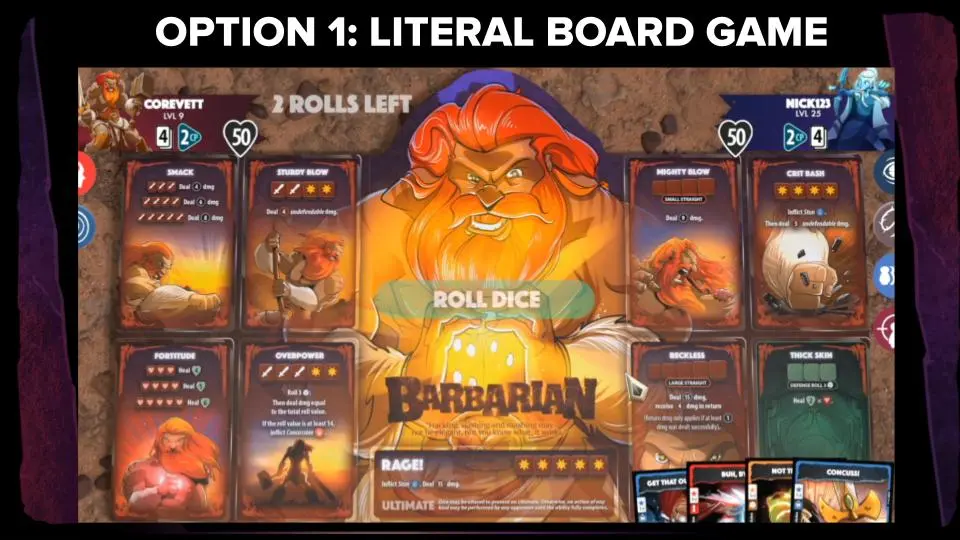
The myriad of awesome heroes and character designs is a big part of the visual presentation when it comes to seeing Dice Throne played on the table, and that was also important for the team to capture in Dice Throne Digital. There were several different versions explored, and while some of those other methods would have been easier to develop and faster to create, Chatellier knew those weren’t going to truly capture that Dice Throne magic.
“That was one of our biggest challenges actually, because we tried a lot of different things. We said, well, what if we just make it the literal board game, right? And that’s the whole, like, we want to digitize it, but we’re like, well, it is the fastest thing. That’s why most games do it, and so let’s look at it. It looks pretty enough, but it just, it lacks the immersion that we wanted,” Chatellier said. “It lacks the character coming to life, like all these things that you can only do digitally, and then we’re not going to do them? Like, that’s not what we wanted to do, so even though it was the cheapest, we said, okay, well, we’d rather push more into like having a full world.”

“So we explored these concepts of like, what if we’re all in an arena, and we have the different characters and the dice are kind of in the middle, or maybe the dice come out on a tray on top of the arena while you’re doing it, and this is really high immersion,” Chatellier said. “It is deep world-building, but then is the focus on my hero? Is it on the environment? And then when you’re on mobile, like, it’s really small and hard to see. So we’re like, I don’t know, I want the hero to be the hero”
“So we said, no, I don’t think that’s it, but maybe there’s a hybrid of those 2 because they both have strengths. So maybe if we tilt the heroes up, we make them 3D models, and the cool thing is now, whether you’re on a widescreen, an iPad, a phone, whether you’re in MR, like, this layout could work in all of them, so let’s go that direction. That’s what we ended up deciding, and now we can kind of get the best of all worlds,” Chatellier said.

Then to your actual question of like, okay, well, what about the hero itself? Do we show them as just, it’s really 2D and we’re faking it? Can we give depth? You know, that again is fast, but there are some downfalls. We lack some immersion. We do 2.5D, so this is actually not a full-blown 3D character, but it kind of looks like it, right? And when you look at the animation, so there are some nice things here, but when you walk around the table in mixed reality or something like that, you see it, like, ah, that’s janky, and then still for some of the animations, we’re limited on the animations that we can do here,” Chatellier said.

“So we thought, you know, if we go full-blown 3D, it’s the most expensive option, but if the goal is to become your hero, this is the right option to be able to do that, and then we can have just really cool animations for all the different characters. Now the challenge became cost and how do we make it still look like it’s an illustration, but it’s come to life. So that’s what we ended up doing,” Chatellier said.
Dice Throne’s Move To Digital Will Also Benefit The Physical Game

Much attention was paid to retaining the core elements of the original game in this new digital environment, and as a result, there were also lessons learned during the process that will end up benefiting the physical game, including how powers and abilities are presented.
“That’s correct. In fact, one of the problems that we had to solve was mobile clarity. Like when you look at the full-blown board on your phone screen, I mean, this works, but it is a lot compared to what most people are used to on a phone screen,” Chatellier said. “So there was a big question of, well, how can we simplify this and make it a little mobile-friendly? And one of the things that we started to realize right away was we could actually get rid of most all of that content and then have players zoom in to get all the details.”

“So dynamically, for example, depending on how many swords you roll, you’ll do a different amount of damage. So what if we show the range to begin with? You roll your dice, and then instead of a range, we show precisely how much damage it’ll do right there, and so as I’m rolling dice, I’m seeing, oh, now it’s this, now it’s that, I’m gonna heal 5, I’m gonna heal 6, whatever,” Chatellier said. “But then there was some confusion of like, well, we currently in the board game only have these black damage symbols and these red damage symbols, and red could be undefendable, pure collateral, or ultimate damage.”
That led to the creation of new visual signs for damage, and while that’s not in the physical version right now, it likely soon will be, as it provides an even better and easier-to-understand experience. “If we’re gonna go simplification, we need some more distinct numbers. So for example, you know, what if we have a different visual sign for each damage type? And we saw this, we’re like, why doesn’t the board game do this? We should backport this into all our future printings,” Chatellier said.

“Then if you wanted to, let’s say I tapped on Reckless, it’ll come up and I’ve still got the original Reckless ability. So from here I can tap on any ability I want and I can see the full content, but sometimes, I kind of know my character; this is enough. Yeah, it reminds me what that does, so it just speeds it up,” Chatellier said.
Finding The Right Way To Do Free-To-Play

Dice Throne Digital will be a free-to-play game, and the free-to-play model has created a bevy of reactions depending on how it’s implemented. Dice Throne debated several types of systems before ultimately going with free-to-play, though there are barriers in place to keep the core experience pure while also allowing customization that will help to bring in revenue and fund future releases.
“This was single-handedly the biggest challenge of the entire game, to be honest. It really truly was, and we spent, I don’t know, 6+ months debating, trying, going back and forth. Is this a premium game? Is it a freemium game? Is it some kind of hybrid? You know, what do we do? And board games are inherently premium,” Chatellier said. “You buy a game, you’ve got everything you need. They might have expansions or whatever. There’s no like in-game purchases afterwards, so how do we translate that to this?”
“For many board games, I think it should be premium. Like, you’re done and that’s it and you’re finished, but the kind of game we wanted to make was a live service game that had a long, long runway. We’re adding new content at least every month, and we’re adding more and more heroes to the game and everything else, and a premium purchase doesn’t support that,” Chatellier said. “It doesn’t support running servers and matchmaking and everything else. It just doesn’t work, so we had to have in-app purchases, but it’s gotten kind of gross in a lot of games nowadays, and so how do we not be gross, right? How do we be fair, and how do we not ruin what is beautiful about Dice Throne? It would be very easy to ruin that.”

To keep that in check, Dice Throne Digital will follow the already established model for hero releases, so when a new hero comes out, you will just pay for the hero, and then that hero is yours to play in whatever mode you wish. That said, you can earn free heroes as well, though it will take longer to do so.
“So we said, okay, here’s what we’re gonna do. We’re gonna copy our physical model. You pay for heroes. That’s what we do in the real world; that’s what we’ll do in the game. You pay for heroes. Everybody will start with one free. You’ll be able to earn a premium currency to drip, so you can earn more heroes for free over time, but it will take a long time, because we need to make some money. So that’s kind of where we landed, but in classic mode only, so those that want to be able to have exactly what the physical game experience is, that’s classic, exactly the same thing, faithful adaptation. And monetarily, it’s exactly the same as the physical game as well. However, we’ll have some other game modes where we can explore some new things,” Chatellier said.
“So for example, we have our campaign mode, which I’m super pumped about. I can’t wait to play campaign. I’m so excited for it, and in that game, it’s a roguelike game, so you’ll have upgrades during your run. You have permanent upgrades you get long-term. Well, what if you take some of your permanent upgrades, and now you and I can battle against each other using our permanent upgrades, and we called that game mode Unlimited,” Chatellier said. “So we said, hey, what if Unlimited, there are more things that you can spend money on. to make your character more powerful, and all it does is, it just speeds up the gameplay.”

“There’s nothing you can get that someone else can’t get, right? One player can play more to get the same thing. Someone who doesn’t have as much time can spend money to match their power level, right? Either is available, but let’s contain that with Unlimited, and let’s not touch Classic. Then of course cosmetics just makes sense, right? And if people want cosmetics, they can get them,” Chatellier said. “If they don’t, they don’t have to. Totally optional. It’s frankly a way to buy us a cup of coffee and help us support the game. So those are the main ways we’re monetizing.”
When it comes to customizing heroes, you’ll have a host of options to tweak not just the character’s look, but also the look of the board, the dice, effects, and more. “You can absolutely change their costume, their skin, as we call it. You can change their VFX. effects and animations that will be with it. You can buy cosmetics for the dice that you’re actually rolling and how they look and feel and sound and everything else. You can change your card back. You can change your hero portrait. There are all kinds of different cosmetics where you can become your hero. That’s what we want, and for that, we’ll definitely sell some standard expected stuff. We’ll sell some unexpected stuff. We’ll sell some seasonal holiday stuff, and we hope that, it really is the best way to support us without, it doesn’t mess up the game balance or anything else,” Chatellier said.
Will Dice Throne Ever Hit Consoles?

Right off the bat, Dice Throne Digital will launch on iOS, Android, PC, and Meta Quest, and Chatellier revealed the highest demand on their initial survey for which platforms fans wanted was mobile. PC and Steam were next, and while a console version hasn’t been greenlit yet, the team already set some foundational things in place in case it happens.
“Then if we’re supporting Steam, as a person who also plays a lot on my Steam Deck, let’s do controller support, because if we do controller support, they can play it on Steam with controllers, they can play on Steam Deck with controllers, and if we do want to go to consoles, we’ve got to have controller support anyway. So it’s a nice stepping stone to going to consoles,” Chatellier said.
“So the truth is, I really want this game on every console. Badly is what I want, but it’s not cheap or trivial to port it to all those different things, so our hope is we’re going to launch on these initial 4 platforms: iOS, Android, Steam, and Meta Quest, and then if it does well, we hope to port to other platforms,” Chatellier said. “So please, please, please support the game. I really want it on all of the platforms.”
You can wishlist Dice Throne Digital on Steam right now.