Former Blizzard Dev Reflects On Bringing Fallout: New Vegas To VR
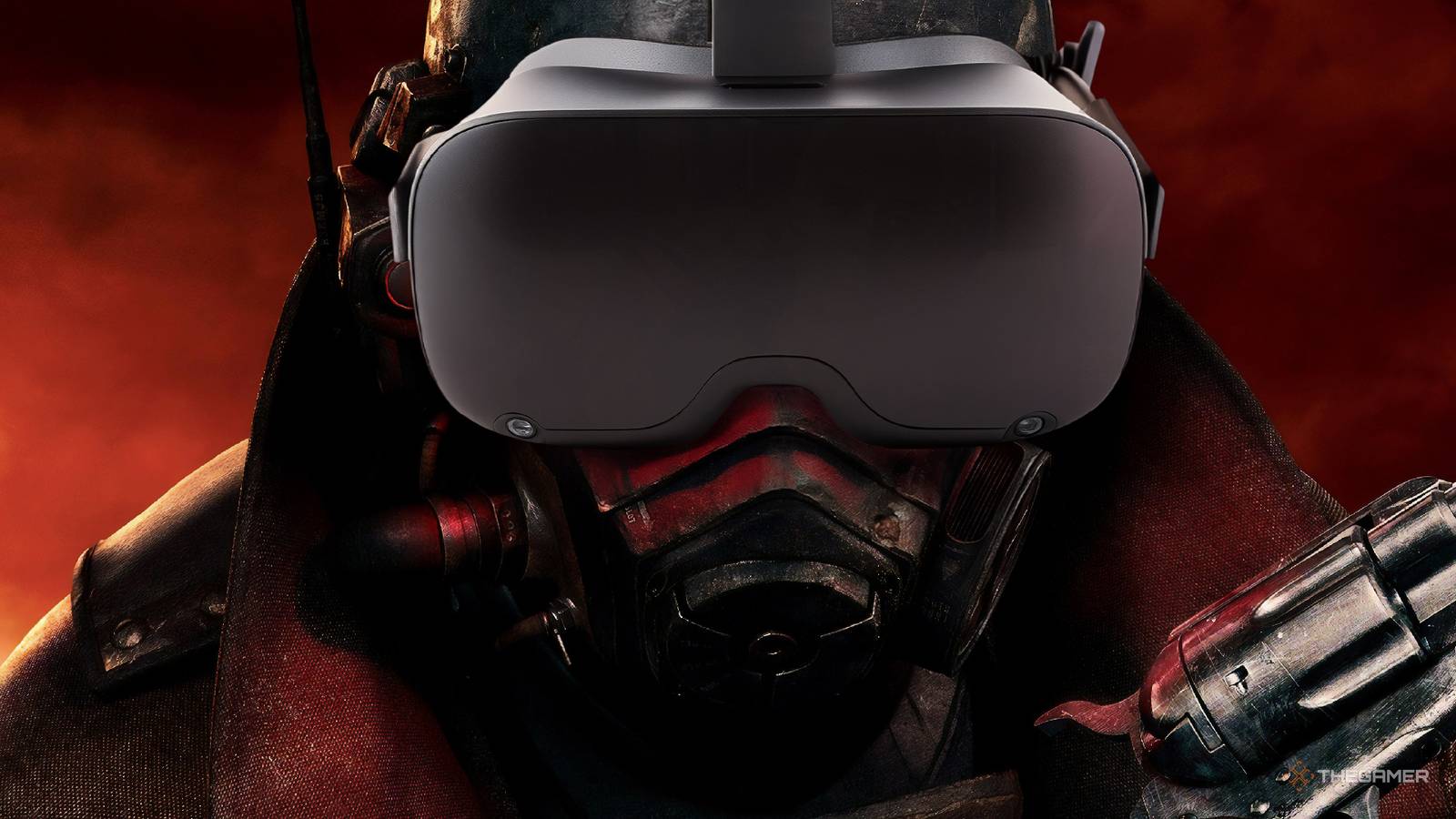
Nick Bryson worked as a senior software engineer at Blizzard, but these days, he's porting Fallout to OpenMW for a complete VR conversion.
“Right now, jumping into modding, it’s just been… I don’t know, exhilarating, honestly.”
I recently sat down with Nick Bryson, a former senior software engineer at Blizzard Entertainment who contributed to World of Warcraft: Shadowlands, Diablo 4, and Hearthstone. However, in 2024, after dedicating five years to the studio, he found himself caught in the crossfire of the Microsoft Blizzard acquisition and was one of the many who were unceremoniously laid off. Thankfully, he landed on his feet almost immediately as the vice president of development at Kind Lending, but in his spare time, he's never left gaming behind. Over the last few months, he even discovered a doorway back into world of development — and it’s all thanks to modding.
“I started out in QA doing a lot of stress testing for World of Warcraft and their games,” Bryson tells me. “We had some proprietary frameworks that I came in and took over, sort of lead on some of that stuff. And then eventually, I was looking to get on a game team, and so Hearthstone presented an opportunity. Team Five was my team, right? Everyone at Blizzard has a sort of secret team name. And you know, Team Two is World of Warcraft, but Team Five — those guys were some of the funnest people I’ve ever met, most passionate people I’ve ever worked with. I did a lot of the tooling, so if you look at some of my stuff, I actually have a card in there, and on the credits, my card says ‘plus three to tools.’ I decided to go ahead and put that in there, so people would know that’s my mark on the game.”
But you’ve read the headline — how do you go from tooling in Hearthstone to porting Fallout into VR? For Bryson, it was a snowball of coincidences. While he had played Oblivion, he completely missed the Morrowind train back in 2002, but as a VR fanatic with over 2,000 hours in Fallout 4, he came across a mod that made the entirety of The Elder Scrolls 3 playable in a virtual reality headset and leaped right in. “My first playthrough of Morrowind was in the OpenMW version of VR,” Bryson says. “There’s a guy, Mads Buvik Sandvei, he is one of the OpenMW main contributors, and he actually has his own VR branch, so that’s really what set me on my… ‘Okay, I love this.’”
From A Morrowind VR Playthrough To Making His Own Mods
It wasn’t a huge leap for Bryson to go from playing Morrowind in VR to thinking, ‘How can I do this?’ The polygonal worm nagging at his developer’s brain never really went away, even if he had been let go from Blizzard. And with the open-source, community-led version of the Morrowind engine now at his disposal, his mind raced towards other Bethesda games and the possibility of back-porting them with complete parity, opening the door to previously impossible Fallout: New Vegas mods and a fully-fledged VR mode - much like Morrowind had enjoyed.
Cue OpenNV, i.e. Open Nevada, Bryson’s expansion of the OpenMW framework that seeks to bring the Fallout games and possibly even other Bethesda titles into this open source engine, allowing modders far more freedom with the studio’s entire catalog. His main motivation was to get games like New Vegas playable from start to finish in virtual reality, but that does a disservice to the project's incredibly ambitious scope.
“The games are very iterative, especially the game engines to some extent,” Bryson explains. “So, if you look at Bethesda, I’m sure they just incrementally went from, ‘Oh, we’re using the same set of tools for Morrowind, now let’s use those same ones kind of in the Fallout style.’ And so that really just plays well. I’m able to — if you look at their code base — get Skyrim assets working, Fallout 4, Fallout 76. I could even do Starfield. And then the most interesting thing to me is the fact I even tried to do the Unreal remaster for Oblivion. I was able to get them to render.
“I want to try to get the originals back exactly, and then we mod them further, right?” Bryson continues. “I hope people can get the vanilla experience out of it, so they can see really, ‘Okay, wow, this was just a conversion.’ And then based on that, we can take it a little further, and really go deep.”
Pip-Boy And Hacking Terminals: What’s In Store For New Vegas VR?
Bryson tells me a funny little anecdote — when he got started, the characters were all T-posing, stuck with their arms stretched outwards like a box of discarded action figures. And it wasn’t as simple as hitting a toggle to make the animations work. Bryson had to fine-tune the weights, bones, and timings, ensuring that everything looked just right. It’s bizarre to look back at that initial challenge when Bryson is now working to recreate the more complex VATS system, hacking minigame, and even Pip-Boy with a working touchscreen. Complete with new quality-of-life features and even support for retail mods, bringing New Vegas in its entirety to OpenMW.
I initially reported that this was a ‘demake’, something akin to the fans porting Half-Life 2 back into GoldSrc, but that couldn’t be further from the truth. The goal is for New Vegas in OpenMW to be easily mistaken for the original. But with a few extra flourishes for VR.
“The first thing I did was like, hey, I wanted hands and a Pip-Boy,” Bryson says. “I started with that. I was like, ‘Let me see if I can articulate fingers,’ and I was able to. I’ve never done that in a VR game before, and I was like, ‘Let me see if I can do it.’ And that was actually pretty hard to get the physics right because I wasn’t just taking it from someone. I thought I was going to sit down with myself and say, ‘How do we model this’ and start looking up algorithms, kind of deeper than just copying someone’s code. I just kind of went naively for a bit. I really want to see how much control I can do. What if you could type at the terminal, right?”
Bryson stumbled on a few technical hurdles with VR development, like how to keep the headset on and do long sessions while debugging, or mocap without a bodysuit (turns out a webcam and some paint works just fine). It was important and ultimately fulfilling to tackle these challenges head-on, because for Bryson, tactical interactivity with the world was paramount for a virtual reality mod.
“You wouldn’t consider it a true VR experience without feedback and physics-based combat or anything like that,” he says. “And you can keep modding even Morrowind if you want to try to get a little bit of that built in there.
“It’s real important,” he continues. “Now, I’m sort of cheating by waiting on Team Beef — they’ve done a ton of ports. They’ve done a lot of Doom and other games. They’re actually working on OpenMW porting it to Android fully. So really, I will probably marry my code with theirs as soon as they do their first release and see what they’ve given me for tools for that. I was like, if these guys are going to get OpenMW on the headset, and I know them, they’re a deep, rich, interactive VR company, meaning that they will have deep, rich interactions. I want to piggyback off those.”
It’s this exact philosophy that OpenMW was built on. Modders can share their work and field feedback from the community and other programmers to improve and iterate on their own projects. Bryson describes it as ‘developing in public’, and while it’s not necessarily an organized team like the ambitious Morrowind and Oblivion remakes, that cross-contaminating from different individuals and smaller teams lends itself to spur-of-the-moment projects like OpenNV, allowing them to take on a life of their own.
“It’s the ultimate feedback machine,” Bryson says. “You give it to streamers, they give it to their people. Everyone tells you what’s good or bad about it, and then you take it and make new versions. I kept a private GitHub forever, and I’ve always written proprietary code. I just changed that this year. I decided I’m going to write everything in public. I even post on LinkedIn, which some people are like, ‘You’re posting some of your vibecode stuff on LinkedIn!?’ Absolutely, because it’s not a secret what I’m doing.”
The Vibecoding Elephant In The Room
 via: aminoapps.com
AI is a hot-button topic, and usually people land on either the ‘it’s the devil’ or ‘replace everyone with robots’ sides of the argument. There’s very little nuance, though it’s understandable why.
Right now, AI companies are run by people who openly admit that it will bring about the end of civilization, while studies show that it could actively be making us dumber (a nice double-whammy with short-form content and endless scrolling). Not to mention the enormous environmental impact it has, using up precious water supply in deprived areas and contributing to the climate crisis, while data centers spur on global computing shortages that lead to skyrocketing prices, making once affordable goods unreachable luxuries. There’s a lot to loathe about AI, but it has fast become a daily part of life. Not just on Facebook, where your parents get duped by deepfakes and conspiracies, but in all facets of game development. That includes modding.
This has been dubbed ‘vibecoding’, and while it originally just meant software developed entirely with LLM prompts, the label is now thrown at mods like OpenNV that use it to assist in development. So, as I was talking to someone who has a unique insight from both major studios like Blizzard and the modding community, I was curious what Bryson made of the backlash to AI-assisted coding.
“I’m using AI to help me solve the hard graphics problems, but I’m a trained software engineer,” he tells me. “I’m doing it very spec driven, very confrontational, right? Like, ‘Hey, talk to me about this,’ like I would a real engineer. And then, ‘Okay, cool. I agree. Let’s make a plan, and you tell me step one.’ Like I would to any group - start working with them and check on them periodically. And once I think they’ve got a good hold on it, let them go for a bit, then check back in. That’s what I do with the AI stuff. I think it’s more the stigma than anything. Like, there’s a big, ‘Hey, we don’t like AI infringing on artists’ rights or people’s rights in general. Is it taking a job away from someone?’ And that’s a very valid concern. I look at the AI tools… my perspective, and I’m a programmer, so I’m not trying to say that I’m taking someone’s job because I’m using AI — I’m not looking at it in that light because I’m looking at it as a tool.
“It’s almost like these are the new compilers where you can get your binary code quicker than you could before, but you’re still going to have to do the thing, so to speak,” Bryson continues. "AI is accelerating; these things are getting easier for it to put together and assist you with. I don’t know what the endgame is. I do think it still takes a skilled artist and an operator — an engineer-type person — to make a good product no matter what.”
What Does The Future Of VR Look Like?

The future of AI is a daunting prospect that we could get lost in the weeds in, but to circle back to the VR conversation, so too is the future of virtual reality ports. Triple-A developers haven’t strictly abandoned VR — we just recently got new Metro, Alien, and Arkham games for virtual reality, not to mention Deadpool. But the era of developers throwing their flat-screen work into VR seems to have subsided, and it’s hard to imagine studios like Bethesda bothering to bring The Elder Scrolls 6 and Fallout 5 to the medium.
Thankfully, modders like Bryson are picking up the slack, and countless projects seek to port beloved titles to virtual reality, whether that’s emulated PSX games like King’s Field or retro shooters like the original Doom.
“It’s still too niche,” Bryson says. “It’s more of a passion, and so what you’re going to see is like Trombone Champ. It was very VR centered. That’s where a lot of VR goes because people are like, ‘Oh, I’m going to pick up a thing and do it.’ That’s kind of what it’s about — traditional gaming. It’s really interesting in this time where we’re modding — it’s an explosion of flat to VR mods because all of us modders have decided, ‘Okay, we’ll just do it.’ The studios — they’ll never do this, right — but would they ever expose some VR hooks for us generically so that, ‘Hey, we’re not going to do VR, but here’s three or four things that would make it way easier on everyone.’ That would be my ask.”
OpenNV Isn’t Trying To Be The Next Skyblivion Or Black Mesa
There’s a temptation with a project of OpenNV’s scope to open a Discord, assign roles, and build up a team who dedicate huge chunks of their spare time to volunteering, working together to port an entire game to another engine that can then be modded in its own unique ways. Bryson has no intention of taking that route. He explains to me that he doesn’t want it to become a second job — it’s a passion project. And there’s a fine line between working for a volunteer studio and modding.
“What I really need to do now is kind of treat it not like a job, but at least have it set up so that other people can help me commit some things without it being a real job,” Bryson says. “I don’t think I’ll set up an OpenMW.org, have a contributor role — that’s very job-like to me, and I don’t want a second job. But I don’t want to be siloed. That’s kind of why I did it in open source. So, I don’t know. That’s kind of where I’m going next. What do I do?”
It was touching to sit down with Bryson and hear his excitement spill out, even coming up with ideas mid-call as he showed off his VR headset and talked me through the work he had done so far. It’s clear that while he hasn’t been at Blizzard for almost three years now, his love of game development wasn’t stomped out by the corporate mismanagement and layoffs he was subjected to. In fact, Bryson tells me that he would “go back to a studio immediately” if someone asked. Even if that meant getting laid off all over again. “I would jump right back in because it’s too much of an opportunity to miss out,” he tells me. “I learned every single day so much from that group. And I gave back as much as I could because I’m so passionate about it. I would do it again.”