Doctor Who's Real Main Villain, Missing For Over 40 Years, Makes The Master Look Like An Amateur
Who would be considered the overarching 'big bad' of Doctor Who? As one of the most iconic monsters in popular culture, the Daleks can't help but spring to mind. Certainly, the Daleks have plunged and whisked various civilizations into extinction, and their sheer power positioned them as the Time Lords' natural enemy. After so many defeats, however, the Daleks' fearsome reputation has taken a permanent dent. And, ultimately, they are just one of many alien races in Doctor Who intent on violent intergalactic conquest, even if they are particularly good at it.
The other frontrunner spot belongs to The Master. Through numerous regenerations, The Master has launched nefarious scheme after nefarious scheme, arguably enjoying more success than any other Doctor Who villain. Even so, it's hard to seriously crown The Master as 'Doctor Who's true big bad.' They're framed as The Doctor's rival; a personal nemesis or dark mirror image. In any case, John Simm and Michelle Gomez proved The Master had a (very) well-hidden softer side.
Rassilon often gets wheeled out whenever Doctor Who needs an S-rank enemy for a season finale, but Gallifrey's toxic president isn't inherently evil. He's just an embarrassing political mistake the Time Lords can't seem to vote out.
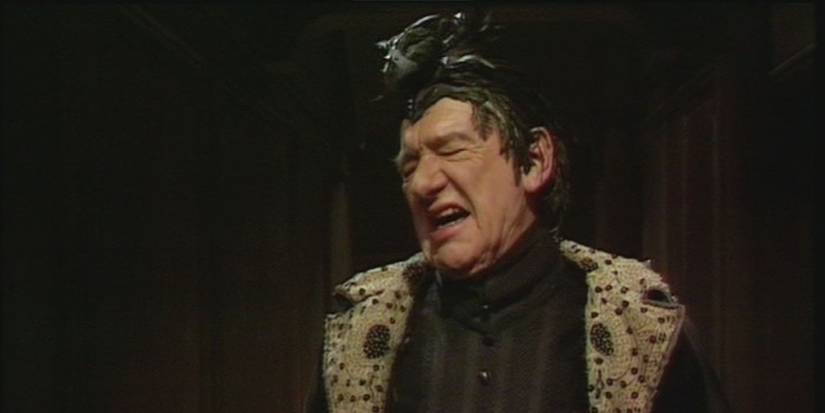
No, if Doctor Who does have one overarching source of evil devoid of redeeming qualities and more dangerous than any other, it would have to be the Black Guardian from the Fourth and Fifth Doctor eras.
The REAL Main Villain Of Doctor Who
Determining the relative evil-ness of Doctor Who characters means looking at two main factors: motivation and power.
Most who fear the sight of the TARDIS have reasons for acting the way they do. The Daleks are conditioned to follow a wartime 'survival of the fittest' philosophy, The Master is desperately trying to outrun their insecurities, and Rassilon seeks to protect Gallifrey no matter the cost. These aren't justifications, but there's a logic to how these villains behave. It's a twisted logic, but a logic nonetheless.
The Black Guardian is one of very few evildoers who do evil simply because it's their nature. Doctor Who's Black Guardian episodes make very clear that a war between good and evil is raging in the background of the show's universe: the fight for goodness led by the White Guardian vs. the side of evil led by the Black Guardian, who embodies everything horrible. The Black Guardian isn't deluded into thinking he's somehow doing the right thing, nor does he have anything to gain on a personal level. Death and destruction simply run through his veins.
In terms of power level, the Black Guardian makes other Doctor Who monsters look like amateurs. The Daleks and Cybermen may boast the most technologically advanced arsenals, and The Master might be a Time Lord, but the Black Guardian is a godlike entity who can doom mortals with a wave of his hand or bend reality on a whim. Combining his power with the ancient Key to Time, the Black Guardian can mold time and space like clay, and not for the better.
No other Doctor Who character is powerful and rotten enough to be considered the show's true, overarching antagonist.
Was Doctor Who Setting Up The Black Guardian's Return Before Going On Hiatus?

Russell T Davies' second stint calling the shots on Doctor Who proved surprisingly god-heavy, so much so, a league of classic enemies was retconned into a so-called Pantheon of Discord. RTD would have been fully aware that this coalition of immortal scamps strongly resembled the classic era's Eternals, who the two guardians were associated with.
After the Toymaker, the Mara, and Sutekh all officially became Pantheon members, it feels inevitable that the two Guardians, had they returned, would have received similar treatment. There's even evidence to suggest the White and Black Guardians exist above the Pantheon. Sutekh is already the Pantheon's representative for death, while "malice, mischief, and misery" are all accounted for, as well as disaster, dread, and doubt. The Black Guardian's territory is very much being encroached upon here.
But classic Doctor Who always portrayed the Black Guardian as several levels above the likes of Sutekh, the Mara, and even the Toymaker. It makes complete sense that the White and Black Guardians actually sit atop the Pantheon as its overseers, the White Guardian in charge of the virtuous gods, the Black Guardian in charge of the less virtuous ones. Had Doctor Who not found itself gathering dust after season 15, it's very possible that the Black Guardian would have returned as the arc's final boss. Perhaps even The Boss.
Doctor Who's Future Needs The Black Guardian
Doctor Who is currently not in a healthy place, as fans eagerly await updates amid the BBC's "competitive tender" process. It's not just important that Doctor Who comes back, but that when it does return, it avoids repeating the mistakes that led to this predicament in the first place. The Black Guardian can play a major role in that.
One of the modern era's biggest downfalls has been its long-term arcs. It's a problem that began during the Eleventh Doctor years with Steven Moffat's overly-complicated "Silence Will Fall" angle, but grew considerably worse during the Chibnall and RTD2 eras. The root cause appears to be Doctor Who striving to deliver the ground-shaking, cinematic, blockbuster finales audiences want, but without recycling the usual suspects of Daleks, Cybermen, The Master, and Rassilon. Doctor Who is yet to find a balance, usually because its ideas end up breaking canon, not being climactic enough, or having a reveal that doesn't justify the setup.
With that in mind, the Black Guardian presents Doctor Who's next showrunner with the most golden of opportunities. Here, we have a villain who is potentially the most powerful in Doctor Who history, who is already enshrined within canon, and who is mysterious enough to offer incoming writers a blank slate. The Black Guardian has the mavitas to feel like the biggest threat in years, won't upset fans as much as the Timeless Child and bi-generation, and doesn't come with a huge tome of lore.
As long as the Black Guardian hasn't been hiding inside the sonic screwdriver for 40 years, this is as close as Doctor Who gets to a classic villain return being foolproof. Even better, the character physically appeared in a grand total of four episodes during the 1980s, meaning there's no risk of wearing him thin. As an added bonus, the Black Guardian is versatile enough to tie into some of Doctor Who's lingering unsolved mysteries. We mentioned The Boss previously, but the Black Guardian could just as easily be connected to Susan's situation, The Doctor's true home planet, the Valeyard, or the Toymaker's golden tooth.
With its back against the wall, Doctor Who needs a villain who's a safe bet while still being ambitious, that changes the game without rewriting history, and a character we've met before but know almost nothing about. Only the Black Guardian holds the solution.