Ask the Developer Vol. 23: Fire Emblem: Fortune's Weave — Part 2 - News - Nintendo Official Site
Check out the rest of the interview
Part 2: Weaving experiences into a single outcome
So far, we’ve talked about the game's setting. When it comes to the Fire Emblem series, developing characters and leading them into battle is a key part of the experience. Could you tell us more about the gameplay in this title?
Nakanishi: In terms of gameplay, one major change in this title is that we’ve added exploration sections that give players a lot of freedom. In these sections, players can move freely around Dagsion and across the world map as they recruit allies, develop characters, and explore dungeons. In that sense, I’d say there are more RPG-like elements in this title.
Kusakihara: Dungeon exploration was something we also had in Fire Emblem Echoes: Shadows of Valentia (4), but this time, the world is much larger, and there are more places to visit. Within the time allotted in the game, players can go to all sorts of places, or they can choose not to explore much and simply keep moving the story forward. You may come across useful items in unexpected places, so I hope players enjoy the feeling of exploring the vast continent of Dagda and discovering it for themselves.
(4) A Nintendo 3DS game released in April 2017 in Japan and May 2017 in North America and Europe. It is based on Fire Emblem Gaiden, a Family Computer (Famicom) title released exclusively in Japan in March 1992, and carries over many of the original gameplay elements while featuring updated graphics and an expanded story.
I see. With more places to go and the ability to move around freely, it seems like players will be able to dive pretty deeply into exploration. So, can players explore and develop characters in the same way no matter which protagonist they choose?
Nakanishi: That was an area we put a lot of thought into. I became fully involved in the project partway through development, and at that point, players could do all kinds of exploration and character development regardless of which protagonist they chose. But because there were just so many gameplay elements, it was hard for players to tell how they were supposed to approach the game. It also meant that, even if they chose another protagonist, they ended up repeating the same kinds of gameplay. So, we worked with Intelligent Systems to give each path its own personality in terms of gameplay, in a way that matched each protagonist’s characteristics and story.
Kusakihara: For example, Cai can catch animals to ride and build bonds with by caring for them. He’s also good at farmwork. At certain spots on the map, players can create fields where Cai works the land and then trades what he harvests. Dietrich can acquire combat arts by defeating enemies and strengthen those arts further, while Theodora can recruit soldiers in settlements and deploy them as battalions. Leda, meanwhile, can travel to different towns and perform at taverns, which may earn her rewards or information about secret locations. In this way, each protagonist’s path has its own gameplay, designed around that character’s unique traits.
Nakanishi: Giving each path its own personality means that exploration and character development feels different for each protagonist, so even on repeat playthroughs, players can have a different experience. It also helped us strike a balance between giving players freedom and making sure they don’t feel lost about how to play.
Yokota: What’s more, this title is a story about everything coming together as one, so as players progress through the game, the experiences they’ve had in each path and the unique qualities of those paths gradually start to weave together.
Higuchi: For example, animals caught in Cai's path can only be used there by Cai and his allies. But this feature can be unlocked for other paths as well. The names you give the animals in Cai's path stay throughout the game, so I think players may grow even more attached to them. I think the more you play, the more you’ll come to understand the world of Fire Emblem: Fortune’s Weave. We designed the game so that the experiences in each path create a kind of synergy, both in terms of the story and the gameplay.
In Fire Emblem: Three Houses, the path you choose at the start greatly affects how things develop from there. With this title, though, the protagonists gradually come together later on. Since the gameplay differs for each of the four protagonists, I can imagine players wondering who they should start with.
Yokota: Players can feel free to choose whichever protagonist they’d like to start with.
Nakanishi: The protagonists are each involved in the same event in different ways, so as players progress through the story, they may encounter the other protagonists. If you think, “I want to see this character’s story too,” you can jump over to another protagonist. So, you can start with one protagonist, and change to someone else partway through if you feel like it.
So, players can decide to really focus on one protagonist, or gradually progress through all four stories in parallel, right? Does anything change depending on how they proceed through the game or how they choose to play?
Yokota: We designed the game so players don’t have to worry about making an irreversible choice, no matter what order they play the paths in or how they choose to proceed. So, I hope they’ll follow whichever path takes their fancy. Once players reach a certain point in the game, spots on the world map that they unlocked in one path will be available from the start in other paths as well. So, I think exploration will be easier than it was the first time.
So, there’s no correct order to play the paths in, and players don’t have to worry about regretting their choices later. They can just play the way they want to.
Higuchi: Right. We designed the game to offer a lot of freedom in that regard. Players can focus on a single protagonist and make their way to the end of the game, or they can choose to fully experience all the paths. The more they play, the more I think they’ll come to understand this title’s world. What we were aiming for was a kind of culmination of the gameplay, where everything comes together at the end, and all the experiences players have had up to that point are woven together.
I’d like to ask more specifically about the elements players build up as they progress through the game. The characters who can join you change depending on which protagonist you choose, right?
Nakanishi: Yes. The four protagonists each have their own team, called a clan, and for the most part, they travel with characters from that clan. Beyond that, in Dagsion, the city that serves as the story’s base, players can find people who work much like mercenaries and scout them as allies. They can also scout certain members of the other protagonists’ clans.
Kusakihara: In fact, the number of characters you can recruit is one of the largest in the Fire Emblem series. Players can start by choosing characters who catch their interest at first glance. They may also find that a character they didn’t pay much attention to at first makes a surprisingly good impression once they talk to them. I hope players enjoy moments like that as they recruit more allies. Ultimately, the characters players have recruited and developed along the way all come together and head toward the final battle.
Can you also explain in detail how the progression system works across a large cast of characters?
Nakanishi: In Fire Emblem: Three Houses, there is a system in which characters can choose any classes they want by passing certification exams. Generally, characters can change into any class they prefer as long as they meet its skill requirements. I thought it was an interesting system because the player’s personality shone through in how they chose to develop each character. We’ve adopted that system again this time, so depending on the player, the same character may become a mage for one player and a mounted unit for another. Please feel free to develop the characters however you like.
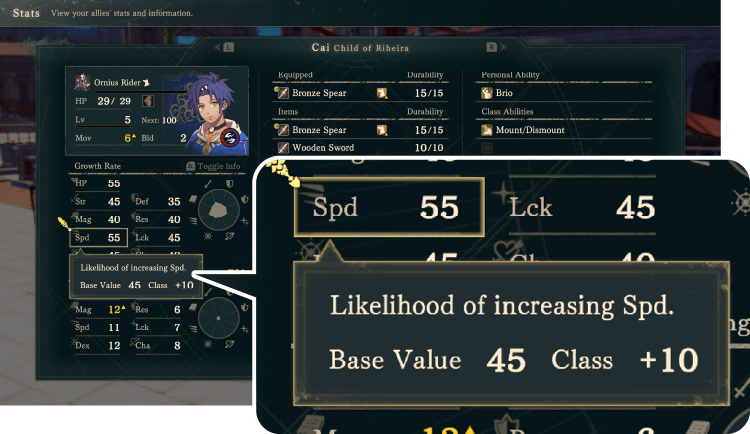
Yokota: This may be a bit of a niche detail, but for the first time in the series, we’ve made each character’s growth rate visible. By looking at the character’s growth rate, you can get an idea of which basic stats, such as Strength or Speed, are more likely to increase. I think this will help players decide how they want to build that character.
Kusakihara: At first glance, a character might not seem suited to being a mage, but if you deliberately choose to train them as one, you may end up discovering things like, “Oh, I never expected them to learn this spell.” Because each character learns different things, there’s also the fun of experimenting and seeing what kinds of skills they might learn when developed in a particular class.
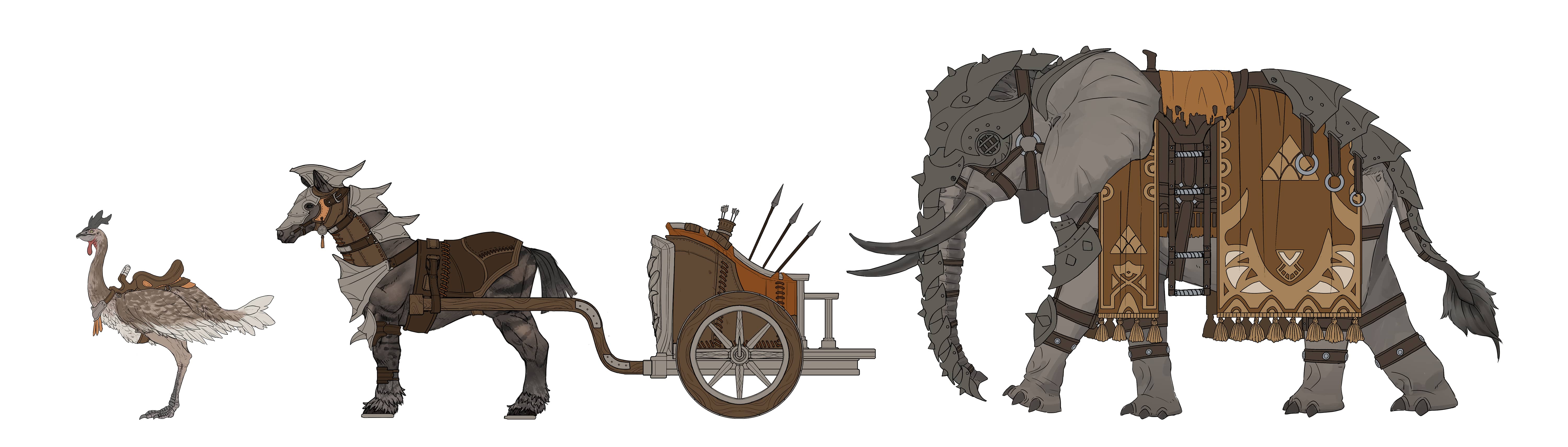
Higuchi: We’ve also created some new classes for this game. Since the story is set in Dagda, a brand-new setting for the series, we decided to introduce some entirely new classes that are unique to that land. For example, there's the ornius rider, which is essentially a cavalry unit mounted on an ostrich-like creature. There's also an ancient chariot-based class, as well as the elephant rider. We hope players will have fun trying them out and find themselves thinking, “Just what is this?!”
Nakanishi: When it comes to combat, we made sure to give each character a distinct fighting style. There are special techniques called Blaze Arts that come with certain risks, but can be extremely powerful. They're tailored to each character’s unique traits, so they function quite differently from one character to another. Some can unleash wide-area attacks, while others provide beneficial effects to nearby allies. However, enemies can also use similarly powerful abilities, so there are times when you'll need to fight strategically rather than simply charging into enemy lines.
Yokota: By the way, there’s also a character who uses a firearm-like weapon.
A firearm-like weapon? That’s something that hasn’t been in the series up to now, right?
Higuchi: Right. It’s rather an unusual weapon for the series, but as players progress through the story, they may uncover the reasons why something like it exists in this game’s world.
Nakanishi: We’ve mentioned that players are free to choose among the paths of the four heroes, but it’s also possible to play the same route more than once. For example, you could build the protagonist to use melee weapons on your first playthrough and then try developing them in a more magic-oriented direction on your second.
But wait a minute. If you replay the same path, surely the characters you developed during your first playthrough will get overwritten and disappear, right?
Kusakihara: Actually, the system is designed so that the character data you've built up is merged together later on.
Yokota: For example, if you complete one playthrough with the protagonist developed as a mage and a second with the same protagonist developed with melee combat in mind, that character will acquire the strengths of both.
Higuchi: This isn't limited to the four heroes. Let’s say you recruit the same character to your unit in both Cai’s route and Dietrich’s route and build them differently in each playthrough. The stats from both versions will later be merged, resulting in an even stronger character. That’s also one of the features that expands the game's possibilities the more you play.
I see. So not only will playing more deepen your understanding of the story, but it will also make your characters stronger and stronger. As a result, you gradually build a party that feels like the culmination of everything you’ve accomplished.
Kusakihara: The idea of things converging into one is a core concept behind the story, and in terms of gameplay, we believe that everything players experience in the game has value. The basic idea was to create a system where nothing players go through is ever wasted. Everything is preserved and eventually coalesces into a whole. In Fire Emblem: Fortune’s Weave, players can progress through multiple paths simultaneously as well as replay the same path multiple times. To ensure that none of the experiences players had accumulated would go to waste, we felt that consolidating everything into a single save file was the best approach for this game.
Nakanishi: Of course, I’m sure there are players who prefer to keep multiple save files, and I’m actually one of those players myself. But because the game system of Fire Emblem: Fortune's Weave is built around multiple paths, having separate save files would create system-related complications. It becomes difficult to keep track of how far players have progressed in each protagonist’s story when that progress is spread across multiple save files. So rather than simply limiting the game to a single save file, we added other creative ideas to make the system work better. In this game, we preserved save data from the start of every chapter for each main protagonist, and made it possible for players to jump back to those points. If players think, “I want to play this chapter again,” they can play again from the beginning of the selected chapter. This feature isn't just for replaying chapters, either. Players can use it to review maps, revisit specific cutscenes, or even retry particular battles, so we hope players will make full use of it.
That’s quite a bold approach. But as you said, since everything is recorded and you can go back and redo things at various points in the game, it does seem like you could play without having to worry about managing save files.
Nakanishi: In previous Fire Emblem games, it was possible for players to reset the game and try again, but I felt that this could lead to a playstyle where players repeatedly reset whenever things didn't go their way, whether in battles or exploration. We also wanted to make this game as approachable as possible. Since there are no permanently missable elements, we hope players won't feel pressured to go back and redo things immediately. Instead, we'd be happy if they simply continued with their playthrough and picked up anything they missed in a later playthrough.
Kusakihara: On top of that, players can repeatedly go back into the past using the Goddess of Fate’s power and retry situations as many times as they like. In that sense, I think the game's system ties in very closely with the story, as both revolve around the concept of retrying, building upon past experiences, and ultimately weaving those experiences together into a single outcome.