mushlume co-creates with living organisms to grow design objects at MADE: bush terminal
MUSHLUME RETHINKS MATERIAL APPROACH INSIDE MADE: BUSH TERMINAL
MADE: Bush Terminal, a revitalized public landmark, reopens its historic doors as a productive workspace designed to fuel local innovation and economic growth. Inside the renewed space, designboom speaks with Danielle Trofe, founder of MushLume, one of the resident studios shaping the hub combining biofabrication laboratory, and production. Awarded for its sustainable lighting and acoustic panels, MushLume grows its collection using living mycelium and agricultural hemp, pioneering a design approach that treats nature as a true partner rather than a simple material resource.
‘The story of how I came across this material really shaped my relationship with this living organism. I began my design studio in 2011 and was working mainly in hydroponics. Then, I found this material in a materials library that was grown using living mycelium and hemp. Just that concept alone was so intriguing: that I didn’t have to take an inert material and shape it into something; I could actually co-create with a living organism to grow an object. It really changed my whole design approach,’ Danielle Trofe starts the exclusive interview with designboom.
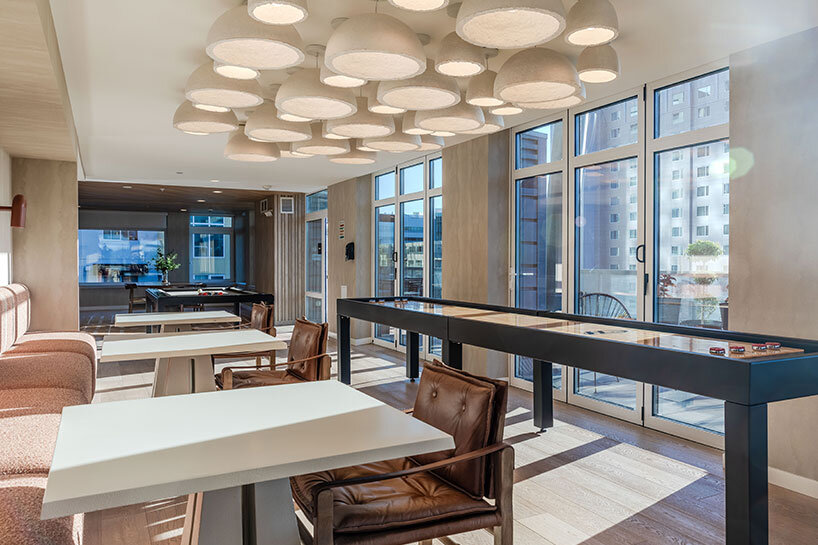
MushLume sound-absorbing lighting fixtures | image © Rob Frost, Chance Productions
LEARNING FROM NATURE, NOT EXTRACTING FROM IT
Grounded in the philosophy of learning from nature instead of extracting from it, MushLume applies biomimicry by studying biological processes rather than simply copying their visual forms. Fostering optimal conditions for organisms to thrive, the studio cultivates the growth of living materials and collaborates directly with biological systems to create sustainable design solutions.
‘It’s really about understanding these intricate relationships, whether on an ecosystem level or on the organism level of how it functions. Nature has evolved over millions, if not billions, of years. The species that exist today have the solutions for surviving and thriving in this world. We are looking at nature as a source of information rather than just a source of material,’ says Danielle.
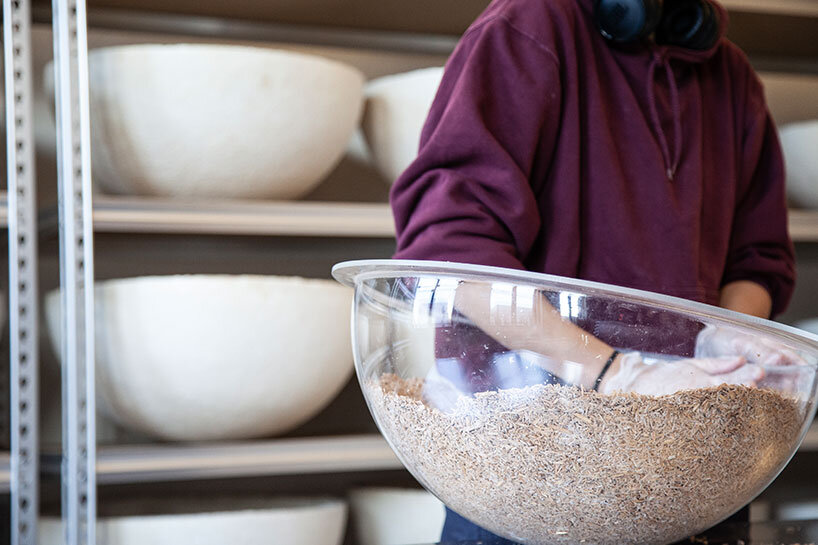
MushLume leverages biomimicry, integrating biological functions into design
Ditching traditional manufacturing norms, MushLume develops products designed to return safely to the earth at the end of their life cycle. Instead of competing with mass production materials like plastic, the studio engages directly with architects and interior designers seeking healthy, low-embodied-carbon alternatives. This material focus results in bio-based lighting and acoustic solutions that support both planetary health and indoor well-being.
‘There aren’t many architects or designers who don’t want to use healthy materials that have low embodied carbon or energy impact. We are all trying to specify products that are good for both the planet and the people using those spaces. What we need now is more investment and specification of biomaterials that are proving themselves. We differentiate ourselves by showing the true benefits of a compostable, non-toxic material that doesn’t off-gas,’ Trofe affirms.
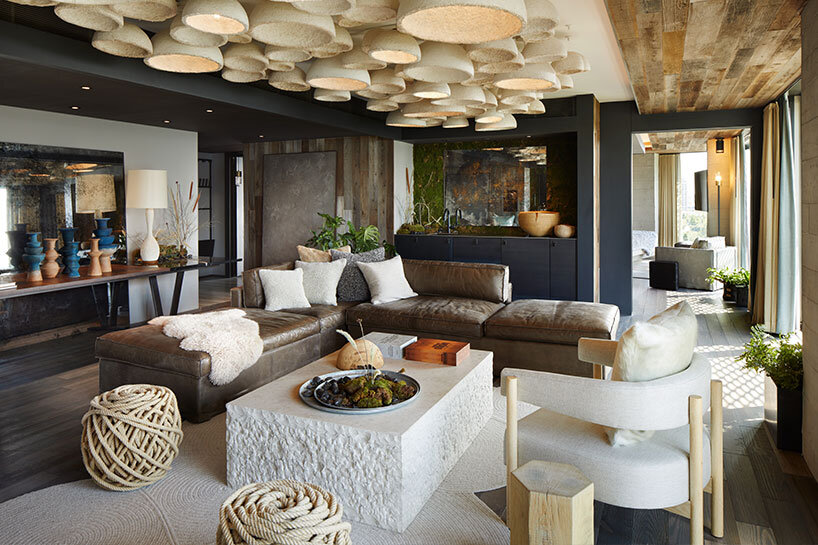
partnering with architects and designers, the practice delivers sustainable solutions for contemporary interiors | image courtesy of Starwood Capital Group
SCALing HANDCRAFTED BIOMATERIALS FOR COMMERCIAL spaces
In the crafting process, agricultural and fiber hemp waste is upcycled and combined with living mycelium, the underground root network of mushrooms. Utilizing the full organism instead of its fruiting body, the studio does not take it directly from nature, but grows its material in lab or farm environments.
‘We inoculate the substrate and pack it into custom molds that hold the shape of this loose, mulch-like material. Then, we create the conditions for the living organism to grow by controlling humidity, temperature, and light, allowing it to do what it does best: grow. This happens in days. Most of our lampshades are grown within 7 to 10 days,’ Danielle declares.
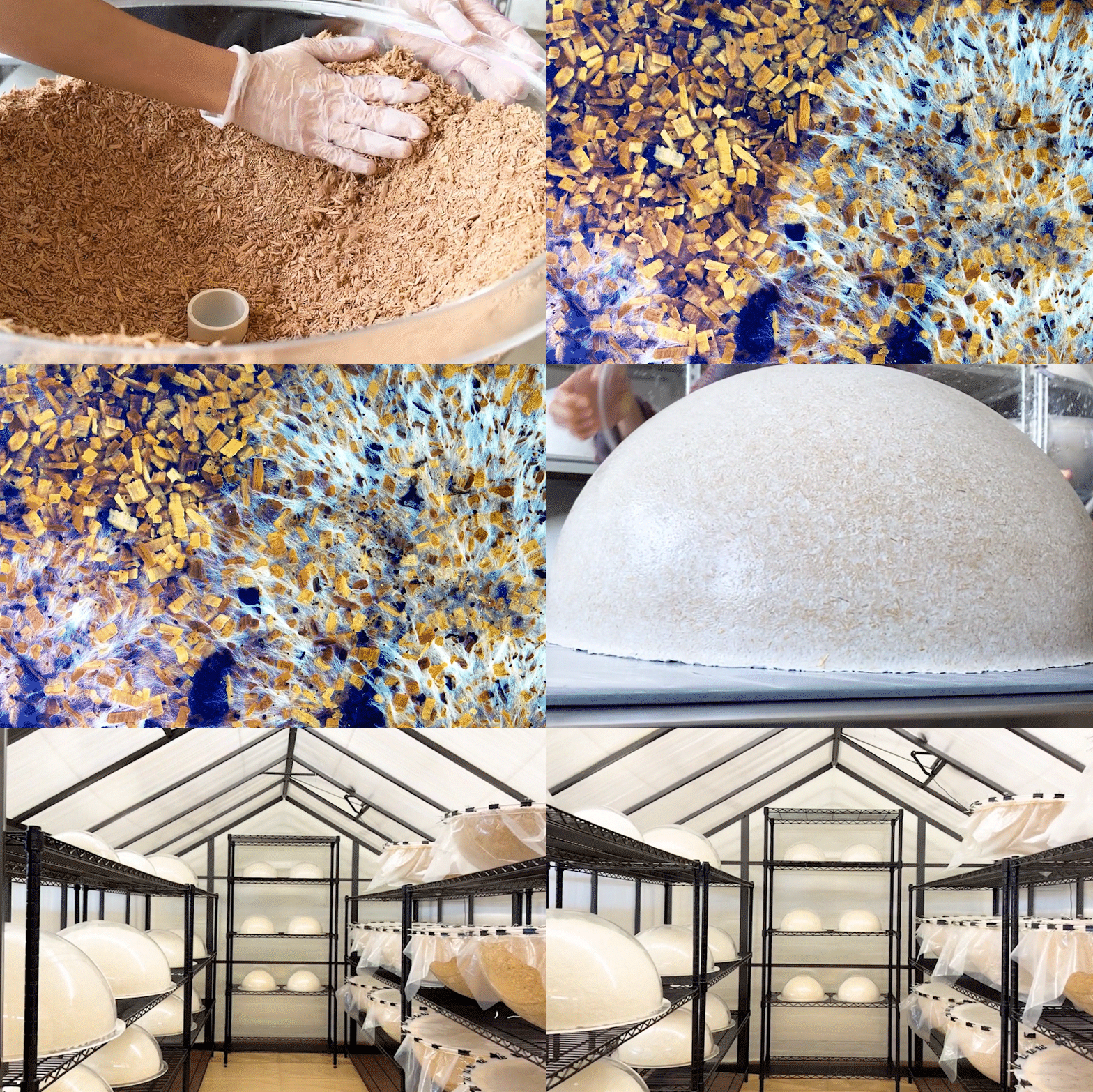
hemp waste is upcycled and bound with living mycelium, transforming raw byproduct into bio-based material
Managed entirely in-house, inventory is constantly rotated through a strict production schedule to maximize output within a minimal footprint. ‘We’re growing, drying, storing, and then shipping — trying to do this in the least amount of space. We understand that scale is crucial for a biomaterial like this to compete in a commercial marketplace, so we need to prove that a handcraft can still compete on cost as well,’ says the designer.
Whether crafting lighting fixtures, acoustic panels, or custom sculptures, MushLume scales its bio-fabricated designs to meet the demands of commercial, workplace, and residential spaces. The studio leverages the inherent performance qualities of its two core ingredients: mycelium and hemp. Achieving a Class A fire rating required for commercial lighting standards, the material relies entirely on mycelium’s natural fire resistance without synthetic chemical retardants. Additionally, the porous fibrous matrix naturally absorbs sound, delivering dual-function performance that combines high-efficiency acoustic dampening directly within illuminated elements.
‘Instead of just single lamps, we are creating integrated acoustic lighting systems that feel like art on your wall while silently performing by adding light and sound absorption to the space,’ Trofe tells designboom.
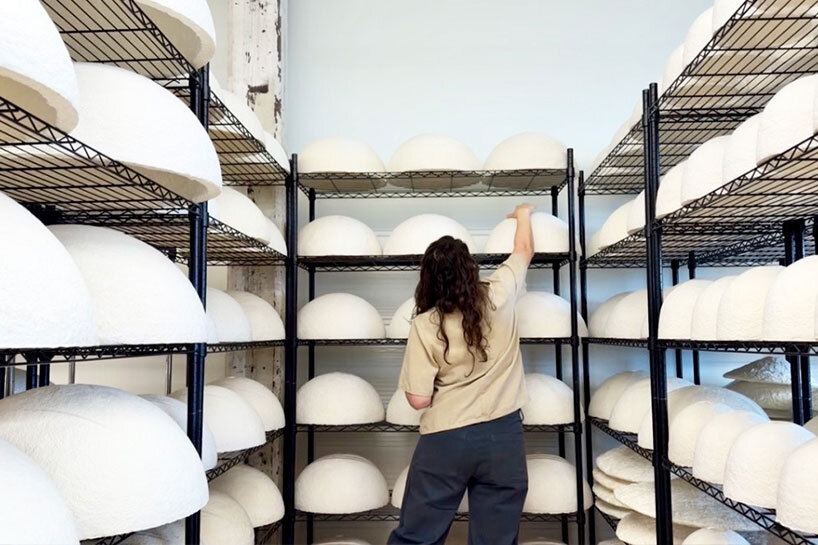
mushlume bio-fabricated fixtures secure a class a fire rating through mycelium’s natural flame resistance
The new MushLume lab at MADE: Bush Terminal opens a pivotal chapter for the studio, consolidating design, cultivation, and production under one roof. Bringing these operations together in a single facility enables the studio to transition from an innovative experimental lab into a fully scaled commercial producer of bio-fabricated lighting and acoustic systems.
‘Now, we can combine everything under one roof. Beyond achieving a higher scale of production, we chose this space because we wanted a public-facing side. It allows us to bring in designers, architects, and clients to visualize the process and the end product in space. It also lets us engage with the public — students, designers interested in biomaterials, or anyone curious about the field — by hosting workshops for hands-on experience with biomaterials,’ Trofe notes.
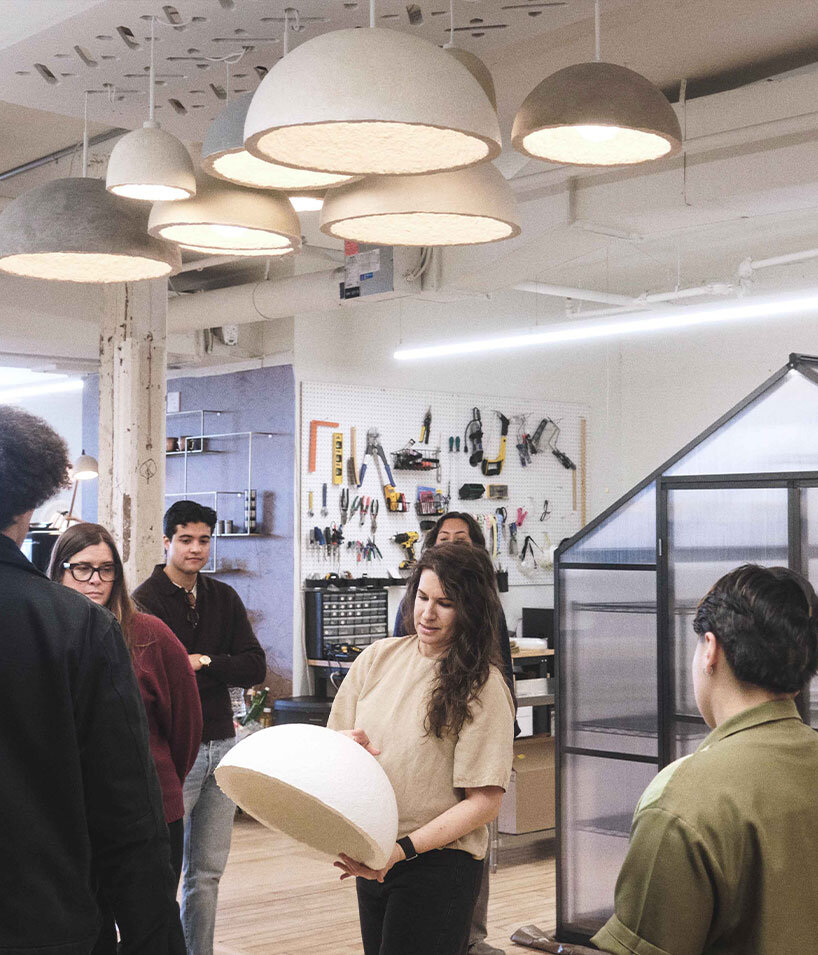
unifying research, growth, and production under one roof accelerates the studio’s evolution
Embedded in the vibrant maker community of Sunset Park, South Brooklyn, the studio benefits from a unique creative ecosystem. Proximity to diverse fabricators, materials, and production methods encourages spontaneous cross-pollination and collaborative innovation.
‘As we expand into new product categories, being able to consult with fabricators working in metal, wood, or digital fabrication is so important. Just like nature operates better through shared resources in an ecosystem, the new lab allows designers and artists to collaborate by sharing resources and intelligence,’ concludes Danielle Trofe.
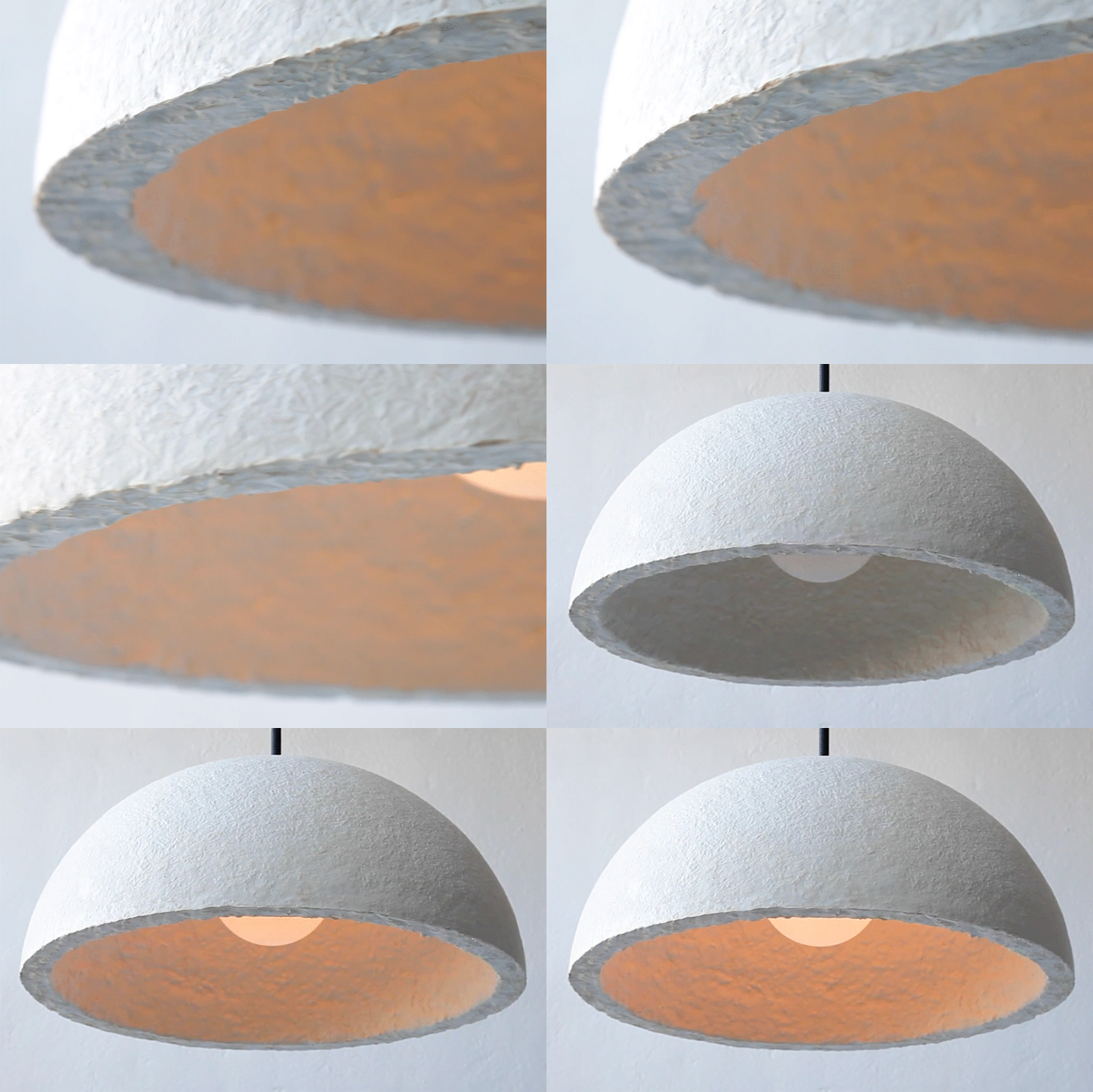
the studio’s proximity to diverse creators at sunset park fuels continuous collaborative design
project info:
name: MADE: Bush Terminal
organizer: New York City Economic Development Corporation (NYCEDC) | @nycedc
design studio: MushLume | @mushlume_lighting
location: Sunset Park, Brooklyn, New York