Why making the real thing still holds its magic: Isabel + Helen on a decade of putting impossible inventions into motion
INT: I think that’s the thing that makes all your work so captivating. It’s so nice to hear which work has stood out from your perspective.
You’ve always said that play is a really big part of your creative process, that each project starts with these physical experiments (a lot of which are in the show!) that grow into something much larger. How do you think that process has evolved over the years as more and more projects have come through the door? I’m sure each new brief always presents very different challenges or problems to solve, especially when working at scale.
HC: That’s a hard one. I think over time in general you understand what works better and what doesn’t, we’ve probably become more efficient in our making and I guess we’ve got all these different projects which we can now reference and build on as well, mixing a few methods from this one or the other. It’s almost like creating our own set of references which you can then make new things out of which is quite nice.
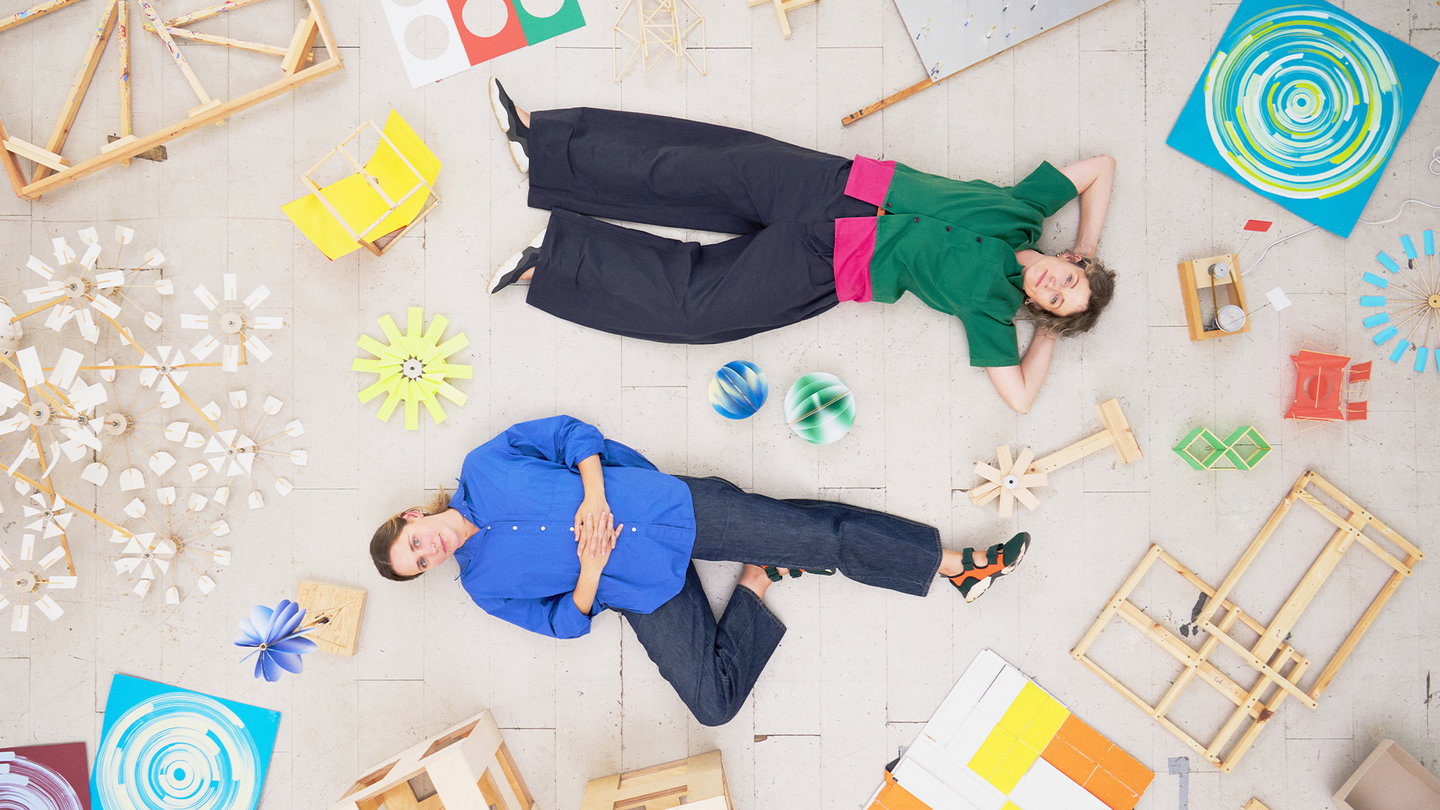
IG: That’s where the archive and all these models and movement tests have helped feed new work in a way. They have become almost like our brain in visual form. That’s what’s inspired the show really – the idea that we have all of this stuff that we’ve made but maybe hasn’t always been seen. It’s all the stuff in the background.
INT: You share some lovely making tests on Instagram too, these kinds of quick iterations of things that are always a joy to see. It’s like a catalogue of experience and motion solutions and design ideas that becomes almost like a toolbox to sort of dig back into as you go on, I’m sure.
HC: Yes, that’s exactly it!
IG: We will always get to the point in a project where we’ll be on the computer sketching but you do just need to actually test stuff out or make stuff to understand if it’s going to work – it’s so integral.
HC: Whenever we test something, we stand back from it, look at it and ask: is it bringing that feeling of wonder or excitement that we wanted to share? You can only work that out through trying to make it.
INT: Yes, there are some days in the studio where you leave and think that the day was written off but it’s not because you tried so many things that failed and that’s the point.
IG: Totally, that’s probably what we spend 80 percent of our time doing: making something that didn’t quite work and having to make a new one. It always takes longer than you think but it’s worth it and if something completely fails it will always still lead on to something else. Things change so much and evolve as you go.
HC: We often find the simplest ideas to be the most effective a lot of the time.
INT: It’s always so interesting to wrestle with that gap between what you thought something would be and what it can be – what the practical limits of a project are.
HC: Yes, definitely. I think the trick is not jumping to that end point too early which is probably a bit more scary but in the long run it pays off.
IG: With what you were saying about how every brief being different I think that’s always been the nicest thing. You almost become a real expert at something or you really hone something and then you get another brief and it’s just something completely different. Like the brief for Burberry – we were wondering how to make a perfectly Burberry plaid on a pole? A skill we might never use ever again! But that’s the fun of it.