public art keeps inviting us to play, so why is so little of it actually thrilling?
the top of keff joons
In April 2025 I entered a warehouse in Brooklyn and couldn’t believe we were actually being invited to climb the installation that filled the huge space. Cj Hendry’s Keff Joons rose as a colossal tangle of inflatable tubes. It was a twenty foot-tall, three-dimensional maze and it had no railings and no nets. Each of us was handed a pair of orange grippy socks, and we were sent on up to explore.
It was a rare encounter with art that felt like a genuine thrill. Navigating the enormous maze was daunting and dynamic, as unexpected reverberations shook the tubes when other climbers bounced somewhere beyond my view. I remember peering downward to see the mats a long way below, and thinking that one slip could send me tumbling. The landing would probably be forgiving, but my brain was still registering the drop.
That slight contrast between what I knew and what I felt made the experience exciting and, looking back, scrambling around the inflatable artwork was a great example of what’s called ‘risky play‘.
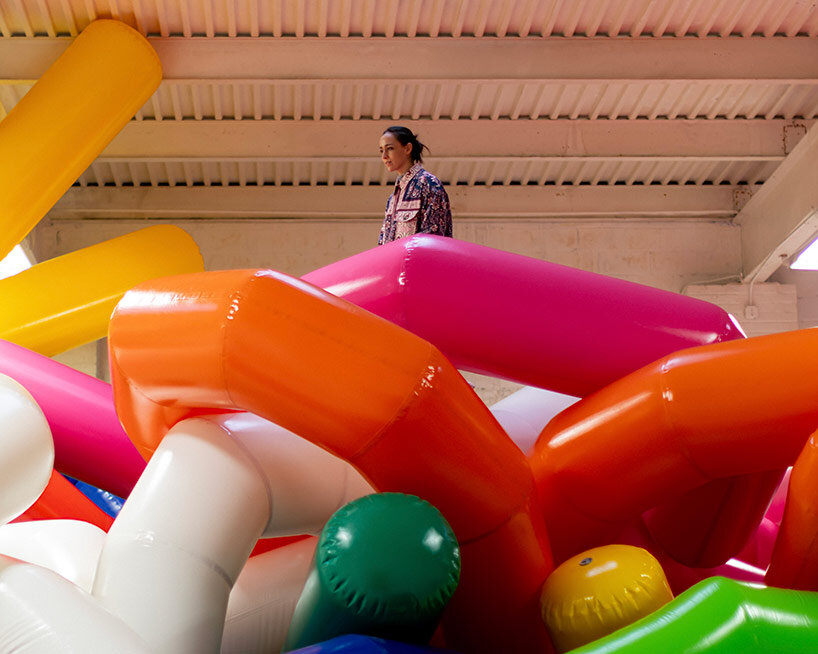
Cj Hendry sculpts an inflatable dreamscape (see here) | image © Cj Hendry Studio (header © designboom)
the gap between knowing and feeling
As a familiar example, rock climbing with a belay has a similar split. The harness and rope system are designed to catch a fall, but many climbers still feel that thrilling sensation of height. Every movement is calculated, but the worst consequence of a misstep has already been reduced by design as the belay works in the background (alternatively, in the case of the image below, a safe landing is offered by the waters of Copenhagen’s harbor).
Knowing logically that you’re safe, while still feeling that sense of unease is close to what researchers call ‘risky play’. A 2024 study in Planning Theory & Practice defines it as thrilling physical play involving uncertainty and the possibility of injury.
The authors argue that decades of risk reduction have narrowed opportunities for adventurous play, while research associates physically challenging play with stronger risk-assessment skills and greater self-confidence. Of course, the group’s focus is children, but that feeling is familiar at any age. We become alert when an environment calls for us to judge our own limits.
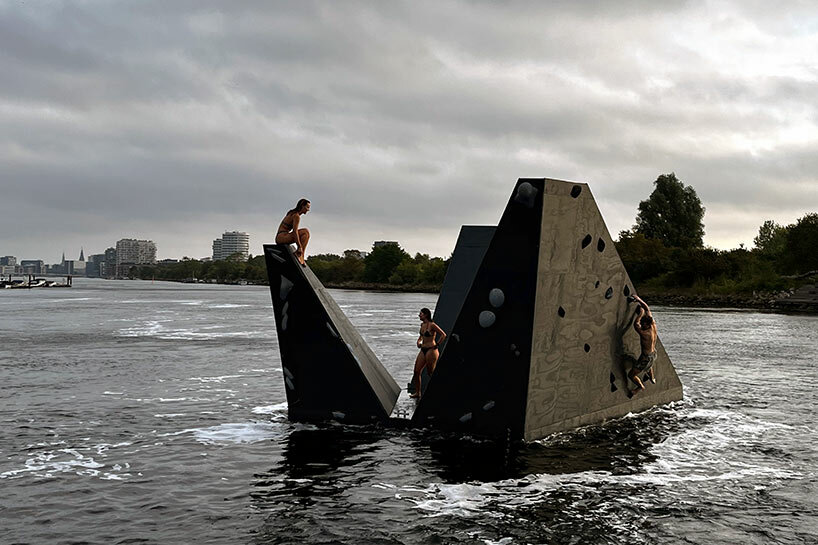
MAST designs the world’s first free-floating open bouldering gym in Copenhagen (see here) | image © MAST
a web that moved beneath everyone
I had felt another version of this in 2022, on Tomás Saraceno’s installation ‘Free the Air: How to hear the universe in a spider/web‘ at The Shed. A group of us visitors were ushered onto the suspended nets, entering a 95-foot-wide structure designed to mimic the sensory world of a spider. Even one footstep on the far end traveled across the weave as a tremor.
We were all tittering as we fanned out because even though the net was tightly woven, its openings were just wide enough to make us imagine a shoe slipping through. The installation comprised two layers of netting, meaning another visitor might hover above your head or move beneath your body, which added to that buzz.
We even started to bond as a group over our nervousness. We watched each other more closely and warned one another about missteps. Each shift in the net brought a slight spike in tension. Saraceno’s spider metaphor became physical through that interdependence. With every subtle move, we were affecting the experience for our neighbors.

Tomás Saraceno, Free the air: how to hear the universe in a spider/web, The Shed, 2022 | image by Nicholas Knight
play beyond design
This past week I hiked the Waihe’e Ridge Trail on Maui, whose upper section is known to be perpetually cloaked in mist, and thus usually slick with mud. Even though there was a low chance of serious harm along this stretch, each step felt uncertain enough to call for constant attention.
Just like the Saraceno exhibition, we became close with the other hikers, laughing before the slips even happened. It was partly from nerves and partly because we could see our wobbles foreshadowed by the person ahead of us. The real fun of the trail came from the feeling that each step was a manageable risk, and from sharing that experience with others.
Thinking back on it, that hike helped me understand why a designed environment can feel dead even when it offers plenty to touch. Often times, ‘play’ grows through an exchange between the body and its surroundings. The mud gave us a problem without prescribing the movement that would solve it. We took tinier steps and looked for firmer surfaces.
Again, it was the uncertainty made the landscape more dynamic and the group more connected. A dry walkway would have overlooked the same view, but it would have asked less of us.

Waihe’e Ridge Trail, Maui, Hawaii | image © designboom
play versus hollow interaction
It’s my opinion that many ‘interactive’ installations built around the theme of ‘play’ lose energy when the visitor’s role has already been fully scripted. Some involve nostalgic toys enlarged to an architectural scale, but the level of engagement is quite limited. Often times, they ultimately serve as just photo opportunities. The object may invite engagement, but it offers little room to test a route, change the conditions, or influence someone else’s experience.
One could argue that this points to a larger confusion between interaction and agency. Oversized swings or ball pits can create an immediate visual cue which reminds us of ‘play,’ but many times the experience lends something hollow and repeatable.
Plenty of artists and designers have approached the problem through structures that ask more from the body. Sven Pfeiffer’s Risky Playground at the Kyoto Art Center used perforated plywood panels to form a climbable pavilion that could be rotated by 90 degrees, changing its spaces and uses. The project was conceived around forms of transgressive play commonly excluded from Japanese public space.
Numen/For Use, meanwhile, builds inhabitable tape and net environments in which visitors crawl through taut membranes that shift under collective weight.