Mercedes Slashes Outlook As China Demand Hits Wall; Europe's Auto Profit Warnings Pile Up
Mercedes-Benz Group AG became the latest European automaker to slash its profit outlook as deteriorating demand in China and rising input costs squeeze margins.
Shares tumbled in European trading this morning as the auto industry as a whole confronts intensifying Chinese competition, softening demand, and ongoing cost pressures.
"Mercedes-Benz Group AG today updated its full-year 2026 outlook for Mercedes-Benz Cars and the Mercedes-Benz Group. In addition to an increasingly challenging market environment in China, Mercedes-Benz Group expects higher costs in the fourth quarter, including higher material costs," Mercedes wrote at the start of the update.

The struggling automaker now expects an adjusted operating margin of 2% to 3% in its core cars division this year, compared with as high as 5% stated in a previous forecast. Group earnings before interest and tax are forecast to be roughly flat.
Add Mercedes to the growing list of European automakers sounding the alarm about soft demand in China and a tough operating environment overall. Volkswagen and BMW have recently warned about worsening conditions in China.
UBS markets analyst Eva Kindt wrote earlier, "Auto stocks are down 1.5% with the sector under pressure after Mercedes-Benz (down 4.8%) cut its FY cars adjusted return on sales forecast, noting a tough China environment, while Porsche is up 3% as the company's profitability held up despite a decline in vehicle sales."
Mercedes shares in Europe declined as much as 5.5%, the steepest intraday decline in more than a month. The weakness spread across the sector, with European autos ranking as the second-worst-performing sector in the Stoxx 600, falling 1.3%.
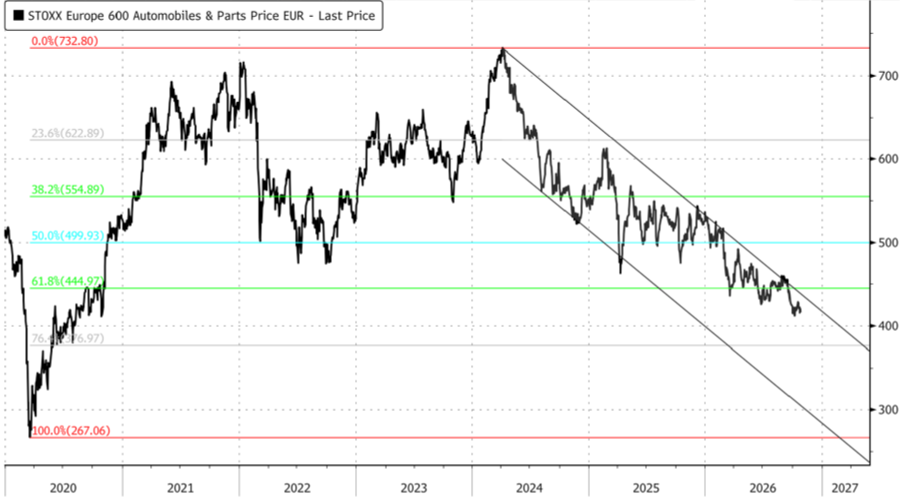
Brussels' recent cap of 350,000 Chinese hybrid imports per year marks a major escalation in Europe's trade confrontation with Beijing. Protecting domestic automakers risks Chinese retaliation, potentially through tighter rare-earth restrictions that could further strain European production. Yet allowing lower-priced imports to erode the continent's industrial base risks national suicide.