Oracle's Massive "Project Jupiter" Data Center Declares Force Majeure, Jeopardizing Entire US AI Rollout
Two days ago, when we discussed the startling news that loans backing one of the world's largest data centers - Oracle's massive $165 billion Project Jupiter, located on a 1,400 acres campu in Dona Ana country, New Mexico and which is projected to power 2.45GW of compute when it is completed - had tumbled into stressed territory and were trading below 90 cents on the dollar due to a surge in project delays due to fierce local opposition over concerns about its impact on the local area’s water supply and air quality, as well as outcry about the gas emissions from the company's contracted energy provider, Bloom Energy, we warned that "Project Jupiter’s initial phase is as of this moment at least seven months behind its proposed date to come online. It was expected to be completed by November this year. It won't be; in fact it may not be completed for years."
We were right.
This morning Bloomberg reported that - in the first very clear sign of huge storm clouds gathering for the US data center rollout - Oracle had moved to shield itself from racking up expenses on its data center, by sending the project’s developer, a unit of Blue Owl Capital Inc., a notice citing "force majeure", meaning the company had encountered conditions "beyond its contractual control" preventing it from proceeding as scheduled.
As Bloomberg explains the first shot across the data center bow, "rather than trying to walk away as the site’s main tenant, Oracle is attempting to put off payments should the data center dubbed Project Jupiter get derailed and fail to come online in 2028 as planned."
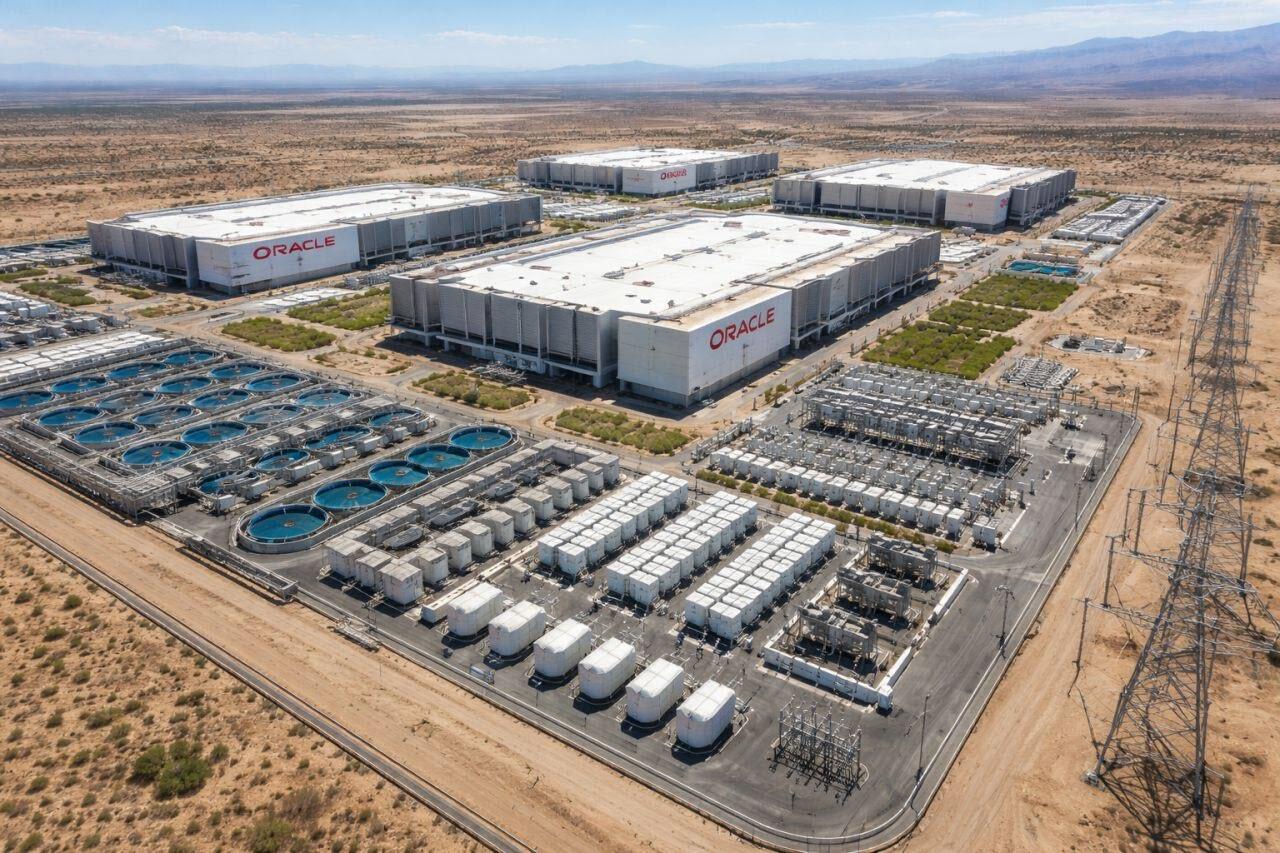
Companies only invoke force majeure to free themselves from contractual obligations when problems arise beyond their control - a recent such example was Qatar's LNG plant telling its customers it can't deliver the contracted product due to enemy action by Iran, which crippled the country's LNG production for years. In this case, Oracle is seeking to assert its contractual position if the build out is delayed.
Still, Bloomberg cautions, it’s not certain that such a maneuver would free Oracle from its previously agreed financial obligations.
Translation: the construction delays - which will only get worse if Democrats win back the house at the midterm elections - have blown up the project's scheduled rollout, are wreaking havoc on the data center's budget revenues, and even the extremely levered company that is supposed to be the data center's core tenant, Oracle, is no longer confident it will be able to fund its contractual obligations.
Oracle - naturally - tried to talk down the impact of the force majeure, with a spokesman saying “Project Jupiter remains on our planned schedule,” without commenting on the notice. “We are fully committed to New Mexico and confident in our path forward.”
Well, and this goes without saying, if Oracle was so confident in the "path forward" it wouldn't be advising its project developer it won't be held to its contractual obligations.
As we showed earlier this week (see corporate entity chart below), the massive project in southern New Mexico is a major part of the Stargate AI infrastructure build-out that US President Donald Trump unveiled alongside leaders of Oracle, OpenAI and SoftBank Group Corp., serving as the marquee announcement in a series of US spending commitments that he touted in the early days of his second term. At the time, Trump called it a “tremendous investment” at a scale that “nobody’s really ever seen.” More importantly, as the anchor Project Stargate campus, any delays in its rollout put OpenAI's own timing and budgets in peril as it won't have access to Oracle compute (it gets worse as the other Stargate data center, SB Energy, is also facing staggering challenges as discussed two days ago).
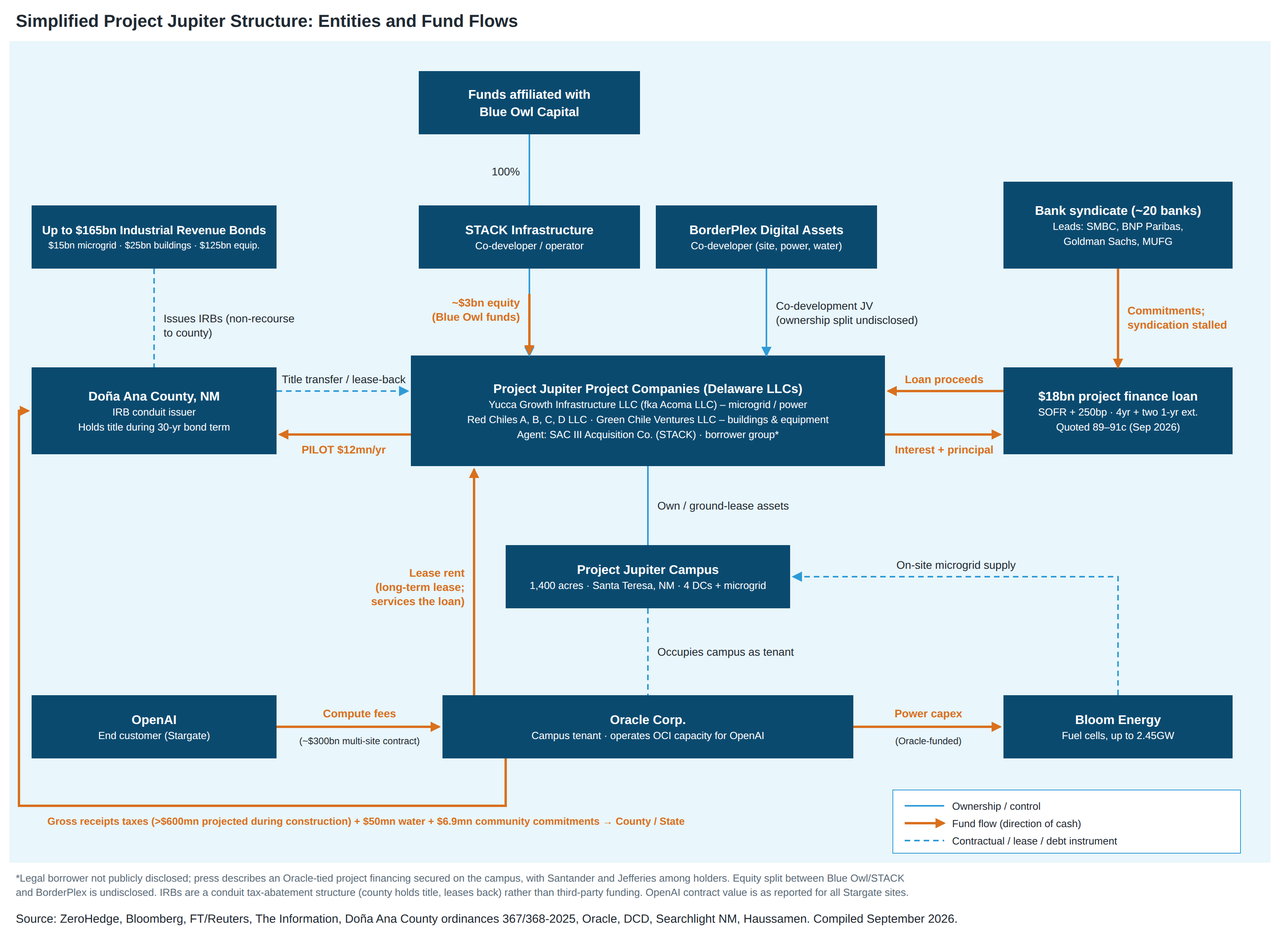
As we explained here, the biggest problem facing the data center is that almost two years after it was announced, the campus designed to handle a massive 2.45 gigawatts - enough electricity to power roughly 1.8 million homes at any given moment - has hit serious setbacks including the denial of a permit key to its plans for energy resources, and has now become a symbol of the growing backlash against the broader AI data center boom and a political flashpoint ahead of the US midterm elections that threatens to turn races into referendums over the build-out.
Where today's announcement gets especially problematic is that even if the force majeure notice is intended as a precautionary step to win some wiggle room - as the company apparently intends - it risks alarming lenders backing the project, and we expect the price of the $18 billion leverage loan backing the project to be down sharply today from its recent level around 90 cents on the dollar. A group of about 20 banks led by SMBC, BNP Paribas, Goldman and MUFG, provided an $18 billion loan to help fund the construction of the data center campus, one of several mega-debt deals that have helped bankroll the AI infrastructure boom.
The notice will also raise questions again about the resilience of data center leases. Contracts often include a clause allowing customers to back out if service doesn’t begin as scheduled. Earlier this year, Google agreed to pay Elon Musk’s SpaceX for computing power through mid-2029, for example, but reserved the right to terminate if it didn’t gain access by a certain date.
Force majeure have become common in the energy and commodities world (especially after the Iran war) when events such as bad weather and geopolitical conflicts disrupt supplies, leaving companies unable to fulfill their contracts. The clauses are becoming more common in data center developments as well, according to a recent client alert from Quinn Emanuel Urquhart & Sullivan LLP.
“In AI data center projects, force majeure is no longer a back-end boilerplate provision,” the June alert said. “It is a core litigation and risk-allocation tool that can determine whether a delay remains isolated — or cascades through the project’s construction, customer, power, insurance, and financing documents.”
The challenge is that even the smallest delays throw the bondholders' IRR calculation into disarray, which risks chilling the entire debt-funded AI buildout, as lack of data centers will quickly propagate, putting expansion plans on hold across the entire AI value chain.
It also risks snagging OpenAI's much anticipated IPO.
Not only is Sam Altman's compute-starved company reliant on the prompt rollout of data centers such as Project Jupiter, much to the delight of China which as we noted has almost 4x more spare energy and compute capacity than the US...
And unlike the US, China has the electrical capacity to build all of this. China has 4000GW of total power generation and growing 20%. The US is at 1200GW and flat (with PJM and ERCOT nearing capacity) https://t.co/mEwD3LzvXs pic.twitter.com/p0xFKqeEAB
— zerohedge (@zerohedge) September 23, 2026
... OpenAI is also directly on the hook for the data center's rollout, having signed a $400 billion deal with Oracle and SoftBank last year to support the development of five US data centers including the New Mexico site. Stack Infrastructure, a portfolio company of Blue Owl, is developing the facility, while Blue Owl itself has committed to providing equity (see org chart above). Not surprisingly OWL stock tumbled to a new 2 month low today and is rapidly approaching its all time lows.
And speaking of the energy needed to power the data center, here there are delays too: a key natural gas pipeline project developed by Energy Transfer LP that was supposed to begin service this month and supply fuel to Project Jupiter was instead delayed by at least six months to Feb. 1, 2027, following repeated permit denials from the New Mexico State Land Office to approve a proposed route for the line. Project Jupiter is designed to be powered by gas-powered fuel cells from Bloom Energy (whose stock is also sliding on the news).
Oracle, for its part, has launched a charm offensive in New Mexico to counter the opposition. It remains unclear whether the company will win over the project’s skeptics.
Before Project Jupiter was revealed in full, the developers worked with local officials on an incentive plan and a strategy for how to roll out information to the public, according to documents previously reviewed by Bloomberg. Locals only learned the venture was tied to Oracle and OpenAI after it was approved.
And even if the Oracle data center somehow manages to overcome the massive movement of grassroot opposition, outrage and discontent against data centers in New Mexico - where a Democrat victory in November virtually assures even more delays - and the broader US, OpenAI has even more problems ahead.
As we explained on Tuesday, its second, and even bigger Stargate anchor data center, SB Energy, just delayed its IPO for very much the same concerns: delays, delays, delays. Today's Oracle news could very well be the final nail in the coffin of that particular public offering before it even leaves the ground.
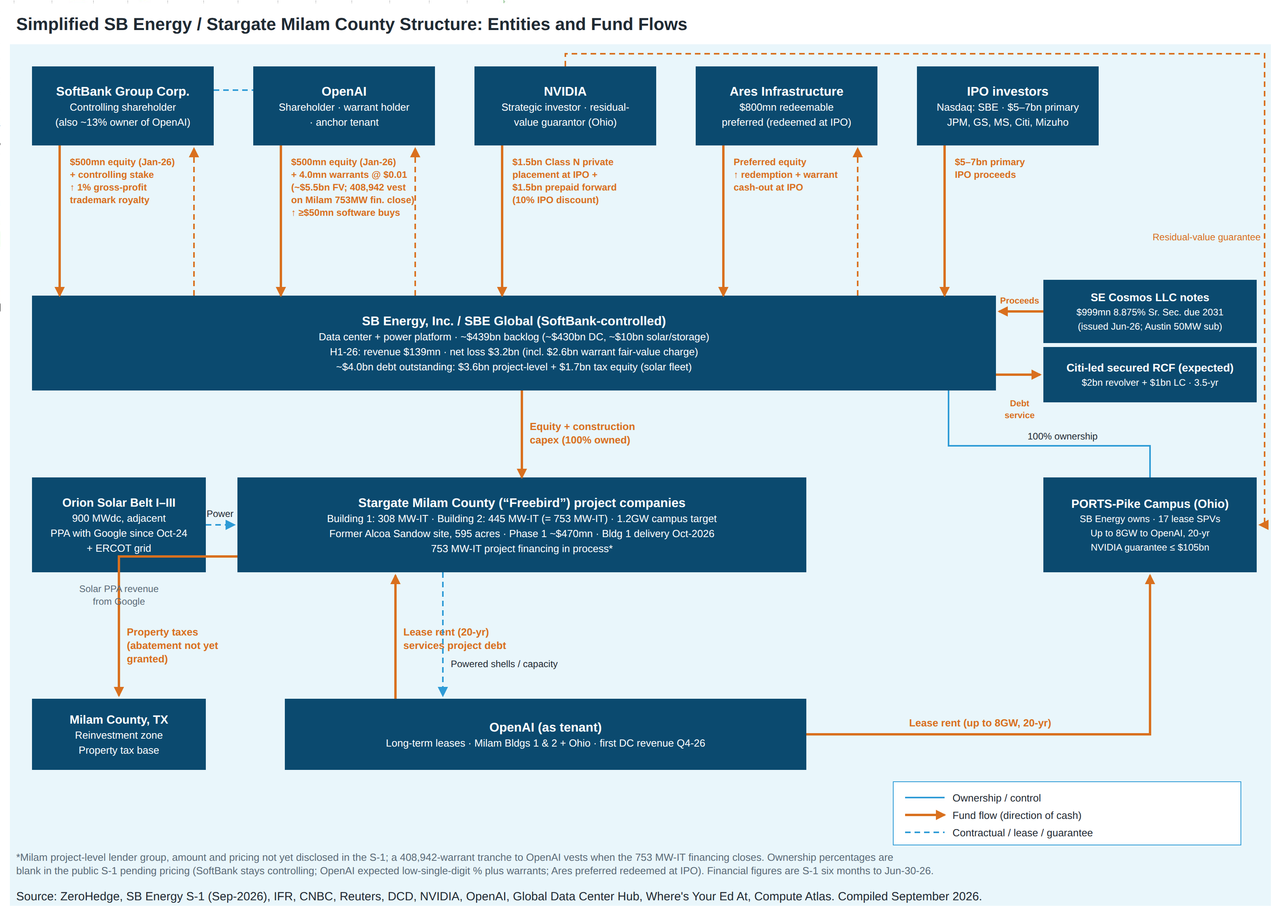
The SB Energy data center, which when completed would be the world's biggest generating as much as 8GW of compute, would be Masa Son's crowning achievement as the Japanese investor strives for AI immortality. Yet if ordinary people on the ground resist and refuse to greenlight its development, it - along with Stargate and his investment in OpenAI - could very well be the last investment Masa Son ever makes.