"Calm Before The Storm?" UBS Warns Of Stock Market Turbulence As Midterms Loom
"This may be the calm before the storm," UBS chief economist Arend Kapteyn wrote in a note on Wednesday morning.
Kapteyn is referring to a historically turbulent stretch for equity markets ahead of midterm elections, which threatens to amplify the seasonal rise in market volatility.
"Indeed, since 1928, these have been the most volatile months of the calendar, with volatility increasing in both election and non-election years before falling sharply thereafter," Kapteyn continued.
Since 1950, the president's party has lost an average of 25 House seats and three Senate seats in midterm elections, Kapteyn said.
For this election, Kapteyn cited betting odds close to 50-50 for Democratic control of the Senate, asserting there was little reason to expect less uncertainty or volatility in the months ahead.
Bank of America's Michael Hartnett expects a market rout if Democrats sweep. Traders worry that Democrats have already signaled regulatory safeguards and data center moratoriums that could stymie the AI bubble. We detailed these threats in a note titled "If Dems Win The House: Data Centers, Nuclear, Venezuela Oil Deal Likely Targets."
Meanwhile, JPMorgan's Andrew Tyler recently shared his base-case with clients: Across the 23 midterm cycles since 1934, the sitting president's party has lost roughly 27 House seats and about 3 Senate seats on average. Applied to a 218-seat Republican House majority and a 53-47 Senate, history says Democrats take the House and Republicans hold the Senate. And while betting markets give Dems an 85% chance of taking back the House, the chance Republicans keep the Senate is a very tight 53% according to Kalshi.
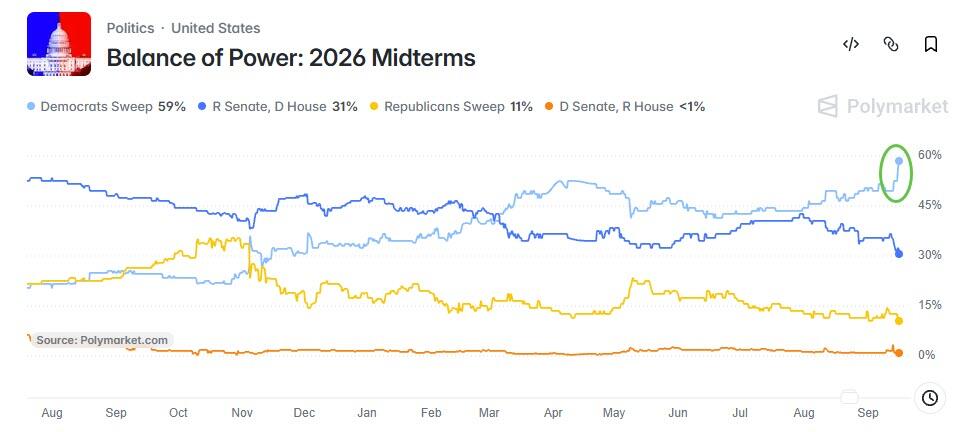
Polymarket suggests the market is pretty sure the Dems will sweep...
Kapteyn added more color on equity vol trends:
The S&P's performance mirrors this volatility pattern. During midterm election years, the S&P 500 has typically declined between late August and early October, but by March of the following year it has recovered and delivered an average return of roughly 14% (with a median return of 16.4%).
The only exceptions were 1978, during the inflation shock, 2002, following the tech bubble burst, and 2018, amid trade-war tensions and Fed tightening. By contrast, the average return over the same period in other years is less than 5%. With betting odds of Democratic control of the Senate still close to 50-50, there is little reason to believe uncertainty (and volatility) will be lower this year than in past midterm election years
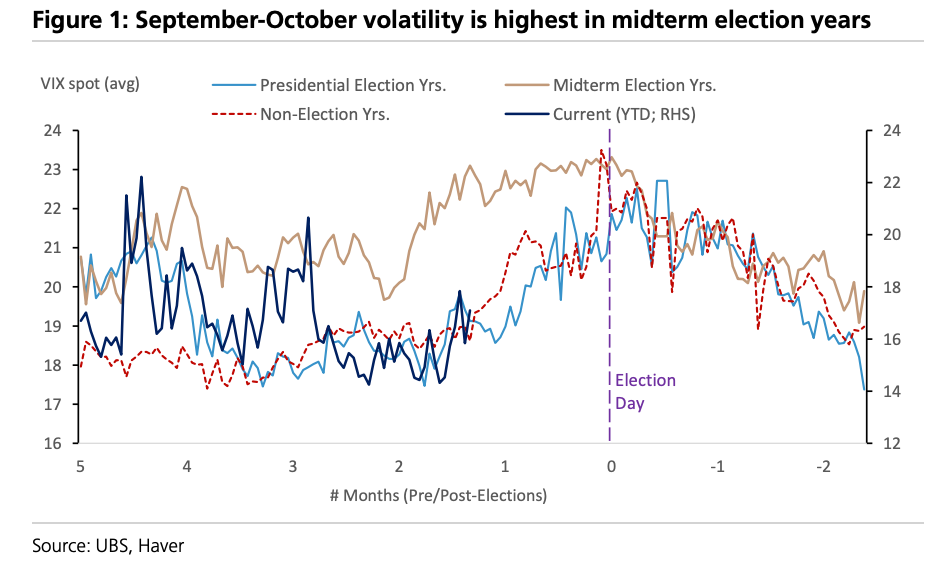
Kapteyn then questions: "The calm before the storm?"