EU Opens Door For Canada To Become Bloc's First-Ever "Associate Member"
Thanks to how mean President Trump has been, Canada could become the first-ever "associate member" of the European Union under a proposal unveiled Wednesday by European Commission President Ursula von der Leyen, as Ottawa looks to reduce its economic dependence on the United States.
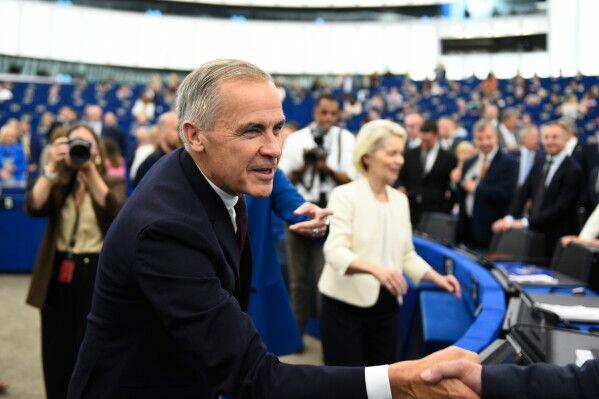
Speaking during her annual State of the Union address in Strasbourg, with Canadian Prime Minister Mark Carney in the front row as the first foreign head of government ever to attend the speech, von der Leyen said Brussels wants to take its relationship with Canada to an unprecedented level.
"We must urgently reimagine our partnerships," von der Leyen said, before telling Carney she wanted to work with him on "opening the door for Canada to be the first associate member of the EU."
There is just one complication: no such status currently exists.
EU treaties allow European countries to apply for full membership, while Brussels maintains an assortment of trade, association and single-market agreements with countries outside the bloc. But "associate membership" would be something new, meaning its rights, obligations and legal structure would have to be negotiated essentially from scratch.
Reuters notes that any serious move toward such a status would also face the politically difficult task of winning support from all 27 EU member states.
And Carney himself has stopped short of calling for full EU membership. On Sunday, after a Wall Street Journal report that Canada was exploring membership, he described what Ottawa is seeking as a "unique alliance" with Europe. He addresses the European Parliament on Thursday.
The substance of what Brussels is proposing, however, goes considerably beyond another trade agreement.
Canada and the EU already have CETA, their comprehensive free-trade deal. Von der Leyen said Wednesday that the two sides now want to move "from CETA to an Alliance for the Future" encompassing manufacturing, technology, defense, energy, critical minerals, batteries, artificial intelligence, quantum computing, cybersecurity and Arctic security.
"We will integrate defence industrial bases," she said.
That process has already begun.
Canada became the first non-European country allowed to participate in the EU's €150 billion SAFE defense procurement program under an agreement signed in February and formally concluded by the EU Council in June. The arrangement allows eligible Canadian companies and Canadian-origin products to participate in procurement financed by the program.
The EU-Canada defense relationship has also expanded into military mobility, interoperability, maritime and space security and defense-industrial cooperation.
Then there's the economics of the idea. Roughly 70% of Canadian exports go to the United States, making any rapid decoupling unrealistic. At the same time, Trump's tariffs and repeated talk of a 51st state have given Ottawa a powerful incentive to diversify. Europe, meanwhile, needs resources.
Von der Leyen warned Wednesday that Europe remains more than 80% dependent on China for many critical raw materials, with dependence reaching 90% for some rare earths.
"No country can do this alone," she said.
Canada possesses significant reserves of nickel, uranium, potash, cobalt, lithium and rare earth elements, among other commodities increasingly regarded as strategic inputs for batteries, semiconductors, defense equipment and energy infrastructure.
That makes a deeper Canada-EU relationship potentially complementary: Europe gets another source of strategic commodities and energy while Canada gets a large alternative market, industrial investment and greater access to European defense and technology programs.
There is nevertheless a potentially uncomfortable tradeoff for Ottawa. If "associate membership" eventually includes meaningful access to the EU's roughly €18 trillion single market, Canada could be required to align portions of its regulatory regime with EU rules. Reuters notes that this could leave Ottawa accepting European regulations without receiving the voting rights enjoyed by actual EU members.
Canada could gain market access while becoming, at least in some areas, a rule-taker rather than a rule-maker.