New York City Votes To Ban Horse-Drawn Carriages, Ending 170-Year Tradition
Authored by Kimberly Hayek via The Epoch Times,
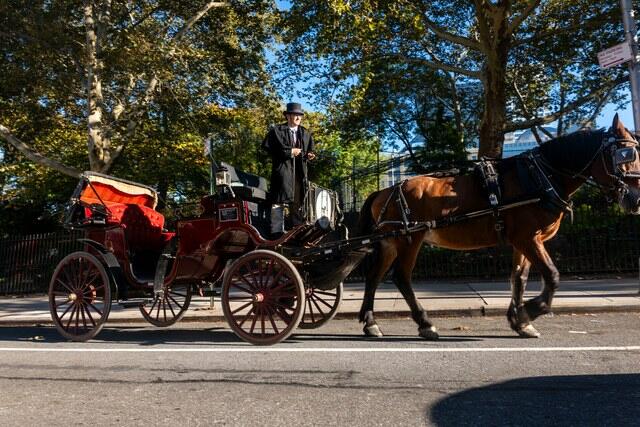
The New York City Council voted on Thursday to pass Romanch's Law, phasing out horse-drawn carriages in Central Park by June 1, 2028.
Forty Council members voted yes. Twenty-nine had signed onto the bill sponsored by Council Member Christopher Marte. Speaker Julie Menin is the first sitting speaker to support such a ban.
"Today, the City Council made history. Our landmark vote to pass Romanch's Law is a demonstration of this Council's commitment to animal welfare, public safety, and worker protection," Menin said in a statement.
The law bars new licenses on or after June 1, 2028. Existing ones expire permanently on May 31, 2028. The law requires the mayor's administration to create a workforce transition program by April 1, 2027, which includes job referrals, career counseling, hiring fairs, and educational opportunities.
It also considers compensation for owners based on business value, licenses, and equipment. Horses must be certified by June 1, 2027, not to be sold for slaughter or other inhumane purposes, and owners may keep them.
A joint working group will include one representative each from the speaker's office, the administration, and labor.
The vote followed the June death of 18-year-old Romanch Mahajan, a tourist from India.
On June 17, Mahajan fell from a carriage after the horse spooked and bolted during a ride with his family. Mahajan hit his head and died. After his death, Menin announced her support for the ban in a video on X.
"The tragic and preventable death of 18-year-old Romanch Mahajan made clear that the status quo is no longer acceptable," Menin said Oct. 14 when announcing the Oct. 22 full council vote on the measure.
Mahajan's death was the first in more than 160 years of horse-drawn carriages operating under the Transport Workers Union, which represents the carriage drivers, in the park.
Mayor Zohran Mamdani confirmed he and the speaker had agreed to the June 1, 2028, end date.
"I think that we have a civic responsibility to ensure that we are not leaving anybody out to dry," Mamdani said at an unrelated press conference on Oct. 14.
The Transport Workers Union denounced the text of the bill as noncommittal, with "no meaningful economic relief for workers."
The bill does not require the city to compensate the 68 owners for their city-issued licenses or medallions.
In a statement, the union denounced Menin for what it described as using "the tragic death of a tourist to contrive a public safety crisis."
President Donald Trump, who is from New York City, criticized the ban on Truth Social, writing: "So sad to see the beloved Central Park Horse-drawn Carriage Industry ending after over a Century, based largely on one tragic accident. When there is a car accident in the area, of which there are many, they don't stop cars from entering the Park. So why would they stop the Carriages? It was a Great Tradition. Another piece of History that's gone. It will be missed!"
In a separate post, he added, "The Horse-drawn Carriage in New York City is a quintessential New York experience. So sad that, for political reasons, we will see it go!"
Animal rights group New Yorkers for Clean, Livable, and Safe Streets (NYCLASS) reacted on X to the ban.
"For decades, NYCLASS fought to end cruel and dangerous horse carriages," it wrote. "It took the extraordinary courage, compassion, and unwavering leadership of Speaker Menin."
Horse-drawn carriages have operated in Central Park since 1858. They began as transportation and became a tourist attraction.
Council Member Tony Avella introduced the first ban legislation in 2007. Later efforts, including under Mayor Bill de Blasio in 2014, failed. Ryder's Law after a 2022 horse collapse also did not pass. Council Member Robert Holden reintroduced a version in November 2025 focused on workforce programs, which also stalled.
Carriage license owner Ahmet Bilici, who trained as a veterinarian in Turkey before coming to the United States in 2001, became a carriage driver to support himself as he was learning English.
The job stuck, and he's been a driver for 23 years. He said that if the City Council wanted to work with carriage drivers, drivers would be amenable, but he said the City Council just wants a ban.
"When you take this carriage from me, I am going to lose my quarter century! No way!" he previously told The Epoch Times. "I trusted the city because the city licensed the medallion, and now you are shutting down? No way!"
Bilici said the ban will hurt 300 families including support staff such as stable workers, blacksmiths producing horseshoes, and craftsmen making saddles.
"This is my small business, my investment. It's like my house. You're burning my house!" he said. "There's no way we can accept this."
Another driver, Danielle Slot, also said she was extremely disappointed. She said she thinks there is no solid justification for the ban.
"Our City Council is supposed to look out for people and represent people, and they're supposed to see through these things," Slot previously told The Epoch Times, referring to the long-term campaign of NYCLASS head Steven Nislick to ban carriage horses, which dates to 2008.
"I've just completely lost faith in the government here, which is very sad," she said. "It feels like they're capitalizing on sensationalism.
"It's a really nice thought that there would be some magical sanctuary [for the horses]. But it's just not realistic."
City rules currently limit horses to nine-hour workdays, five weeks of annual vacation, and prohibit work when temperatures are below 18 degrees or above 90 degrees.