What If Warsh Shocks The Market And Keeps Rates On Hold
Ahead of today's FOMC announcement at 2pm, the prevailing consensus is that Warsh will raise rates but he doesn't need to, as tariff inflation is now fading fast, the bulk of headline inflation is driven by one-time supply shocks from the Iran war which the Fed is powerless to fix, and the upcoming change to the PCE methodology will trim the YoY print by about 0.3%, suggesting that the Fed will be hiking at a time when core inflation is the lowest in years. In fact, as Goldman and many others suggested, the only reason why Warsh will hike is because the market is now certain Warsh will hike as the Fed does not want to disappoint the market and spark a rout ... thereby making a mockery of his prior statements that he won't be led by the market (we previewed all this in great detail here), to wit:
The CPI report had little impact on our inflation view but pushed market pricing of the probability of a hike to nearly 90%, which puts pressure on the FOMC to deliver a hike to avoid the market reaction that would likely follow from remaining on hold... We expect the FOMC to make only the minimum necessary change to its statement, which will likely note that the FOMC is hiking in support of the goal of returning inflation to 2% but will likely avoid providing guidance on the path forward or the criteria for further hikes. - Goldman
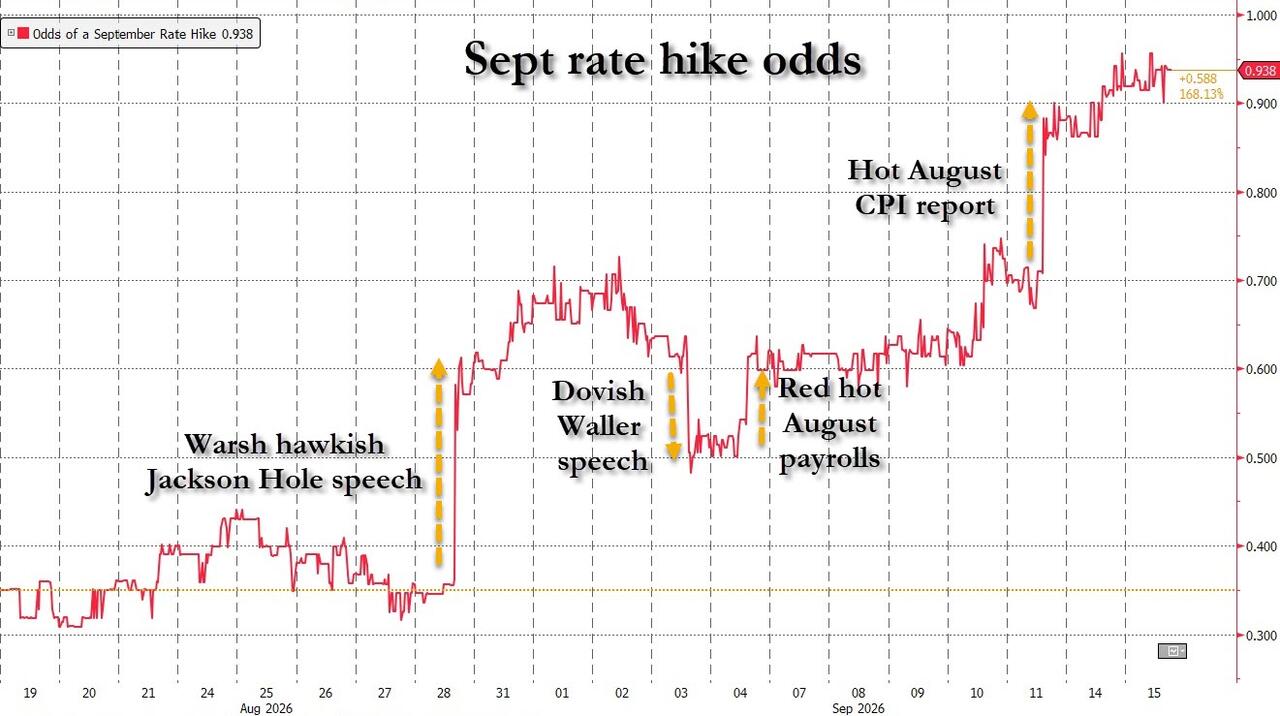
But what if Warsh does precisely what he warned he would, and - ignoring market certainty and expectations of a 25bps rate hike, not to mention the resulting tantrum - he keeps rates on hold?
To be sure, it's hard enough to go against the market, so one can only imagine how hard it is for Fed Chair Warsh and the FOMC to stare it down. Yet as Standard Chartered's Steven Englander writes, "there seems to have been a market echo chamber pushing up expectations despite a limited amount of incoming data, little sign that inflation is going up, some indications that underlying inflation is much lower if tariffs and other factors are removed and the prospect of more informative data within a couple of meetings."
As Englander notes, much of Warsh’s discussion has focused on the Fed influencing the market too much, but the move from the pre-Jackson Hole ‘Warsh has to show that he is willing to hike’ to ‘Warsh will hike if inflation doesn’t come down’ to ‘Warsh has to hike unless the next CPI is really soft’ to ‘Now the debate is on how many hikes he has to do’ in two weeks suggests that the influencing pattern can go both ways.
To be sure, while the path of least resistance may be to hike, the Std Chartered strategist sees a real cost down the road if the hiking turns out to be unneeded and the FOMC has to reverse. As a result, and setting aside market pricing, Englander believes that there is a very low cost to waiting.
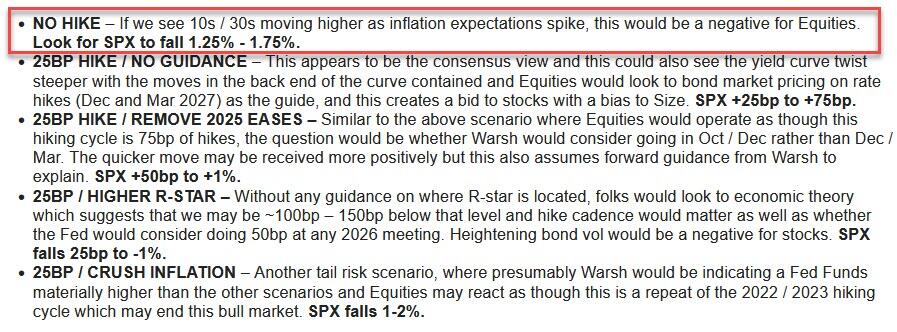
Ok, assume Warsh does not "rip the bandaid" simply because the economy does not merit it, and keeps rates on hold? We already noted that according to JPMorgan this outcome would shock the market and send stocks sliding:
Not surprisingly, Englander has been asked by his readers how Warsh could manage disappointing the market in such a major way. Well, as he discusses in his latest note, it would be hard for Warsh to avoid accusations of being the President’s man and have his credibility questioned harshly, but that is the Day 1 reaction.
At the press conference he could stress that he is opposed to giving forward guidance but not opposed to backward guidance, i.e. explaining precisely the rationale behind the decision and warning the market that the Fed will not be afraid to wrong foot them if it feels pricing is wrong.
Subsequently if others like Waller and Williams who are not tainted with Trump independence issues, defend the hold the market is likely to calm down. And, as a hedge, it wouldn't be forward guidance to say that the FOMC can’t do a 50bp move if it becomes clear that underlying inflation is stubbornly high or rising.
As Englander concludes, in theory this is a second-tier meeting – there is no urgency about moving or not moving. But it is a first-tier meeting because it can define how much stomach Warsh has to be independent of the market. The long game is that if Warsh makes a strong defense of his stance then the credibility crisis is short term. By year-end he can be hiking or holding with more information and moving decisively if a hold is wrong.
But if the perception emerges that Warsh is afraid to face down the market this will be the beginning of a wash, rince, repeat cycle. Market participants will assess the weak side of the Fed stance and press that weakness knowing that the FOMC will bend.
More in Englander's full note "Hiking is the wrong choice."