"Everything Rally" As Futures Rebound From Post-Fed Selloff; Yields And Oil Drop
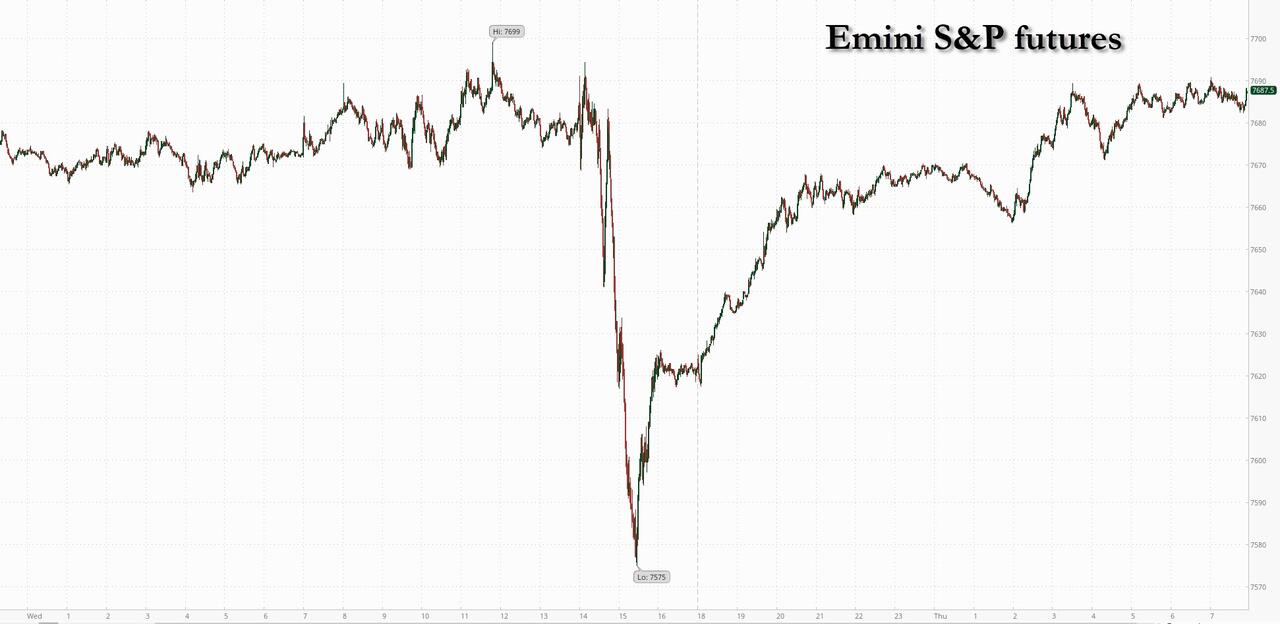
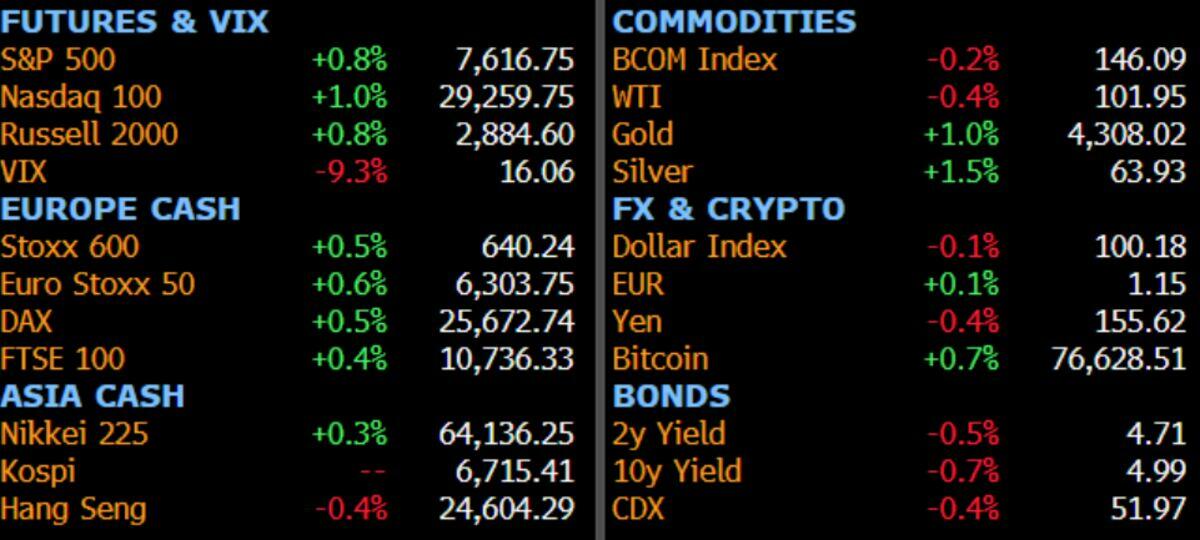
Stocks look set to recover from Wednesday afternoon’s selloff asmarkets digest the rate hike from the Federal Reserve with Warsh (in retrospect) calming markets with a rate hike and tough talk on curbing inflation. A second day of dropping oil prices (no overnight news from Iran is helping) is also helping. Meanwhile, the debate around AI pacing and safety is rumbling on. As of 8:00am ET, S&P 500 futures are up 0.8% with Nasdaq 100 contracts +1% as tech leads with Mag7, semis, memory, and software all higher; look for momentum to continue its rebound today. According to JPM "today is setting up to be an Everything Rally led by the AI and Debasement themes; in Tech seeing Semis, Software, and Mag7 all rallying is intriguing and something to watch to see if fundamental buyers are returning to Mag7 / Software and if so, then what becomes the funding short for Semis?" Bond yields are down 2-4bp; the curve is bull steepening with USD flat. Bond seem to be reacting positively more so to oil than to Warsh. Commodities are mixed with crude lower, precious and base metals higher, but Ags lower. Today’s macro data focus is on jobless data though do not expect the data to be market moving.
In premarket trading Mag 7 stocks are all higher (Alphabet +0.95%, Nvidia +1.3%, Apple +0.4%, Tesla +1.3%, Amazon +1.2%, Microsoft +0.8%, Meta +0.92%)
- Ciena (CIEN) rises 3% as Wall Street firms are positive on the communications equipment company after management provided growth targets at an analyst meeting.
- Coreweave (CRWV) dropped 2% on plans to raise $3 billion from convertible bonds.
- Fluence Energy (FLNC) tumbles 21% after the energy storage company cut its revenue forecast for the year. Analysts note that the trim to the guidance was attributable to production issues at its Houston facility.
- Generac (GNRC) rallies 29% after it agreed to supply up to $8 billion worth of generators for Amazon’s data centers and issued a warrant for a stake in the company.
- Lennar (LEN) drops 1.6% after the homebuilder reported earnings per share for the third quarter that missed the average analyst estimate.
- Pegasystems (PEGA) slips 3% after JPMorgan downgraded the software company to neutral, seeing a weaker growth outlook after meeting with the management team.
- Qiagen (QGEN) rises 3% as TPG and Bain Capital are among potential bidders for molecular testing company, Manager Magazin reports, without saying how it got the information.
- Vicor (VICR) jumps 12% after the power component and systems firm said it has granted a non-exclusive Vertical Power Delivery license to a new original equipment manufacturer.
In other corporate news, Twitch CEO said Take Two’s Grand Theft Auto VI will likely face little serious competition for gamer attention this holiday season. Roche’s late-stage trial of its Lunsumio drug showed a statistically significant and clinically meaningful reduction in disease progression in patients with follicular lymphoma. Snap revealed new partnership and software details about its forthcoming Specs augmented reality glasses, pitching the $2,195 device to early adopters. Apple’s latest iPhone launch drew the strongest web traffic in Bloomberg Alternative Data’s five-year Similarweb series, offering an early signal that consumer interest may be running ahead of current sales expectations. Apollo is said to be in talks with SoftBank about boosting the size of a loan to $9 billion from $5.4 billion to help the Japanese firm amplify its bets on OpenAI. Speaking of OpenAI, the company shared several undisclosed incidents of its AI models misbehaving and unveiled a new framework for tracking and disclosing such occurrences going forward. Huawei is accelerating the debut of its next-generation AI chip in 2027 by several months, while Nikkei reported that Japan and the US are in talks to build a semiconductor factory as part of an agreed $550 billion investment plan.
Traders were reassured by Wednesday’s show of Fed independence and are gaining confidence that inflation is being dealt with. Warsh made it clear that “trends matter, data points are noisy” and said he was “not waiting breathlessly on what any particular data was.” Trump wasn’t happy about the hike, but showed more restraint than usual. Markets are weighing what comes next after the Fed rate hike and pledge to contain inflation helped ease worries over price pressures that had sent bond yields to the highest in decades.
For the Fed, the so-called dot plot, which officials use to signal their outlook for policy, suggests one more hike this year. Money markets are pricing in a total of three hikes over the next 12 months. “Current market expectations for additional rate hikes in 2027 are probably overdone,” said Joachim Klement, a strategist at Panmure Liberum. “We think that the next move in bond yields is probably lower, which in turn should support stock markets.”
Meanwhile, falling oil prices are bolstering hopes that the worst fears over inflation won’t come to pass. Signs that supply disruptions in the Middle East were set to ease helped drive the pullback in crude. Saudi Arabia is aiming to restore about half the capacity of its East-West pipeline within days, while the kingdom also sold Asian refiners more oil for collection at locations just outside the Strait of Hormuz.
In the UK, the Bank of England held rates steady as widely expected, though Governor Andrew Bailey warned policy may have to tighten if the war in the Middle East remained unresolved. The central bank also scrapped plans to sell long-dated gilts. The pound gave up early gains, while gilts rose across the curve, led by the longer end. Traders slightly pared bets on future hikes and no longer fully priced in a move at the next meeting in November.
Companies linked to artificial intelligence outperformed in early trading. Nvidia Corp. rose 1.4% as all members of the Magnificent Seven posted gains. With the rate decision now in the rearview, earnings expectations are back as the main driver for stocks, said Alexandre Drabowicz at Indosuez Wealth Management. The next significant catalyst for AI stocks could come when Anthropic files for an initial public offering, noted Tej Sthankiya at Federated Hermes.
“Public investors currently do not have visibility on revenue growth and margin dynamics for the largest AI native business in the market,” Sthankiya said. “If both metrics are higher than expected, this should give the market greater conviction that there is a large and durable return on investment in AI capex.”
The Stoxx 600 is rising 0.5%, led by autos, telecoms and industrials.Here are the biggest movers Thursday:
- Man Group shares rose as much as 6% to their highest since November 2009 after UBS upgraded the hedge fund manager to buy from hold on the recent strong performance from its AHL strategies
- Allegro shares gained as much as 5.3%, the most since July, after the Polish e-commerce platform raised its full-year guidance on a pickup in early third-quarter volumes
- Sodexo shares gained as much as 5.2%, the most in over two months, after JPMorgan upgraded the catering company and set a new Street-high price target
- Helvetia Baloise gained as much as 4.4%, the most since April, after the Swiss holding company reported its latest earnings
- Exosens shares rose as much as 13%, their steepest jump in almost a year, after the French defense firm raised full-year revenue and adjusted Ebitda targets
- Bytes Technology shares rallied as much as 11% after the firm raised its guidance for FY operating profits, now seeing low- to mid-single-digit growth compared with a previous outlook of “broadly flat.”
- Next shares rose as much as 3.3%, the most since Aug. 5, after the retailer’s results modestly beat expectations and a guidance raise brought forecasts in line with analysts’ consensus
- Raiffeisen Bank International shares fell as much as 9.7% in Vienna, the biggest drop since March, after Grizzly Research said it’s short the stock
- Bilfinger shares fell as much as 26% after the German industrial services provider cut its full-year sales forecast amid the conflict in the Middle East and the impact on customers of high energy costs
Asian stocks fluctuated as a rally in Taiwan’s semiconductor shares steadied the regional benchmark following the Federal Reserve’s interest rate hike. The MSCI Asia Pacific Index was little changed while swinging between gains and losses, with TSMC contributing the most to the advance. Taiwan and Japan rose, while China and Hong Kong declined. South Korea’s Kospi index erased morning gains to close Thursday down, as its chipmakers Samsung Electronics and SK Hynix fell. The regional markets traded narrowly as investors weighed the Fed’s rate path and higher borrowing costs. Still, gains in some tech shares suggest investors are adding exposure to the sector, counting on strong earnings that would help offset macro headwinds. Asian and emerging-market stocks face the possibility of another pullback in the weeks ahead, as a hawkish Fed hike compounds risks from elevated oil prices, Morgan Stanley strategists said in a note.
In FX, G10s are mostly firmer against the USD this morning, which is giving back some of its post-FOMC strength. The JPY moves higher as traders eye the BoJ tomorrow, whilst the Kiwi benefits post-GDP, which was stronger than expected. The pound gave up early gains, while gilts rose across the curve, led by the longer end. Traders slightly pared bets on future hikes and no longer fully priced in a move at the next meeting in November. the yen’s sharp drop after the Fed’s hawkish hike is raising the stakes for the Bank of Japan’s policy meeting Friday. The currency weakened as much as 1% overnight to 156.42 per dollar before paring some losses.
In rates, treasuries hold gains amid steeper advance for gilts after Bank of England held rates at 3.75% as expected by a 6-3 vote. Also, oil prices are falling following signs that pipeline restoration may ease Middle East supply disruptions. US session includes weekly jobless claims data and a 10-year TIPS reopening. US yields are 3bp to 5bp lower led led by belly tenors, slightly steepening 5s30s spread from Wednesday’s first close below 50bp since March 2025 after flattening move unleashed by Fed rate decision.Gilt yields are lower by 4bp-7bp after Bank of England decision led to a dip in expectations for rate hikes; BOE-dated OIS contracts price in around 35bp of tightening by the end of the year. IG dollar issuance slate empty so far but seen as having potential to build in the wake of the Fed rate decision; Treasury’s $19 billion TIPS reopening is at 1 p.m. New York time
In commodities, oil prices are dipping, with Brent falling back to around $103/bbl, while gold prices are higher and have moved back above $4,300/oz.
US economic data slate includes September Philadelphia Fed business outlook, weekly jobless claims and August housing starts (8:30 a.m.) and August pending home sales (10 a.m.). Fed speaker slate resumes Friday with Governor Bowman (9:30 a.m.) and Kansas City’s Schmid (11:45 a.m.) scheduled
Market Snapshot
Top Overnight News
- Trump told reporters that Fed Chair Warsh has a tough board and that he was standing by Warsh,and that he spoke to him just before the central bank unanimously voted to raise interest rates. “I’m relying on Kevin. But he has a very tough board"; he stated that interest rates are too high and not appropriate. Trump said they should be paying the lowest interest rates in the world and noted that inflation is too high. Furthermore, Trump stated he told Warsh to do what he wants and that he wants Warsh to be independent: WSJ
- Oil prices fell on Wednesday after reports that Saudi Arabia was offering additional crude cargoes through Oman eased some concerns about Middle East supply disruptions, while a smaller-than-expected draw in U.S. crude inventories added further downward pressure. RTRS
- Saudi Arabia is seeking to return about half the capacity of its cross-country oil pipeline within days after the link was halted last week following drone attacks. BBG
- Iran vowed to respond to a U.S. blockade by pushing more trade overland. On the ground, it isn’t going according to plan. WSJ
- Oil prices in China have jumped to record highs, as refiners in the world’s biggest crude importer step up a hunt for supplies amid widening fears over the security of exports from the Middle East. Oil futures in Shanghai were trading at $129 a barrel on Wednesday, above their peak of $121.80 in the first weeks of the Iran war. FT
- China cut its holdings of US Treasuries to an 18-year low in July, as overall holdings by foreign countries fell for a second consecutive month amid deepening worries over the sustainability of American government debt. SCMP
- Congress approved a bill giving Trump new powers to impose additional 100% tariffs on the five biggest importers of Russian oil or natural gas. The measure now goes to the president for his signature. BBG
- The BOE holds interest rates at 3.75% in a 6-3 vote, all as expected. BBG
- Mark Carney called for a closer alliance between Canada and the EU, risking a deeper rift with Trump, who threatened “very serious” tariffs or trade curbs over the bloc’s push to make Canada an associate member. BBG
- President Donald Trump floated hitting goods imported from the European Union with fresh tariffs or even cutting off some trade if he determined that a push to make Canada a potential associate of the bloc was harmful to the US: BBG
- Shares of Raiffeisen Bank International AG tumbled after Grizzly Research LLC said it’s shorting the bank, citing research showing the lender is exposed to trade involving Russian goods that are subject to import and export restrictions.
- Apollo Global Management Inc. is in talks with SoftBank Group Corp. about boosting the size of a loan to $9 billion from $5.4 billion to help the Japanese firm finance its investment in AI giant OpenAI.
- US Senators have reportedly secured an antitrust exemption for AI companies in the defense policy legislation before negotiations over the measure were delayed: Semafor.
- BofA Institute (w/e Sep 12) Total Card Spending +5.8% Y/Y (prev. +7.8%). Says K-shaped spending looks increasingly like a stale narrative.
- Chinese-founder AI startup Manus is set to double its valuation to $4 billion in its first fundraising since Beijing ordered it to split from Meta, charting a path to a fresh start after getting caught up in a geopolitical tussle: BBG
A more detailed look at global markets courtesy of Newsquawk
APAC stocks traded mixed as the region partially weathered the hawkish reaction triggered by the FOMC meeting, where the Fed hiked the Fed Funds Rate by 25bps to 3.75-4.00%, as expected, in a unanimous decision and the dot plots pencilled in another rate hike this year. ASX 200 was kept afloat as outperformance in financials, healthcare and real estate offset the losses in the commodity-related sectors, but with upside capped amid a lack of bullish drivers. Nikkei 225 began with firm gains following a pullback in energy prices, although it has gradually faded the majority of the opening advances as participants also brace for a widely anticipated BoJ rate hike when the central bank concludes its 2-day policy meeting tomorrow. KOSPI gradually climbed amid tech resilience and with South Korea's Finance Minister vowing to deploy market stabilising measures if required. Hang Seng and Shanghai Comp were pressured with underperformance in Hong Kong after the HKMA raised rates for the first time since 2023 in lock-step with the Fed, while the downside in the mainland is cushioned following the PBoC's increased liquidity efforts.
Top Asian News
- Japanese PM Takaichi said they cannot maintain fiscal sustainability without economic growth, adding that they will accelerate policy to achieve strong growth under proactive fiscal policy. Takaichi said she decided to retain ministers in charge of key policies such as economic and fiscal policy, growth strategy and areas key to diplomatic relations with foreign governments.
- Japanese Finance Minister Katayama said they will review budget requests and control debt issuance at a level that can gain market credibility, while she added they have stated their determination to address excessive volatility when they launched Japan-US joint intervention.
- Japan's Chief Cabinet Secretary Kihara said Japan will continue close talks with the US Treasury to support orderly foreign exchange markets.
- Japan's GPIF has reportedly requested alternative investment strategy expertise from South Korea's NPS, according to Maeil.
European bourses are firmer across the board, helped by lower energy prices, while the rebound in fixed income is also lifting equities. For the FTSE 100 specifically, focus will be on the BoE decision, with a hold expected at 3.75%. Sectors have a clear positive bias. Travel & Leisure top the sector pile, with Industrials and Telecoms following closely behind. Only sectors in the red are Optimised Personal Care, Real Estate and Construction.
Top European News
- European Commission adopts the EU KIDS Act, banning social media platforms from accessing children under 13 and setting an EU-wide minimum age of 15 for minors to open their own accounts.
- UK government’s EU reset summit could be delayed again unless the EU agrees to include “Made in Europe” legislation on the agenda, according to The Guardian's Elgot citing sources.
- Germany's VDMA expects 2026 production to decline by 2% in real terms, compared with its previous forecast for no growth.
- Swiss SECO forecasts: Raises 2026 GDP to 1.7% (June forecast: 0.9%), 2027 GDP forecast unchanged at 1.6%. 2026 and 2027 CPI forecast unchanged at 0.6%.
FX
- Snapshot: G10s are mostly firmer against the USD this morning, which is giving back some of its post-FOMC strength. The JPY moves higher as traders eye the BoJ tomorrow, whilst the Kiwi benefits post-GDP, which was stronger than expected.
- DXY soared following the Fed’s decision to lift rates by 25bps. Whilst this was expected, what did come as a shock to markets was the unanimous decision and hawkish dot plot, with the median showing another 25bps hike in 2026. The hawkish meeting lifted yields further beyond the 5% mark, but it does help ease concerns related to the Fed’s credibility/stability. Traders will now await Fed speak as the blackout period gets lifted; Bowman and Schmid are the first scheduled to speak on Friday.
- On the subject of the Yen, the BoJ is set to deliver a 25bps hike at Friday’s meeting. That likely would not be enough to materially strengthen the JPY any further; however, any indication that the Bank could increase the pace of rate hikes would likely do so. (A full BoJ preview can be found in the Research Suite)
- Elsewhere for the JPY, attention has been on the latest cabinet reshuffle. It has been viewed by markets as a policy continuation, and little cause for concern for the currency. PM Takaichi has been on the wires this morning, where she has largely reiterated her proactive fiscal approach.
- GBP trades steady this morning vs USD, with all attention on the BoE later today. The Bank is expected to hold Bank Rate at 3.75%, with the vote split likely mirroring the July decision at 6–3. Incoming data since the previous meeting have been mixed but, on balance, supportive of a hold, while the proximity of the Autumn Budget also argues against a significant policy shift or signal at this meeting. Attention will be on whether the Bank tries to push back on market pricing, which currently fully prices in a hike by December.
Fixed Income
- Global fixed income benchmarks are mixed, with USTs outperforming, paring back some of the pressure seen following the hawkish FOMC announcement.
- As the European session got underway, USTs rebounded from the post-FOMC lows, and returned to the 106.00 mark, a move which came alongside pressure in the crude complex.
- With the Fed out of the way, focus will be on the BoE today and the BoJ early in tomorrow's session.
- For the BoE, markets expect the Bank to keep rates steady at 3.75% with the vote split seen at 6-3. Lombardelli is seen as the member on the fence, and could tilt the vote to 5-4. The annual QT vote is also due, with the pace of balance-sheet reduction expected to slow to GBP 50bln from GBP 70bln. Active sales are expected to remain at around GBP 20bln, although reports suggest the BoE will halt sales of long-dated gilts in the 20-30yr region. Thus far, Gilts reside in a 84.69-85.15 band.
- Regarding the BoJ, it is widely expected that rates will be hiked by 25bps to 1.25%, with money markets fully pricing in a hike. Multiple source reports have helped markets bake in a rate hike, while hawkish commentary by BoJ members has pointed to the need for further hikes, with Takata even calling for the possibility of a 50bp rate hike.
- France sells EUR 12.991bln vs Exp. EUR 11-13bln 2.40% 2029, 2.70% 2031, 3.25% 2032 and 2.00% 2032 OAT.
- Spain sells EUR 5.74bln vs Exp. EUR 5-6bln 0.70% 2032, 3.45% 2034 and 3.40% 2036 Bono.
- US Treasury Holdings (July, USD): Japan 1.104tln (prev. 1.117tln), China 618bln (prev. 633bln), UK 998bln (prev. 940bln).
Commodities
- WTI and Brent futures are softer intraday but off worst levels, with traders finding little to trade on this morning. Earlier in the session, gradual downside was seen in crude futures despite the lack of an obvious driver. Some attention may be on reports in Axios, which suggested that Trump is expected to meet with Gulf leaders in New York next Tuesday, to discuss the next steps with Iran. The crude complex will likely continue to move on geopolitical developments amid direct influence on the supply side of the equation. WTI Oct resides in a USD 100.39-102.47/bbl, and Brent Nov trades in a USD 103.62-106.02/bbl range. Dutch TTF tilts slightly firmer but remains under EUR 80/MWh at the time of writing, after finding support just above EUR 76/MWh this morning.
- Metals are firmer as oil prices ease alongside the post-FOMC dollar, with spot gold briefly back above its 100 DMA (USD 4,323/oz) after printing a USD 4,235-4,367/oz range yesterday, and with today’s parameter within that range, between USD 4,257-4,335/oz. Spot silver similarly attempts to recoup yesterday’s losses but remains tucked within yesterday’s USD 62.31-64.93/oz range. Base metals are mostly firmer, with 3M LME copper towards the top of a USD 14,128.38-14,338.00/t range.
- Kazakhstan expects oil production to reach 96mln tonnes in 2028 and 99mln tonnes in 2029, according to IFX.
- Azerbaijan's oil production fell 8.3% Y/Y to 2.2mln tonnes in August, according to IFX.
Trade/Tariffs
- US President Trump said the US may impose heavy tariffs on Europe if it considers Europe's decision to grant Canada observer status a hostile act. Trump separately commented that they are very close to a deal with Mexico and we don't need anything Europe has, while he questioned why should the US carry Canada, Mexico and Europe.
- US-Mexico trade talks were pushed back one week, according to the WSJ.
- China's MOFCOM said Chinese and US trade teams are maintaining close contact on negotiations over mutual tariff reductions covering USD 30bln and will publish updates when appropriate. On EU trade, China is concerned about the "Europe First" clause and urged the EU to comply with WTO rules, maintain open markets and amend discriminatory provisions affecting third-country companies.
- China's MOFCOM Minister Wang held a video call with EU Trade Commissioner Sefcovic to talk on China-EU economic and trade issues.
- China's chief trade negotiator Li Chenggang met with a business delegation to discuss issues including China-US economic and trade.
- Japan and the US are reportedly discussing the construction of a semiconductor factory as part of the USD 550bln US investment package agreed during tariff negotiations, Nikkei reported.
- The EU has reportedly asked China to voluntarily restrict exports of hybrid cars as part of a deal to prevent a trade war, threatening of higher tariffs if they fail to do so, according to the FT.
Central Banks
- ECB's Makhlouf, speaking on Bloomberg TV, said he is not seeing signs of second round effects but the outlook is uncertain. He added that every meeting is a live meeting and that inflation risks tilted to the upside.
- HKMA raised its base rate by 25bps to 4.25%, as expected, while Chief Executive Eddie Yue commented that the HKD may gradually ease after carry trade activity.
- Brazilian Central Bank cut the Selic Rate by 25bps to 13.75%, as expected and with the decision unanimous, while it will continue to monitor developments in this scenario in order to keep monetary policy adequately restrictive to ensure convergence to the inflation target. BCB also stated that the scenario requires serenity and cautiousness in the conduct of monetary policy.
Geopolitics: Iran
- US President Trump said Iran wants to make a deal and hopefully we're more at the end of the Iran war. Trump separately commented that the Iran war will end soon because Iran cannot go on and it is going to be a really good conclusion.
- US President Trump is expected to meet Gulf leaders on the sidelines of the UN General Assembly in New York next Tuesday to discuss next steps in the war with Iran, according to Axios
- IRGC Spokesperson said "If the US attacks again, it will face a more decisive, broader, and stronger response", Mehr News reported.
- US, Israel and Arab military chiefs held secret talks in Germany, while it was noted that increased risk in the Strait of Hormuz and Bab Al-Mandab was seen impacting energy, according to Nour News.
- A Saudi source suggested that it would not normalise ties with Israel, even if they would help the Saudis against the Houthis, Times of Israel reported.
- Yemeni government forces are battling Houthis in strategic Kahbub mountains, near Bab al-Mandeb, according to Al Jazeera.
Geopolitics: Ukraine
- US President Trump said they are working very hard on Russia and Ukraine, while he added that the Ukraine war is the toughest war to end and is the one driving up diesel prices.
- The US House voted to impose sanctions and tariffs over Russia's conflict with Ukraine.
- Russia's Kremlin said the implementation of new sanctions by the US will make it harder to find a peace deal on Ukraine.
- Ukrainian President Zelensky said Ukrainian forces hit Russia's Yaroslavl oil refinery overnight while adding that Russians fired on energy in the Sumy and Odessa regions.
- Russia has reportedly damaged a rail bridge in Odessa, which would significantly limit Ukraine's ability to transport grain to its Danube river ports, reports suggest.
US Event Calendar
DB concludes the overnight wrap
The Fed delivered its first hike since 2023 last night, while also signalling that it has likely kicked off a modest tightening cycle. Investors moved to fully price another three Fed hikes by next summer in response, which weighed on both bonds and equities. The 2yr Treasury yield (+7.4bps) rose to its highest level since 2024, while the 10yr yield (+2.1bps) reached a new post-2007 high of 5.02% and the S&P 500 (-0.45%) retreated to its lowest level since July. Those moves came even as the extent of the sell-off was mitigated by a pullback in energy prices, as WTI crude (-3.21%) saw its biggest decline in six weeks amid increased optimism on Saudi oil flows. Markets have pared back some of the losses overnight, with 10yr yields trading at 5.00% and S&P 500 futures erasing yesterday’s losses.
The FOMC raised the fed funds rate by 25bps to 3.75-4.00% as expected, with the unanimous decision accompanied by a more-hawkish-than-expected shift in the Fed’s dot plot. This showed a strong consensus around another hike this year, with 16 out of 18 officials anticipating additional tightening, while 2027 projections showed most officials split between 50bps and 75bps of total tightening.
While still below market pricing, this was visibly above the economists’ consensus that had expected the 2027 dot at the 3.75%-4.00% level, so only reflecting yesterday’s hike. The FOMC framed the hike as supporting “a timelier return” to the 2% inflation target. Tolerance for above-target inflation has declined amid a more optimistic view on growth and the labour market that was also reiterated by Warsh in the press conference. The Fed Chair also framed the hike as removing “a dose of accommodation" as financial conditions showed little sign of being restrictive. Warsh noted that this view on financial conditions is “widely shared across the Committee”, a potential shift given some Fed officials had previously described the policy stance as mildly restrictive. In all, this left a clear sense of the Fed being at the likely start of a moderate tightening cycle rather than delivering a one-off hike.
As Jim noted in yesterday’s Chart of the Day (see link here), this marks only the fourth Fed hiking cycle this century and the 15th since the mid-1950s. Yesterday’s signal has reinforced our US economists’ view of the Fed delivering another 50bps of tightening, with 25bp hikes in December and March. See their full reaction here. Meanwhile, President Trump called for lower interest rates following the decision, posting that US rates “should be 1%, or less, because we are the Best Credit in the World”, though he did not call out Warsh or the Fed directly.
Money markets moved to price in more tightening, with another 75bps of Fed hikes now being fully priced by next June (+10.8bps on the day), and with a hike around 50% priced for the upcoming October meeting. In turn, 2yr Treasury yields surged to a 2-year high of 4.74%, closing +7.4bps on the day and around +13bps above their pre-FOMC lows. The 10yr yield (+2.1bps) saw a more modest rise, having traded lower pre-FOMC amid the decline in oil, but still reached a new post-2007 high of 5.02%. Yields have pared back some of that rise this morning, trading 2-3bps lower across the curve. The rise in US rates also left the US dollar as the best-performing G10 currency yesterday, with the dollar index (+0.64%) rising to a 7-week high.
The hawkish Fed repricing weighed on risk assets. The S&P 500 closed -0.45% lower, having traded a few tenths higher earlier in the day thanks to the decline in oil prices. Tech stocks helped limit the size of the aggregate decline, with the Nasdaq (-0.01%) and the Mag-7 (-0.11%) outperforming as the Philly Semiconductor Index (+0.63%) advanced. There were sharper losses amid blue chip names, with the Dow Jones (-1.21%) falling to a three-month low, while banks (-2.30%) and energy stocks (-2.97%) led the losses for the S&P 500.
The market mood has improved somewhat overnight with S&P 500 futures (+0.60%) reversing yesterday’s losses and NASDAQ futures (+0.69%) similarly stronger. This has left a mixed backdrop in Asian markets overnight. Japan’s Nikkei 225 (+0.15%), South Korea’s KOSPI (+0.89%) and Australia’s S&P/ASX 200 (+0.35%) are all advancing. Elsewhere, Chinese equities are under pressure. The Hang Seng (-0.75%) is leading the losses as the HKMA mirrored the Fed’s move by raising rates +25bps to 4.25%, while the Shanghai Composite (-0.35%) and the CSI 300 (-0.36%) are modestly lower. Meanwhile, bonds in Asia have mostly reversed initial declines, with 10yr JGB (+0.4bps) yields marginally higher but 10yr Aussie (-2.9bps) yields lower.
Before the Fed, yesterday’s main market story was the decline in oil prices as headlines suggested some improvement in the outlook for oil flows out of the Middle East. This included news that Saudi Arabia was increasing tanker loadings in the Gulf and ramping up sales of crude from just outside the Strait of Hormuz, as it seeks to ship more oil via the strait following the closure of its East-West oil pipeline. We then heard Bloomberg report that Saudi Arabia is aiming to restore about half of the East-West pipeline’s capacity within days and return it to full capability “in about six weeks.” Earlier in the day, Reuters reported that 2 pumping stations along the pipeline had been damaged, with the repair timeline unclear. So reporting on the issue has not been entirely consistent. Separately, yesterday also saw news that Libya was restoring normal oil output after outages earlier this week.
Oil prices retreated in response, as Brent crude fell by -2.69% to $105.83/bbl and WTI by -3.21% to $102.43/bbl. Oil is little changed this morning. Separately, Axios reported last night that Trump is expected to discuss next steps on Iran with Gulf leaders on the sidelines of the UN General Assembly next Tuesday.
Yesterday’s pullback was also visible in European natural gas prices, with the front-month TTF futures (-2.54%) falling for a second day running after hitting a post-2022 high on Monday. This helped European markets rebound, with both equities and bonds rising. The Stoxx 600 (+0.46%), DAX (+0.53%), CAC 40 (+0.62%) and FTSE 100 (+0.28%) all recovered from multi-week lows, while yields fell back from Tuesday’s multi-year highs, with 10yr bund (-3.1bps), OAT (-4.0bps), and BTP (-5.4bps) yields all lower.
Gilts led yesterday’s European relief rally, with both 2yr (-13.0bps) and 10yr (-9.1bps) yields seeing sizeable declines following the UK August inflation data. Both headline (+3.1% yoy) and core CPI (+2.6% yoy) came in line with consensus. However, the release fell short of fears of an upside surprise given the recent energy price surge, with a more sanguine take also supported by downside in services inflation (+3.4% yoy vs +3.5% expected).
That CPI print meant markets priced out the chance of a surprise hike at today’s BoE decision, with a 25bps hike now only 9% priced, down from 23% on Tuesday. Our UK economists expect the BoE to stay on hold at 3.75% in a 6-3 vote, with the MPC’s message to focus on higher inflation for longer, given the direction of travel in energy and food prices. We’ll be watching how much weight the MPC puts on the duration of the energy shock and how that will impact its assessment of future second-round effects. You can read our economists’ preview here.
In yesterday’s other news, ahead of the FOMC decision we had received a strong US retail sales print for August (+1.2% vs +0.8% expected). Retail control saw an even larger upside surprise (+1.4% vs +0.5% expected), confirming that consumer spending has remained resilient despite the energy shock. Following the release, the Atlanta Fed’s GDPNow estimate for Q3 was revised up to +5.1% annualised, with consumer spending seen at +4.1% annualised. One softer piece of the US data yesterday came with the NAHB housing market index, which fell to a 12-month low (32 vs 34 expected) in a sign that higher rates are weighing on the US housing market.
Finally, in overnight data releases, New Zealand’s economy delivered a modest upside surprise. Q2 GDP expanded +0.2% qoq (vs +0.1% expected), with the year-on-year rate seeing a bigger upside (+2.6% vs +2.2% expected) thanks to upward revisions. So the data suggests underlying activity remains resilient despite continued headwinds.
Looking at the day ahead now, the main highlight will be the BoE’s decision, while the ECB’s Lane and Rehn are scheduled to speak. Data includes US September Philadelphia Fed business outlook, August housing starts, building permits, pending home sales, and initial jobless claims.