25 States Ask Supreme Court To End Maine's 72-Hour Gun-Purchase Wait
A Montana-led coalition of 24 state attorneys general and the Arizona Legislature is urging the Supreme Court to hear a challenge to Maine's three-day waiting period for gun purchases.
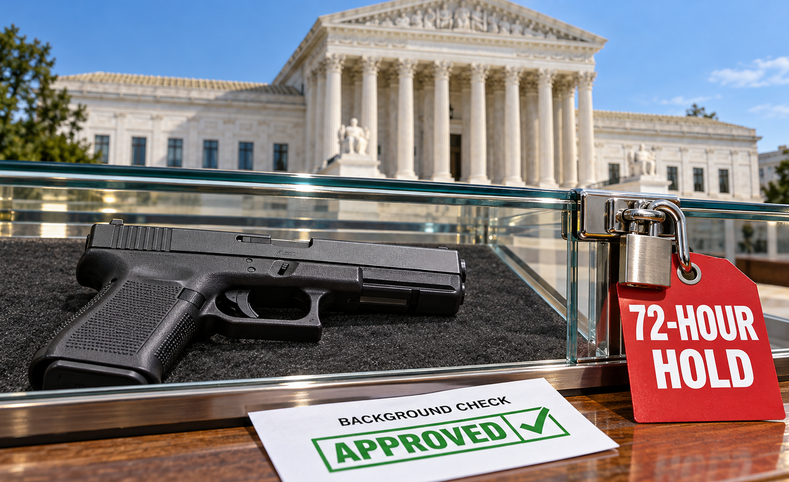
Under Maine's law, a seller can't hand over a firearm until 72 hours after the buyer and seller agree to the sale. The wait runs even if the buyer's background check clears right away. A gun bought at noon Monday can't go home with its owner before noon Thursday.
The law exempts some buyers and sales, including law enforcement and security personnel, dealers, certain family transfers, antique firearms, and sales that don't require a background check. Sellers who break it face civil fines of $200 to $500 for a first violation and $500 to $1,000 after that.
Montana Attorney General Austin Knudsen announced the coalition's friend-of-the-court brief Tuesday. It was filed September 28 in Beckwith v. Frey, a case brought by gun owners and businesses, and argues that the waiting period violates the Second Amendment even for buyers who have already passed a background check.
The challengers asked the Supreme Court to take the case on August 25. Maine has not defended the law there yet: Attorney General Aaron Frey's office filed a waiver on September 24 saying it won't respond unless the Court asks it to - a routine step, not a concession.
Watch: WMTW's August report on the petition.

How Maine Won Round One
The law took effect August 9, 2024, one of several gun measures Maine passed after the October 2023 Lewiston mass shooting. A federal judge blocked it in February 2025, but on April 3 of this year the First Circuit lifted that injunction, finding the law likely constitutional and sending the case back for further proceedings.
The appeals court's reasoning turned on the difference between buying a gun and keeping one. In its decision, the court held that restrictions on buying a gun fall outside the Second Amendment's text:
"laws regulating the purchase or acquisition of firearms do not target conduct covered by the Second Amendment's 'plain text.'"
The court didn't say every purchase restriction is immune from challenge. It treated the waiting period as a presumptively lawful condition on gun sales, similar to licensing systems that issue permits to anyone who meets objective criteria, and found the challengers hadn't shown the law was being applied abusively.
The States' Argument
That framing matters because of the Supreme Court's 2022 decision in New York State Rifle & Pistol Association v. Bruen. If the Second Amendment's text covers the conduct in question, the government has to justify its law by pointing to the nation's historical tradition of gun regulation. It can't simply weigh public-safety benefits against the burden on gun owners.
The coalition says Maine's law has to face that historical test. Its brief argues that keeping a qualified buyer from taking possession of a gun necessarily restricts the right to keep arms. Otherwise, the states warn, governments could regulate every step needed to exercise a right while dodging the scrutiny attached to the right itself.
The states also reject Maine's historical comparisons to licensing and intoxication laws. Those restrictions, they argue, targeted conditions a person could satisfy or avoid. Maine's wait applies even after a buyer has been cleared.
The NRA and Second Amendment Foundation filed their own brief urging review, citing 18th- and 19th-century newspaper advertisements and other records they say show buyers could routinely take a gun home immediately.
A Split Between Circuits
The Tenth Circuit reached the opposite conclusion on New Mexico's seven-day waiting period, holding that acquiring a firearm is protected conduct and that the delay is likely unconstitutional. The coalition argues the conflict between the two appeals courts is reason enough for the Supreme Court to step in.
The New Mexico win has limits. According to an August 28 statement from the Mountain States Legal Foundation, which represents the challengers there, the final injunction protects only its two named clients, Samuel Ortega and Rebecca Scott. Every other buyer in the state is still subject to the wait.
The law's supporters say the point isn't paperwork. The Maine Gun Safety Coalition argues that putting time between a purchase and access to the gun can prevent impulsive suicides and violence driven by short-lived anger or distress - risks a background check can't catch, because the buyer may be legally eligible.
The challengers point to the opposite risk. Their petition describes lead plaintiff Andrea Beckwith as a domestic-violence survivor who teaches firearms and self-defense to other survivors, and argues that a mandatory delay can leave someone who needs protection now unable to take home the gun they just bought.