Bring Your Own Power Plant: Goldman Now Sees Behind-The-Meter Powering 25% Of All Data Centers By 2030
For the past year we have been banging the same drum: if hyperscalers want to plug a city's worth of load into an already-strained grid, especially without being burned down to the ground by an angry mob after it has seen its electricity bill 10x in a year, they should bring their own power plant.
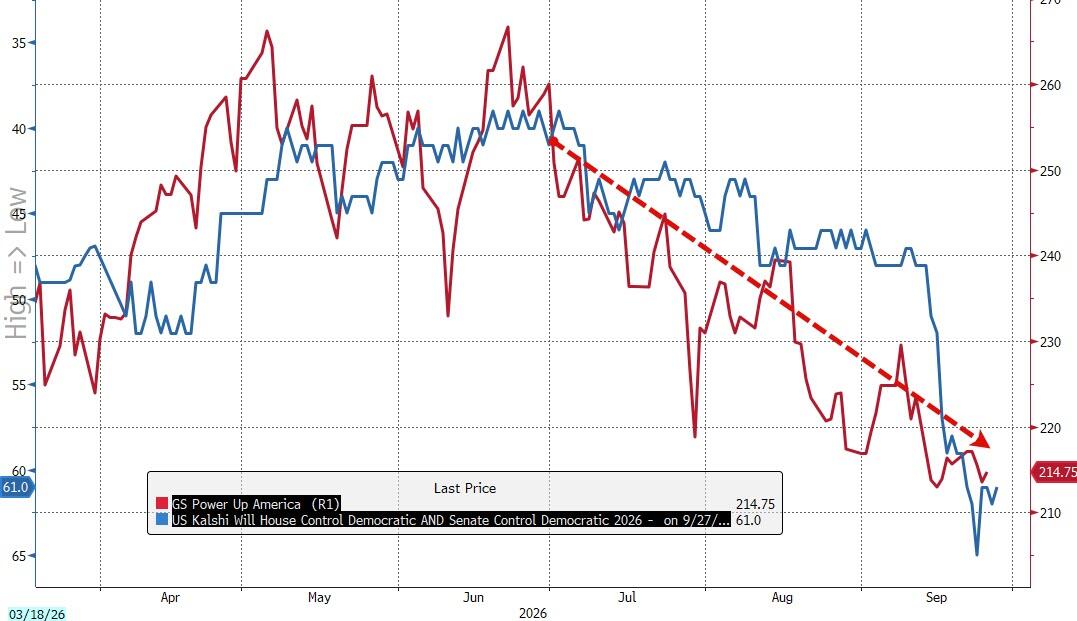
And 'AI Power' has been tracking lower as the odds of a Democratic Party sweep in the MidTerms rises...
Back in November, as electric bills began their now-familiar vertical ascent, we said it plainly:
To prevent skyrocketing electric bills, every state has to follow the Texas example: each data center must have its own "behind the meter" onsite power generation.
— zerohedge (@zerohedge) November 23, 2025
“We believe data centers should pay for the full cost of their power,” Dominion Energy spokesperson Aaron Ruby… https://t.co/0u1owTeAs8 pic.twitter.com/8W421s3rzV
A month later we dropped any pretense of nuance:
Make "behind the meter" mandatory https://t.co/ZEcmX5Ge0e pic.twitter.com/bCBnwx2E5g
— zerohedge (@zerohedge) December 24, 2025
It took a while, but Goldman has now fully joined the "make behind-the-meter mandatory" camp... or at least the "behind-the-meter is inevitable" camp, which is close enough.
In a new, fascinating 50-page Carbonomics report (yes, the bank's climate desk just wrote 50 highly combustible pages about the best ways to burn natural gas, more on that below) titled "Behind-the-meter power solutions for data centers: gas turbines, fuel cells and reciprocating engines", Michele Della Vigna's team raises its outlook for behind-the-meter (BTM) power generation for data centers from 40GW to 67GW by 2030, and now expects gas turbines, reciprocating engines and fuel cells to supply 28% of US and 25% of global data center power demand by 2030 - versus "effectively 0%" in 2025.
The reason is simple: there is not enough grid, and there won't be for years (and for those wondering, yes: it will cost a lot of money, which means much more debt is coming).
The demand side: another 170%
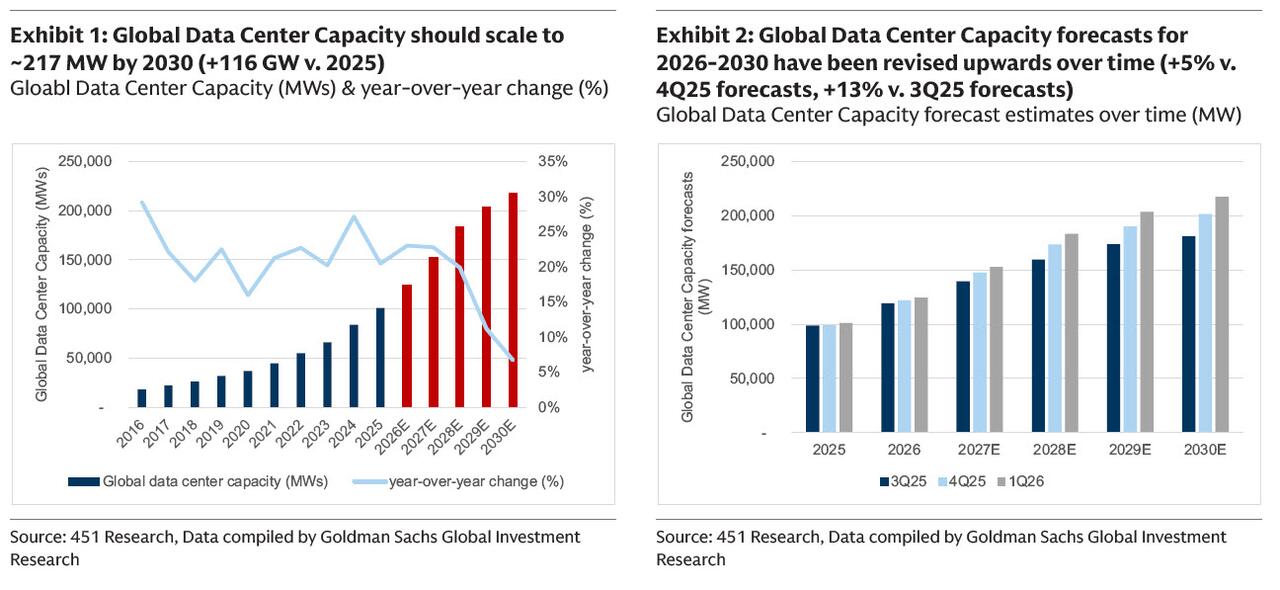
Back in July, Goldman's US Technology and GS SUSTAIN teams raised their global data center capacity forecast to 217GW by 2030, up from 101GW in 2025 (and vs. 168GW in their prior forecast), with the US alone expected to hit 108GW.
In power terms, the bank now sees 170% global data center power demand growth in 2030 vs. 2025 (up from 117% previously), more than 60% of which comes from the US.
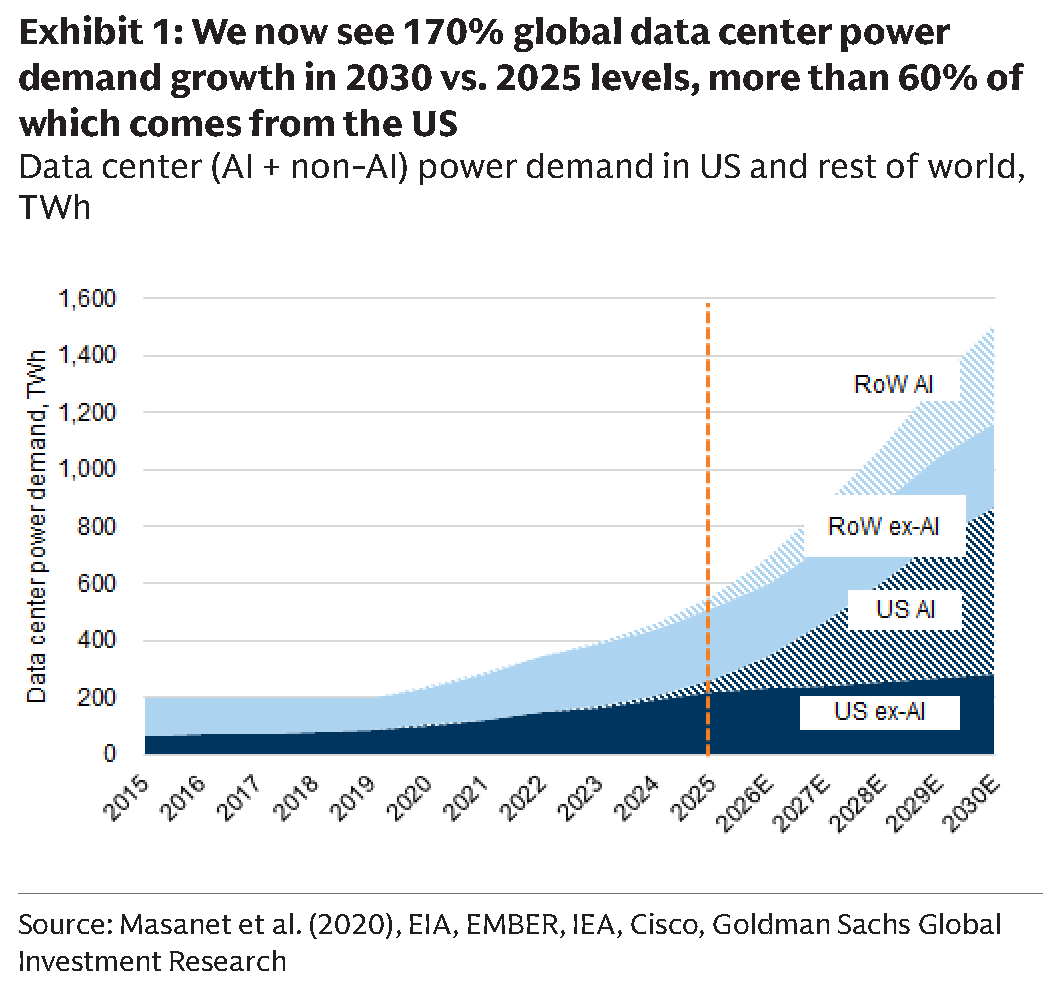
That, in turn, pushes Goldman's total power demand CAGR to 3.5% through 2030 - a number that would have been laughed out of any utility investor day just five years ago.
The supply side: the grid is not coming to save you
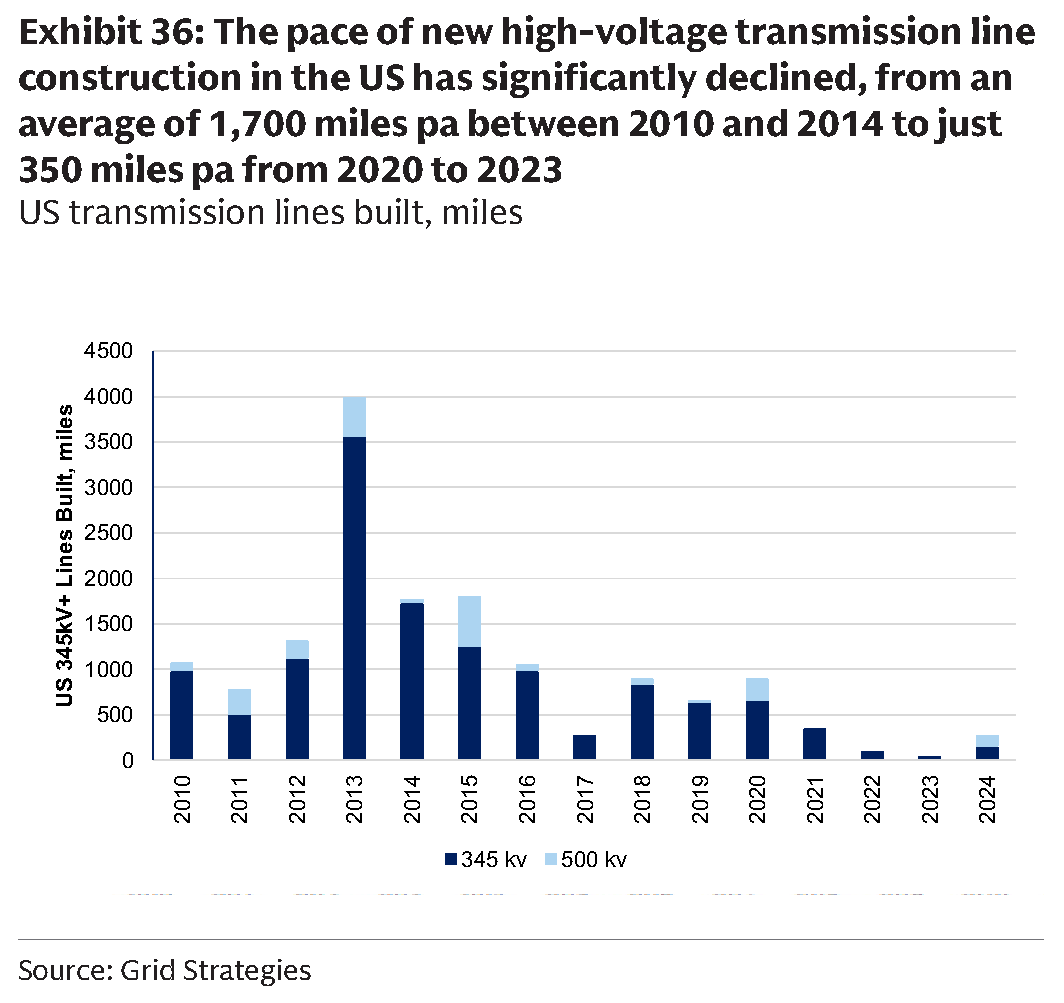
Here is where the report gets properly grim for anyone waiting patiently in an interconnection queue (recall a month ago we said that just Texas alone is facing 474GW of interconnection requests (ERCOT), of which 90% is data centers. Which is why gov Abbott froze rollout of new data centers in Texas). According to Goldman, the pace of new US high-voltage transmission construction has collapsed from an average of 1,700 miles per year in 2010-14 to just 350 miles per year in 2020-23, with only 55-125 new miles added in 2023-24. Meanwhile, the median time from interconnection request to commercial operation is now approaching 5 years.
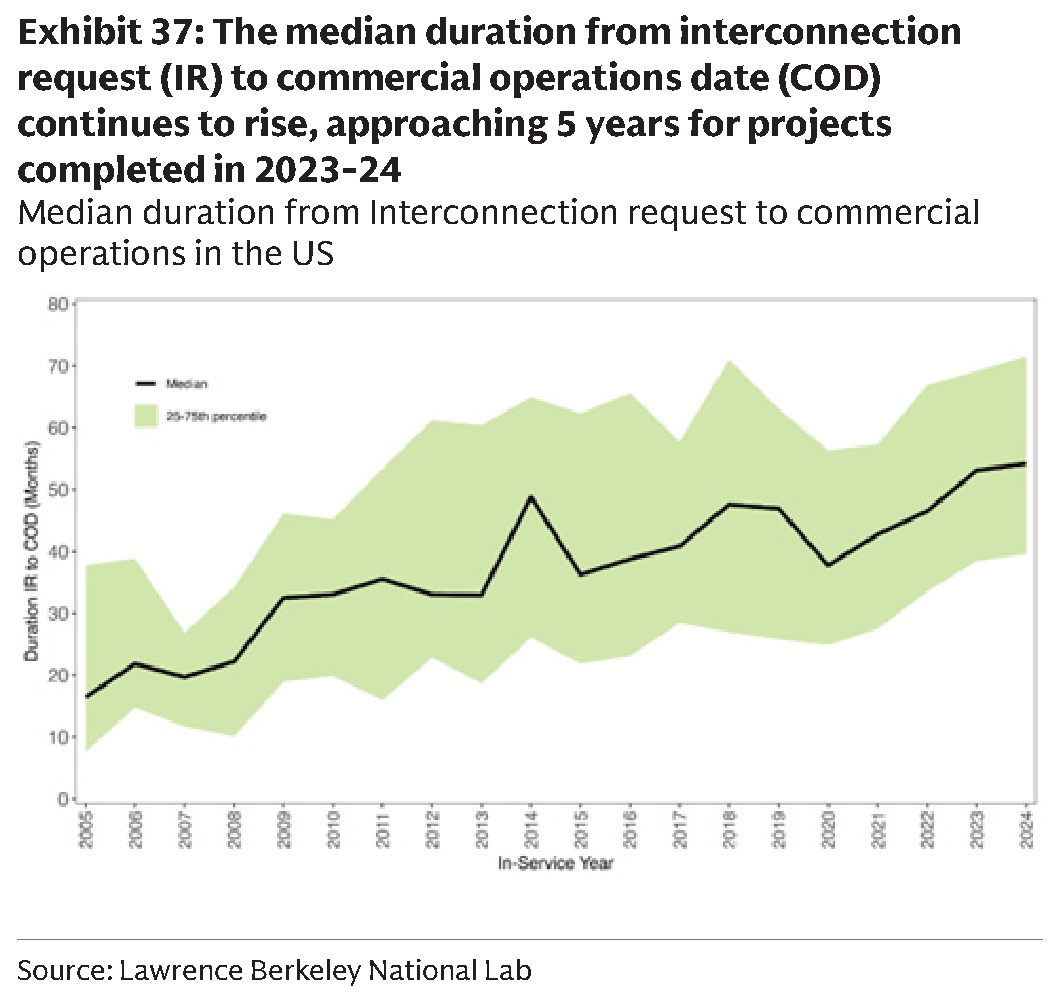
And the grid-side outlook is actually the optimistic read. INNIO, one of the engine makers profiled in the report, says grid connection times have stretched from ~2 years historically to 7+ years today, which is why hyperscalers are now signing 15-year contracts for BTM power. When the alternative is waiting until the next decade to switch on a multi-billion dollar campus, "temporary" on-site power has a way of becoming permanent (as we noted in "Why Data Centers Favor On-Site Gas Power", the marginal cost of running an on-site gas plant may well end up below industrial tariffs anyway).
There is also the ratepayer angle, which is the whole reason we started pounding the table on BTM in the first place. Every GW that a hyperscaler generates on site is a GW that doesn't get socialized into Grandma's electric bill, and with 142 anti-data-center rallies across 42 states this summer (see "The Data-Center Revolt Goes National" from July 19), the political cost of not doing BTM is only going up, and is virtually assuring
So how big does BTM get?
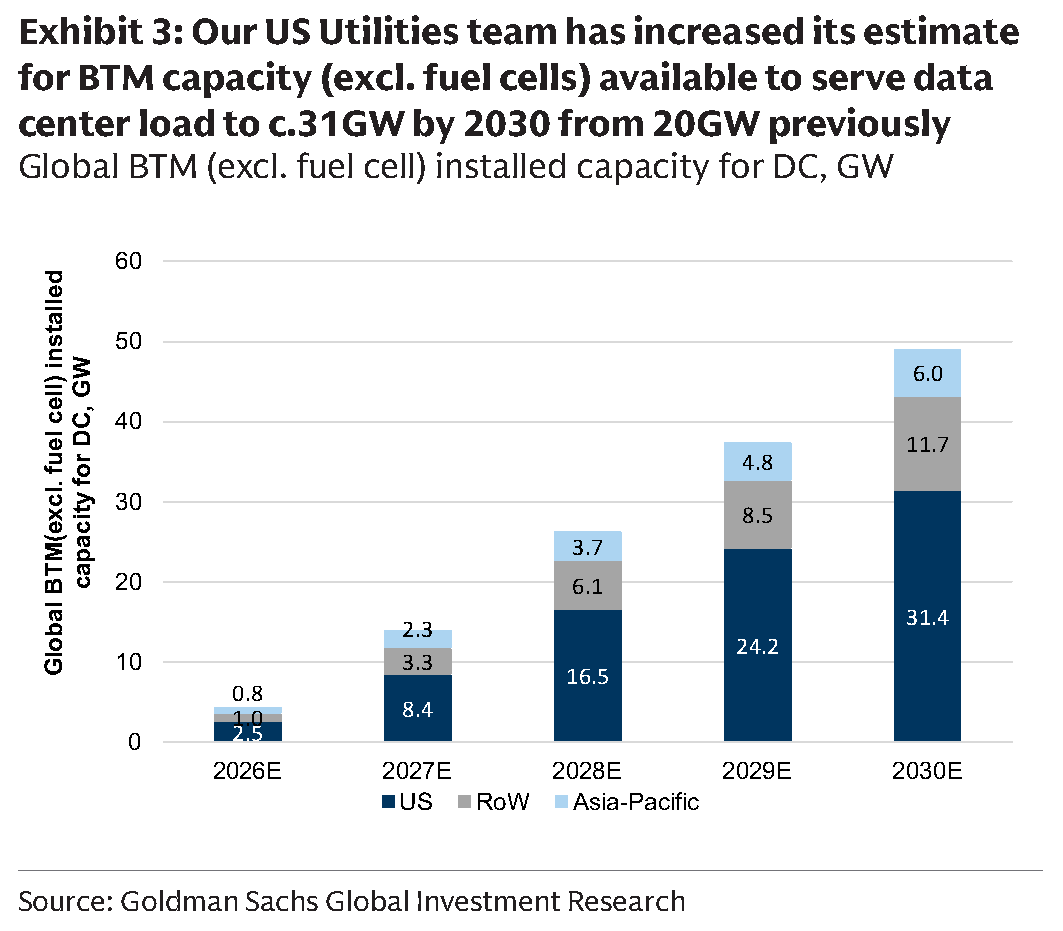
Goldman's US Utilities team raised its estimate of Behind-The-Meter capacity (excluding fuel cells) available to serve data center load to 31GW by 2030 from 20GW previously, corresponding to 22GW of delivered power vs. 14GW before. Globally, gas-BTM capacity for data centers hits almost 50GW by 2030.
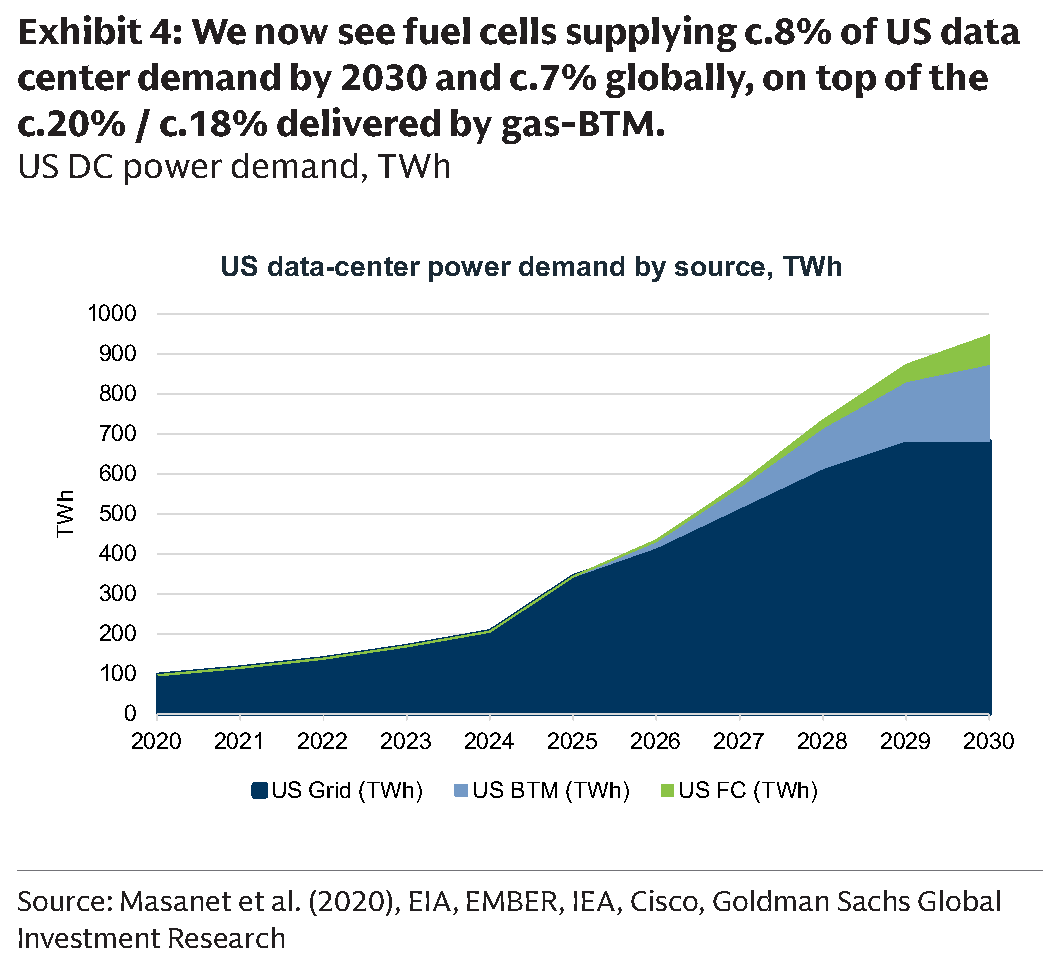
On top of that, Goldman now models a separate pool for fuel cells, which it sees supplying 8% of US data center demand by 2030 (7% globally), on top of the 20% / 18% delivered by gas-BTM. In installed terms, that's 12GW of fuel cells in the US and 18GW globally by 2030, from a de minimis base today, translating into a cumulative equipment TAM of $35bn in the US and $55bn globally, with a recurring service and stack-replacement stream on top.
Regular readers will recall that back in February, in "Fuel Cells Poised To Capture 1/3 Of Data Center Power Demand By 2030", we covered Goldman's first pass at this, when the bank estimated 7-19GW of fuel cell capacity would be needed by 2030. The new 12GW US / 18GW global numbers sit at the top end of that range, which Goldman says gives it "higher conviction in both the level and the composition of the addressable market."
Why LCOE no longer matters (much)
Here is the part of the report that should make every utility-model spreadsheet jockey slightly uncomfortable. On pure cost, fuel cells are the worst option on the table. Goldman's LCOE (Levelized Cost of Energy is the average cost to build and operate a power plant per unit of electricity generated over its entire lifecycle) work for a 500MW data center shows reciprocating engines at $80/MWh, CCGTs at $81/MWh, OCGTs at $91/MWh and fuel cells at a hefty $117/MWh - roughly 45% above CCGT and RICE and c.30% above OCGT (at $4/mmbtu gas). Even with the 30% ITC, fuel cells only get down to $90/MWh.
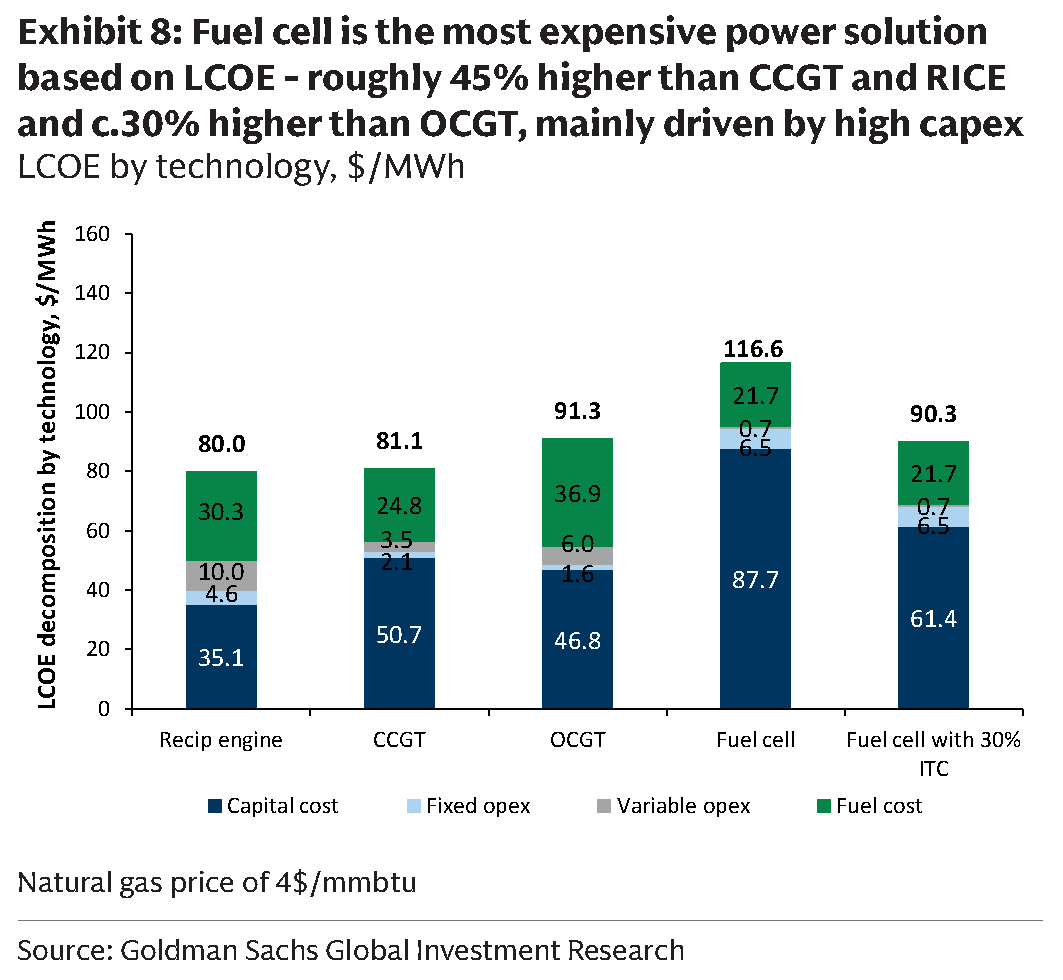
The culprit is capex: Goldman assumes installed costs of $1,800/kW for recip engines, $2,400/kW for OCGT, $2,600/kW for CCGT and a whopping $4,750/kW for fuel cells (the ITC takes the fuel cell system down to ~$2,700/kW). Note also that CCGT costs have gone from ~$1,300/kW in 2023 to $2,000-2,200/kW in 2025, with post-2030 deliveries approaching $2,500/kW - turbine inflation is doing the fuel cell salesmen's work for them.
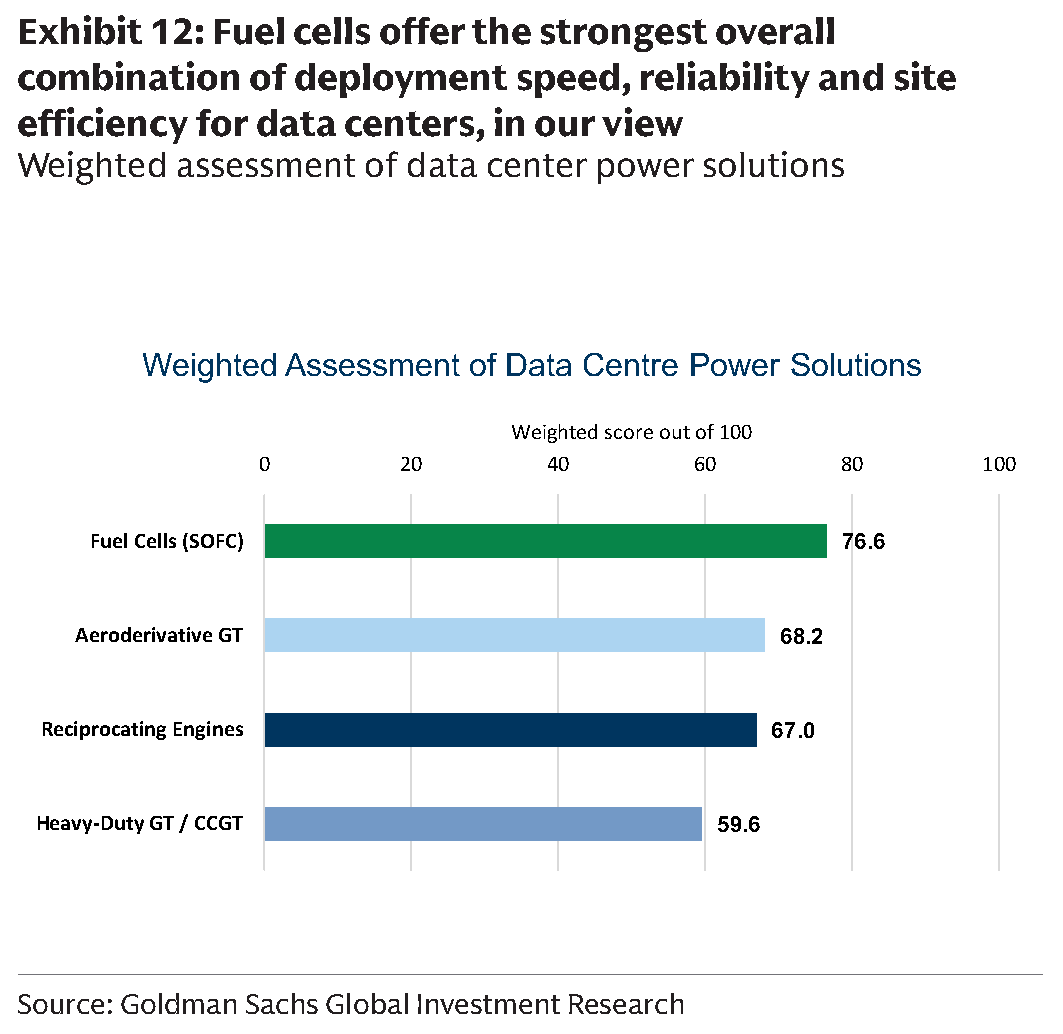
And yet fuel cells win Goldman's weighted scorecard, with a score of 76.6 vs. 68.2 for aeroderivative turbines, 67.0 for recip engines and 59.6 for heavy-duty GT/CCGT.
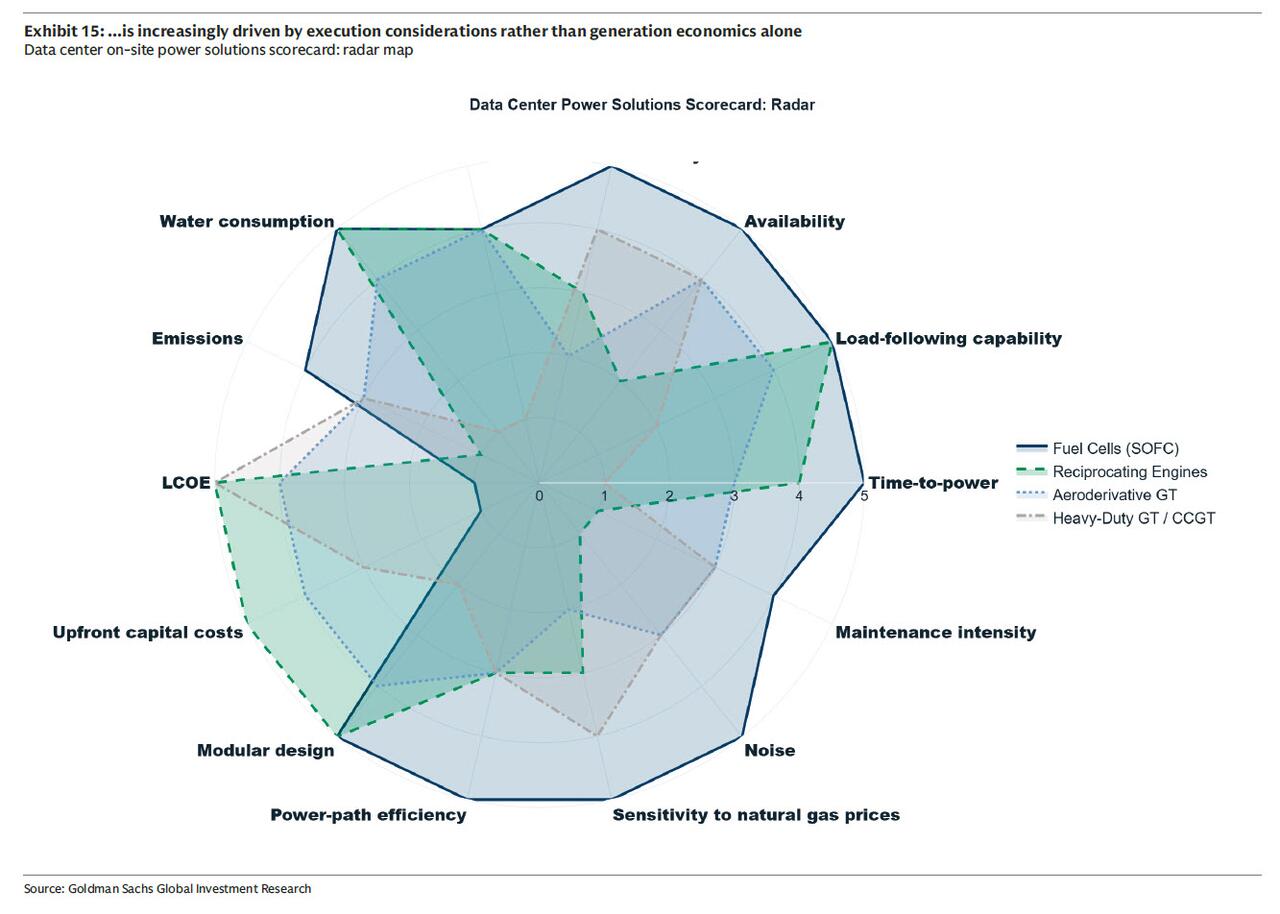
The radar version of the same scorecard shows the trade-off even more clearly. Fuel cells (solid dark blue) max out on time-to-power, availability, load-following, power-path efficiency, water use, noise and sensitivity to gas prices, then collapse toward the center on the two metrics utilities have traditionally cared about most: LCOE and upfront capital costs. Recip engines (green dashes) are close to the mirror image, with top marks on cost, modularity and load-following but near-bottom scores on maintenance, noise and emissions. And the heavy-duty turbine/CCGT, the workhorse of every utility IRP for the past 30 years, scores well on LCOE, availability and efficiency, but ends up close to the center on time-to-power, which is the one axis that matters when the order book runs to 2031.
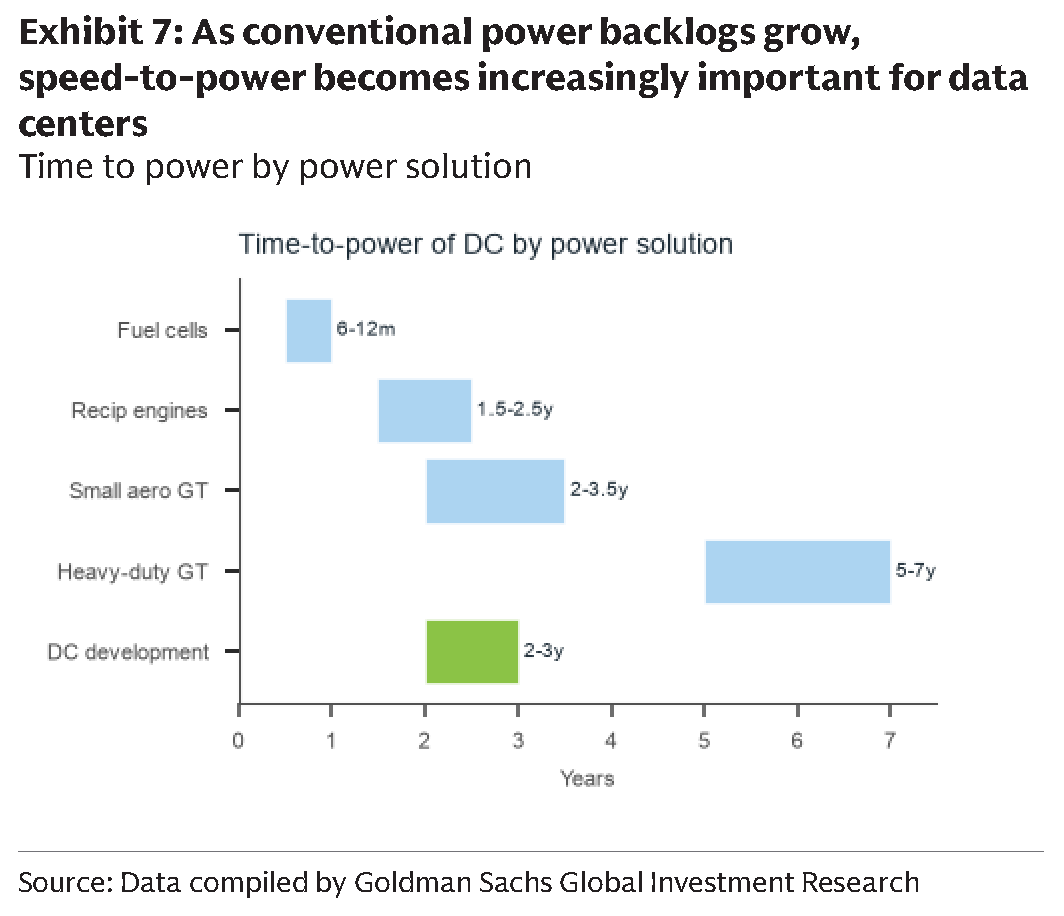
Why does the most expensive option win? Because the scorecard weights time-to-power at 20%, availability at 15%, LCOE at 15% and upfront capex at 10%, and when it comes to time, nothing else comes close. SOFC manufacturers quote 6-12 months from order to power. Recip engines are now 1.5-2.5 years. Heavy-duty gas turbines? 5-7 years, vs. 2-3 years in a "normal" market.
Bottom line: if you want power soon, you're gonna pay. A lot.
Bloom Energy (not covered by Goldman) summed up the new math on its 2Q call better than any LCOE model could: customers now think in terms of "total cost of power to token revenue," and one month of earlier power availability for a 1GW data center could be worth $1-2 billion of revenue. At those numbers, a $37/MWh premium over a CCGT is a rounding error. No wonder Bloom stock ripped to record highs after it blew out estimates and hiked guidance in April (see "Bloom Energy Erupts On Beat, Guidance Upgrade As On-Site Data Center Power Demand Soars" from April 29).
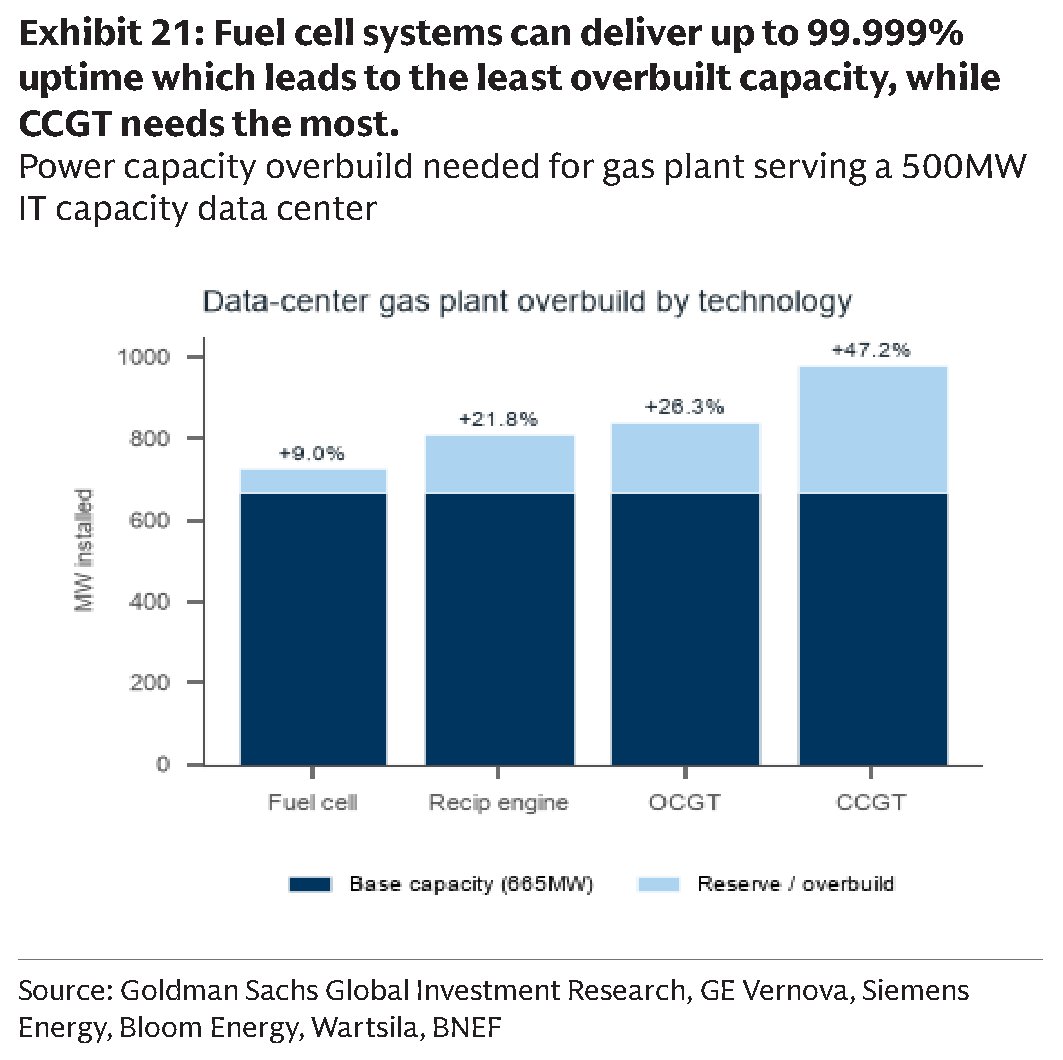
Two more wrinkles work in the fuel cells' favor. First, they need the least overbuild: to serve a 500MW IT load, Goldman estimates fuel cells need just ~9% excess capacity (c.725MW installed) vs. +22% for recip engines, +26% for OCGT and a massive +47% for CCGT (c.979MW).
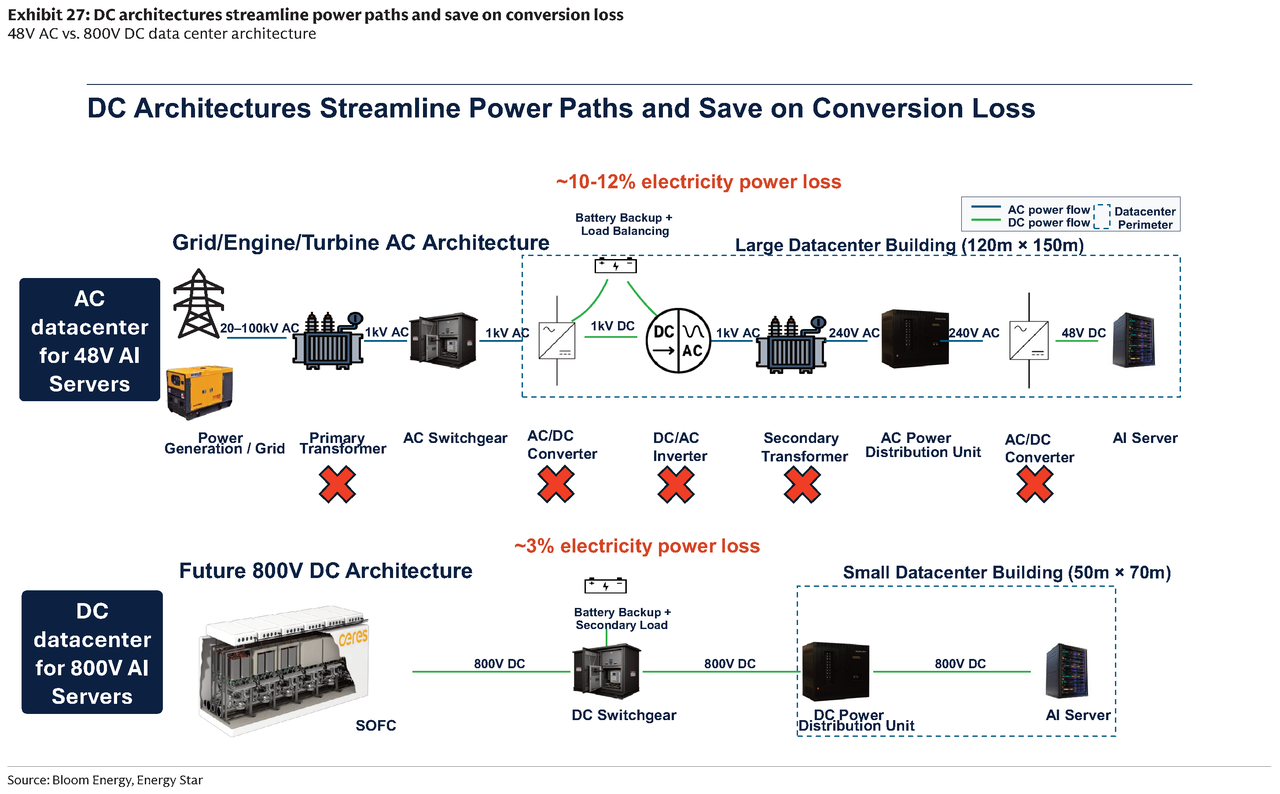
Second, fuel cells spit out DC power, which plugs straight into Nvidia's push for 800V HVDC rack architecture and skips the transformer/converter/inverter chain that currently loses ~10-12% of electricity along the way (vs. ~3% in the DC design).
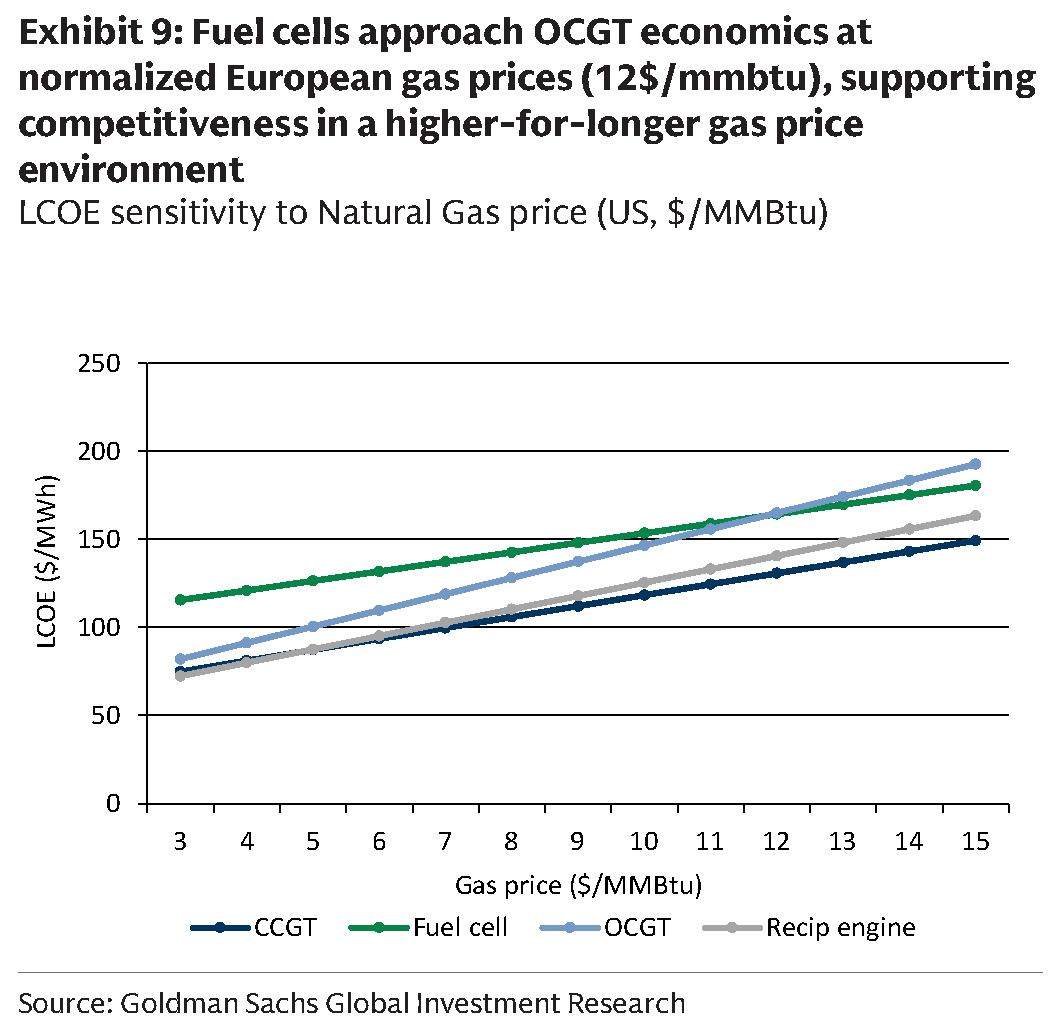
Finally, for those who believe (as we do) that natgas prices aren't staying at $4 forever, fuel cells have the lowest sensitivity to the fuel bill thanks to their ~60% electrical efficiency. At around $12/mmbtu - close to Goldman's normalized 2027 TTF estimate of c.$11 - fuel cell LCOE converges with single-cycle gas turbines.
The turbine queue: "now taking reservations for 2031"
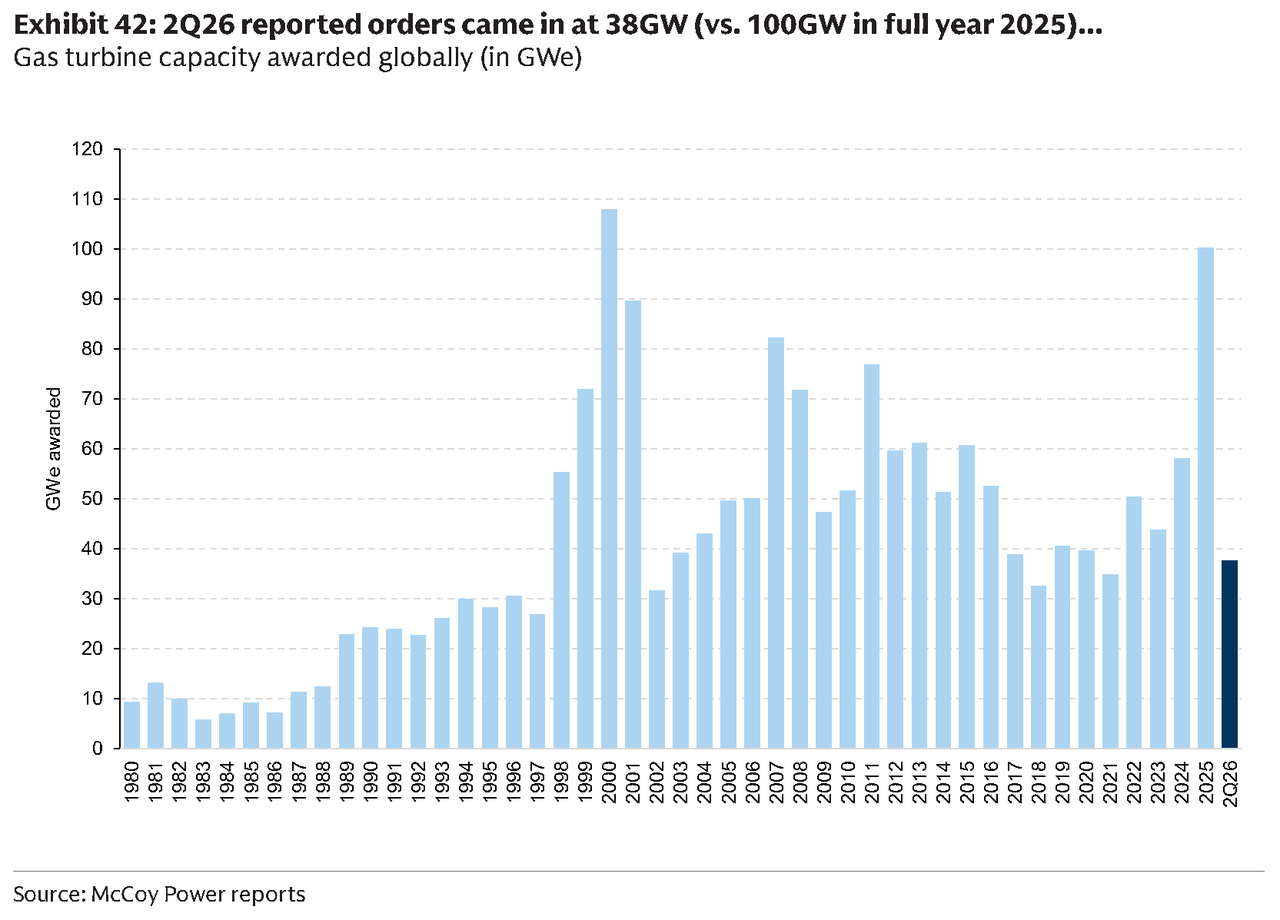
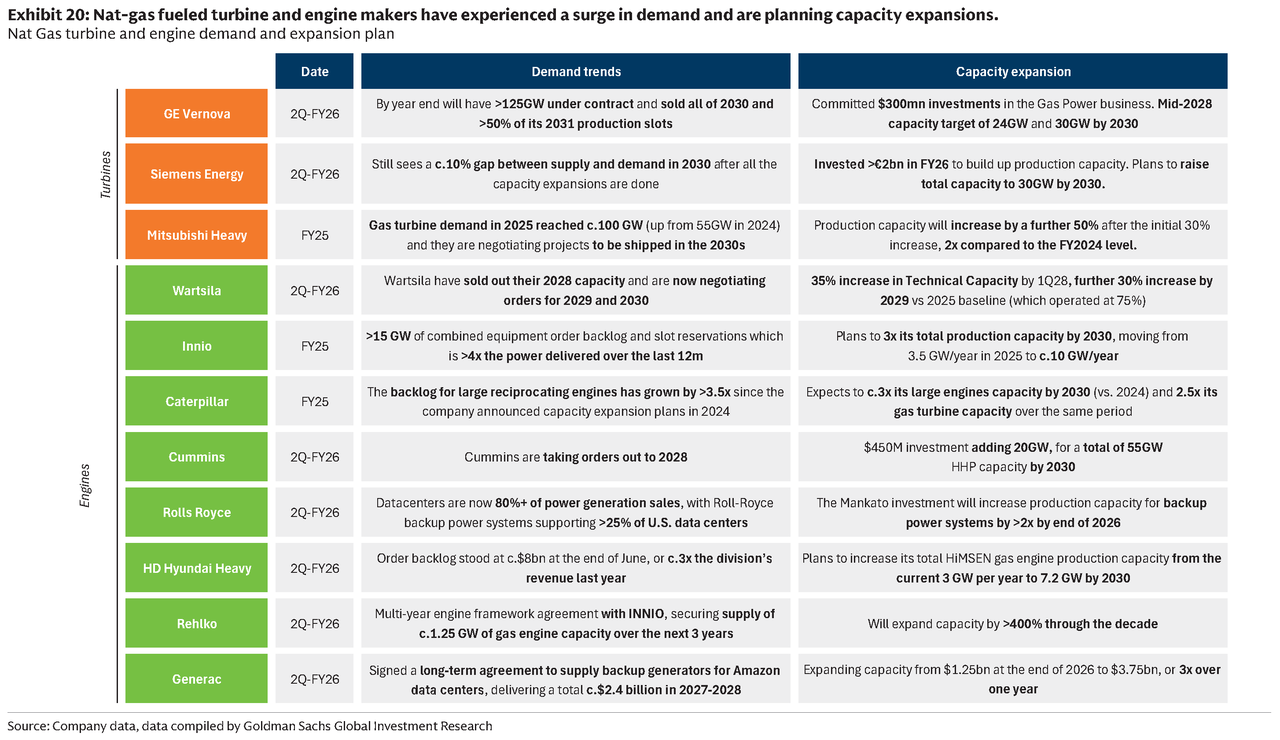
Of course, the main reason fuel cells, recip engines and even refurbished boilers are all suddenly in vogue is that the gas turbine market is sold out. Goldman notes that global gas turbine awards hit 100GW in 2025 (vs. 55GW in 2024), and 2026 is tracking even hotter with 67GW booked YTD (38GW in 2Q alone).
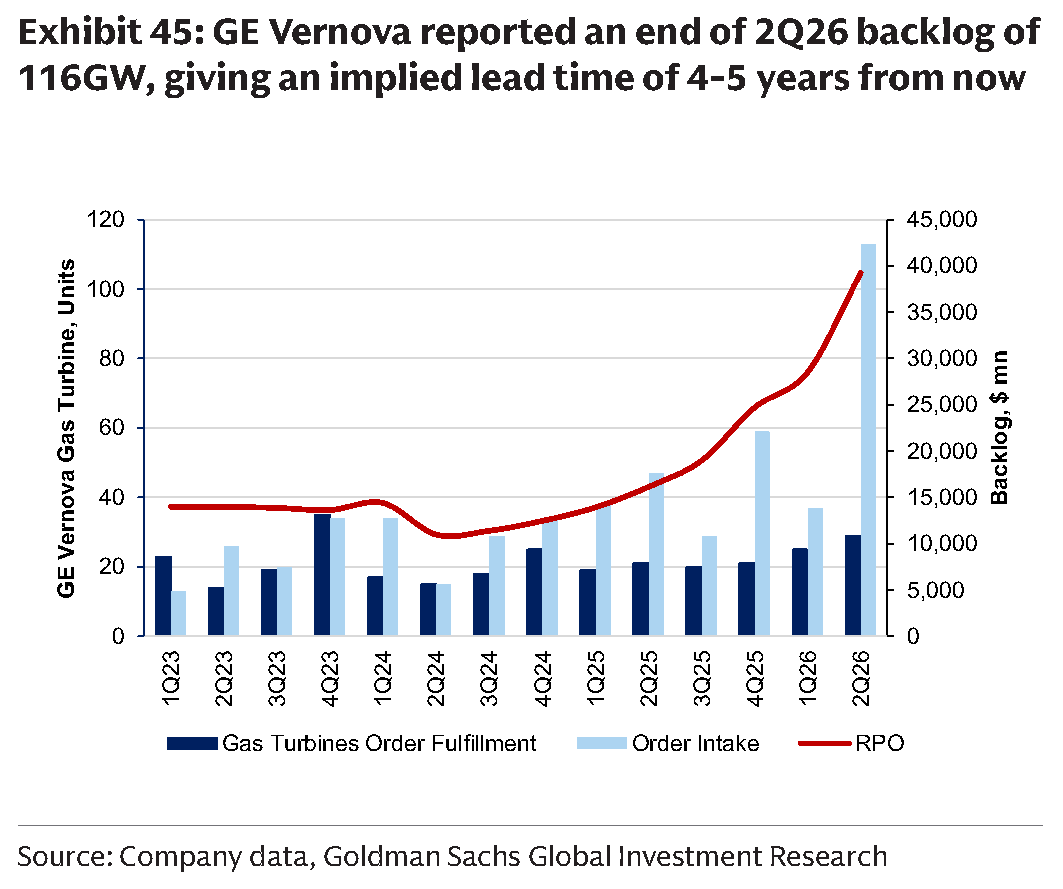
GE Vernova's backlog plus slot reservations reached 116GW at the end of 2Q26, and the company expects >125GW by year-end with all of 2030 sold and >50% of 2031 production slots on contract - which is why, back in July, we titled our GEV earnings recap "Now Taking Reservations For 2031 Delivery". Siemens Energy has accumulated 87GW of commitments, 24GW of which are data center related, and still sees a ~10% supply-demand gap in 2030 after all announced expansions. MHI is already negotiating projects to ship in the 2030s.
The engine makers are no better off: Wärtsilä has sold out 2028 and is negotiating 2029-30 slots; INNIO's backlog plus reservations is >15GW, more than 4x trailing 12-month deliveries (and it just booked a 1.1GW prime-power order for a single megascale data center); Caterpillar's large-engine backlog is up >3.5x; Cummins is taking orders out to 2028; and Rolls-Royce says data centers now account for 80%+ of its power generation sales.
 dc
dc
The desperation is palpable: last month Elon Musk's SpaceX moved to build its own turbine blade factory in Texas to break the bottleneck ("Profound Game-Changer", August 29), and AI developers have gone full 19th century, reviving industrial boilers and steam turbines just to get something spinning before 2032 ("Gas Turbine Shortage Sends AI Developers Back To Boilers And Steam").
...and fuel cells aren't immune either
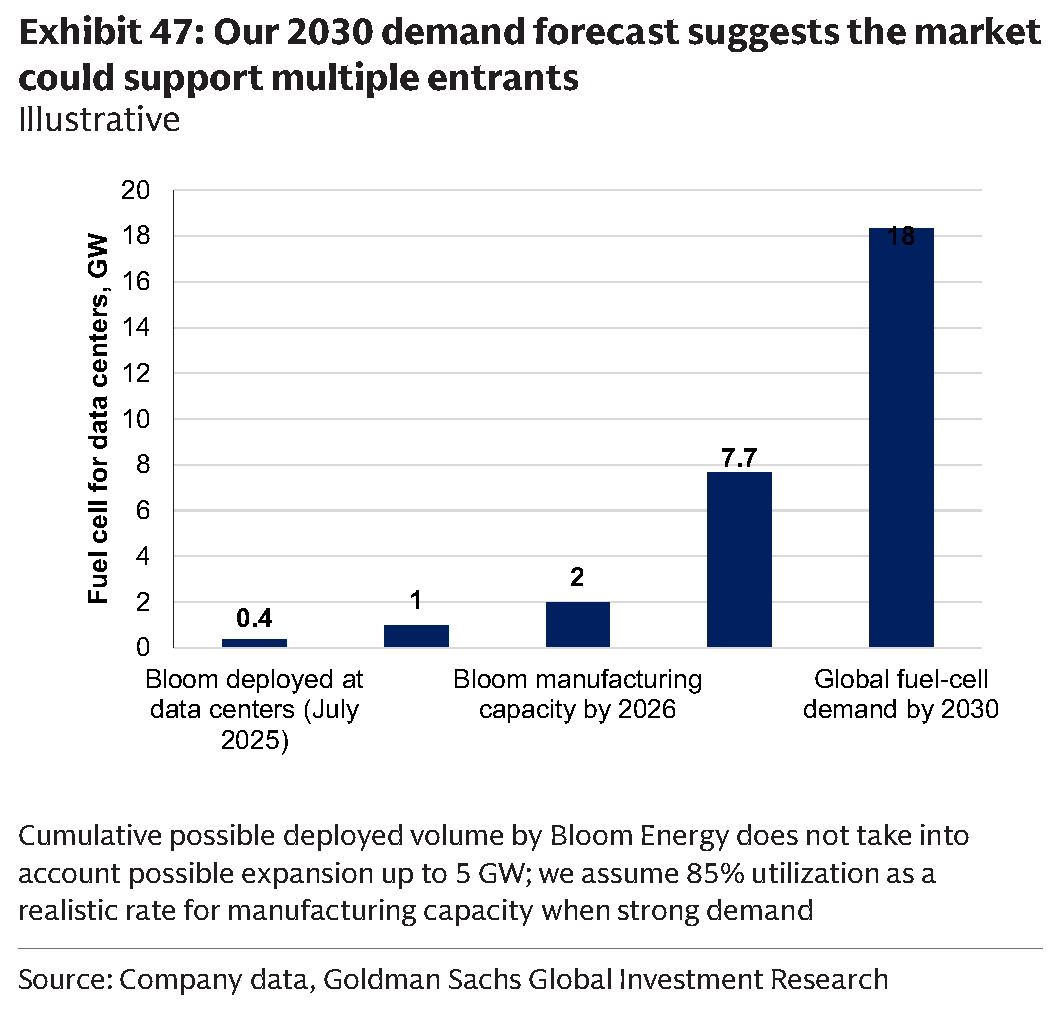
Before anyone concludes that fuel cells are the silver bullet, Goldman's own supply math tells a different story. Bloom's new 2GW production line, assuming full ramp and 85% utilization, would deliver a cumulative ~7.7GW by 2030 - well short of the ~18GW Goldman forecasts is needed. Getting there requires ~3.8GW of installations per year globally, which means multiple manufacturers (Ceres Power licensees Doosan, Delta, Weichai and whoever else signs up) all scaling at the same time. Doosan's dedicated Ceres-tech facility, for reference, currently has 50MW of annual capacity.
In other words, even the "fast" solution is set to be capacity-constrained for years. And let's not forget what these boxes actually run on: natural gas. The fuel cell is cleaner and quieter than a turbine, and it's great that Goldman's Carbonomics team has found a way to love a methane-powered data center, but at the end of the day every one of these BTM solutions is a bet on cheap, abundant gas and pipeline access. Which brings us to...
The long-term answer: go nuclear, go modular
Buried on page 6 of the report is the sentence that matters most for anyone thinking beyond 2030. Goldman lists small modular reactors among the viable BTM options, noting that they are "reliable and relatively cheap over the long run," but concludes that "owing to their long investment cycle, the majority of the investments from data centers are unlikely to result in their realization before 2030."
We agree with the timing, and that is precisely the point. Everything in this report - turbines, recips, fuel cells, even gas - is a bridge. It is the best bridge available, and we'd make it mandatory tomorrow, but it is a bridge built on 5-7 year turbine queues, capacity-constrained fuel cell lines, and the assumption of $4 gas forever. The only permanent, scalable, fuel-price-insensitive, zero-emission, genuinely behind-the-meter solution for a 1GW AI campus is a modular reactor sitting on site.
That's why we have long argued that modular reactors such as those being developed by NANO Nuclear are the only long-term solution to the data center power crunch. As we previously reported, NANO's KRONOS micro modular reactor - designed to produce 15 MWe (45 MWth) - began drilling at the University of Illinois, with the reactor explicitly targeting data centers, industrial sites and military applications. And just last month, NANO signed a commercial framework with Tillman Digital Gateway to deploy modular reactors across US data center campuses, targeting 2GW by the mid-2030s and 6GW by 2040 ("Nano Nuclear Energy Signs Commercial Framework With Tillman To Enable Nuclear Power For Data Centers", August 24). As NANO CEO James Walker put it, "power availability is becoming one of the defining constraints on the continued expansion of AI infrastructure."
In fact, if you line up Goldman's timeline with the SMR developers', the handoff almost writes itself: gas-BTM and fuel cells carry the load through 2030 (and absorb the ratepayer backlash), while modular nuclear scales into the 2030s just as the first generation of on-site gas assets comes up for recontracting and gas prices do whatever gas prices do. (For more on why the "nuclear renaissance" keeps coming back to small reactors, watch our ZH debate on the topic of "Modular Reactors To Solve Data Center Hysteria?" from July 8).
Stock exposure
For those looking for the trade, Goldman's Buy-rated names most leveraged to the BTM theme are:
- Fuel cells: Ceres Power (CWR.L, PT 930p) - asset-light licensing model, with royalties seen reaching £99mn (base) to £178mn (upside) by 2030 and EBIT margins going from loss-making to ~50%; Weichai Power (2338.HK, PT HK$55) - holds a 17.8% stake in Ceres, targets 700MW+ of SOFC capacity by 2030, and every GW shipped adds an estimated Rmb3.5-4bn of net profit; and Delta Electronics (2308.TW, PT NT$4,120) - pilot SOFC production by end-2026, mass production in 2027-28.
- Conventional gas BTM: GE Vernova (GEV, PT $1,268), Siemens Energy (ENR1n.DE, PT €212), Mitsubishi Heavy Industries (7011.T, PT ¥6,200) and INNIO.
And, of course, for those who, like us, think the real endgame is nuclear, there are plenty of names that we have been flagging for a while which aren't in Goldman's report at all - that would be the entire nuclear modular space - and which is trading between 50% and 80% lower compared to a year ago.
The full 50-page Goldman Carbonomics report is available to pro subscribers.