Flock Camera Ping Jails Innocent Woman For 13 Days
Authored by Steve Watson via Modernity News,
A 23-year-old Palm Coast Florida woman spent 13 days in a Volusia County jail cell facing life in prison after Florida Highway Patrol troopers treated a Flock Safety camera hit like a confession.
Lindsey Brooke Isaacs did not cause the crash. Her black Dodge Durango had no collision damage. A 911 caller had already described a maroon Durango and a partial plate that was not hers. None of that stopped the machine-assisted hunt.
The October 4, 2025 hit-and-run on eastbound I-4 near DeBary killed motorcyclist Joaquin Deno, Flagler County Deputy Administrator Jorge Salinas, and Salinas' wife, Nancy. A fourth person was badly hurt. Witnesses described a Dodge Durango fleeing the scene. Investigators searched nearby Flock cameras for a black Durango and found Isaacs' tag, RJVN10, crossing the Seminole-Volusia line at 9:51 p.m., about three miles west of a wreck that started around 9:53 p.m.
Innocent Florida woman spent 13 days in jail after cops' use of Flock cameras incorrectly blamed her in fatal hit & run pic.twitter.com/bOWCKDpV2u
— Tom Elliott (@tomselliott) September 17, 2026
That ping became the case.
Troopers later pounded on Isaacs' door while she was asleep. "I thought I was getting set up. I didn't understand what was going on," she said. They seized the Durango for months and claimed "marks" consistent with the crash.
Photographs later showed an immaculate 2025 SUV. "Where is the damage on the vehicle? Because I'm standing right in front of it and I don't see any damage," Isaacs recalled.
On April 17, 2026, FHP booked her on eight felonies, including three counts of vehicular homicide and three counts of leaving the scene of a crash involving death. She was held without bond, then sat in G Block for 13 days. "Being incarcerated, falsely incarcerated, in jail, in G Block, was the worst 13 days in my life," she said. "I was devastated, I was scared. I thought my life was over."
Attorney Patrick McGeehan did the work the camera search replaced. A time-and-distance analysis using the same Flock timestamp put Isaacs past the crash site when the collision happened. "In Lindsey's case, there was nothing indicating that she was ever there," he said.
A 911 caller described a maroon Durango and the partial plate "458." Paint transfer on a struck Ford Focus was maroon. Isaacs' plate did not match. Witnesses had described three different vehicles: black, white, and maroon. "For some reason, [Florida Highway Patrol] never went past the black Dodge Durango," McGeehan said. "They hooked onto this black Dodge Durango to the exclusion of everything else." He called it "confirmation bias, to the highest degree" and "a major failure of basic investigative skills."
"Lindsey wasn't even at the crash scene," he told NewsNation. "These were investigators that got it in their mind that there was a black Dodge Durango involved. They got on Flock, found the first black Dodge Durango, that belonged to Lindsey Isaacs, and pinned that on her."

On May 22, 2026, prosecutors dropped every charge. The same day, they arrested 47-year-old Alisa Lee Montalvo of Deltona, whose maroon Durango and plate beginning 458 lined up with the original 911 call.
Authorities say her SUV had crash damage, she paid a mechanic to replace doors, pull airbags, and change tires, and an event data recorder later showed roughly 112 mph seconds before impact. Montalvo faces nine counts, including vehicular homicide and tampering with evidence. She has pleaded not guilty. Those charges remain allegations.
Isaacs walked out with a ruined name and a federal lawsuit against FHP Sgts. Tiffany Jateff and Joshua Buday, alleging false arrest and malicious prosecution. "I have to carry this like a big bag of bricks for the rest of my life," she said. "I'm still receiving death threats and hate." She is not suing Flock. She blames how troopers used the footage. "They just picked up my car off a camera and called it the end of the day. We got her."
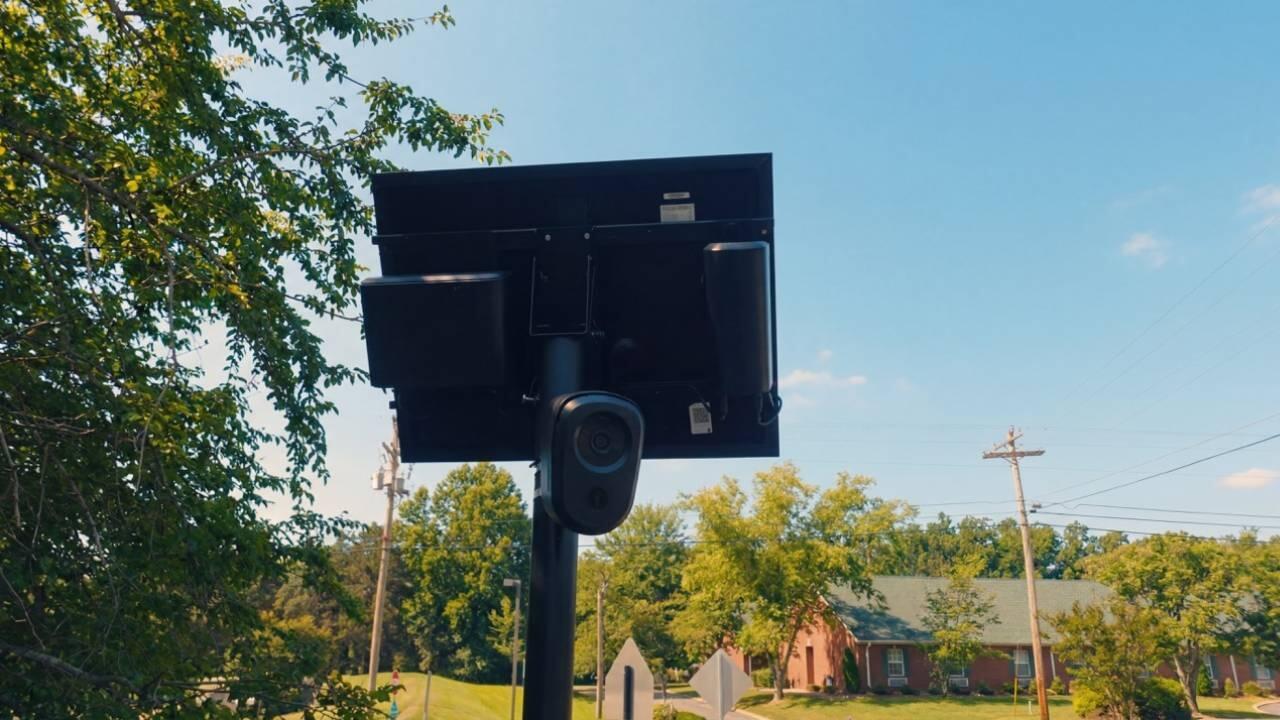
Flock's answer is corporate and tidy. "Flock cameras provide investigative leads; they do not identify perpetrators, determine guilt, or make arrest decisions," a spokesperson said. The company notes Isaacs' own complaint calls the camera record "exculpatory, not inculpatory," because it placed her three miles away two minutes before the crash.
This is the dragnet Gov. Ron DeSantis ordered off state highways. FDOT revoked every permit for Flock units and other automated plate readers in state right-of-way and gave agencies 30 days to pull them. Miss the deadline, and state crews tear the poles down.
"I think these cameras, the license plate readers, I think it's out of control," DeSantis said. He drew the line most voters can understand. "I'm all about having law enforcement have tools to be able to hold criminals accountable... But I don't want to have this become a surveillance state." On another stop: "What we don't want in the state of Florida is to have a digital AI surveillance state where everything we're doing is being tracked at all times." His example was a drive to Buc-ee's. "It's really none of the government's damn business if you're doing that, right?"
Isaacs' case is that argument with a booking photo attached. A tool sold as an Amber Alert machine became a nationwide movement file. Officers in Florida have already used the same network as a stalking app - hundreds of plate runs on exes and partners in Haines City, Sarasota, Sumter, Orange City, Monroe, and Brevard. Texas froze state funding after similar abuse. Cities from Dallas to El Paso to Clark County, Wisconsin, have cut contracts or bagged the lenses.
Knox County, Tennessee, Mayor Glenn Jacobs, the former WWE star Kane, got there first on the product itself. He thought Flock was a passive hit-on-a-hot-list reader. Then he read the contract.
"What I discovered is these things are completely different than that," Jacobs said. "Instead of a passive system... these cameras are an active system that's pulling data from every car that drives by." The snapshot feeds an AI "vehicular fingerprint" - make, model, color, roof racks, bumper stickers. He told Flock the 2020 Knox County deal was invalid after purchases blew past the $100,000 threshold that required County Commission approval, and he refused to renew more than 140 cameras.
"The lack of transparency surrounding Flock's rollout is one of the most troubling aspects about all this," he posted. "It's sure seems like there was a sprint towards a fait accompli before the public took notice."
McGeehan's verdict on the Florida grid is shorter. "It's a good tool, but now it's unrestricted. It's the Wild West of Flock."
Isaacs used to think they were traffic cameras. "I feel very different about those cameras now," she said. "It's like, they're watching me. They're watching, you know? They're watching everybody."
That is the product. A searchable history of who drove where, handed to whoever has a login, and treated in this case as enough to put an innocent woman in a cell for three deaths she did not cause. Targeted tools for actual criminals are not the argument. A warrantless travel dossier on every driver is.
* * *