SoftBank To Sell $11 Billion In Junk Bonds At Soaring Yields To Fund OpenAI Investments
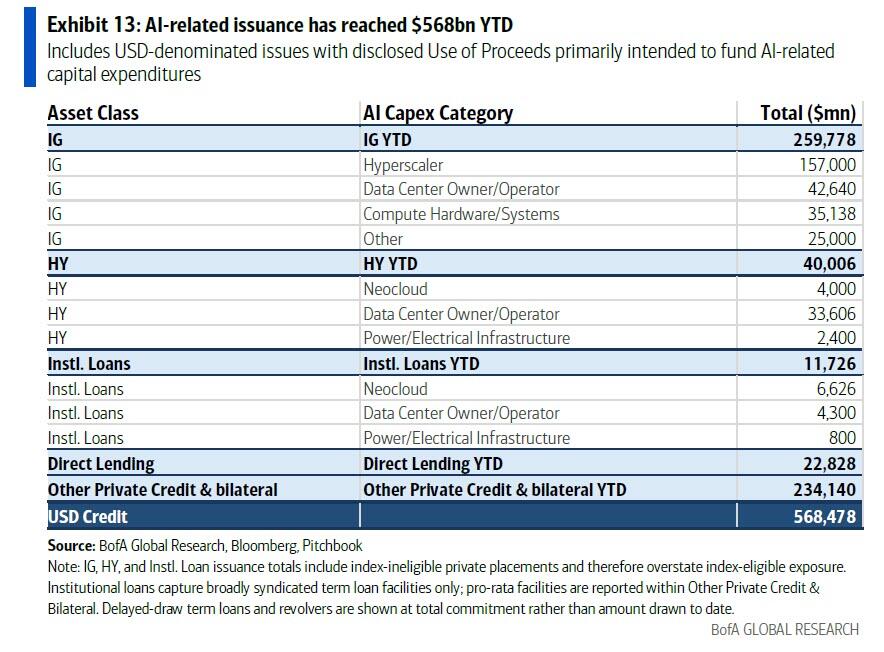
It's only appropriate that just hours after we published an extensive report looking at the trillions in debt funding the AI supercycle - which just this year stands at $568bn, of which $259bn issued in IG, followed by $256bn across Private Credit, Direct Lending, and other bilateral/non-syndicated lending (for SPVs and infrastructure finance), another $40bn for HY and $11bn for institutional loans...
... that SotBank launched what Bloomberg dubbed "one of the biggest junk bond deals ever", as the Japanese conglomerate seeks the equivalent of more than $11 billion in high yield debt as Masayoshi Son’s conglomerate ramps up its investments in ChatGPT creator OpenAI.
If SoftBank sells about $11 billion in debt it would be one of the largest junk bond sales ever by a single firm, excluding distressed debt exchanges. The near-record offering would come in 5 tranches: the company is looking to issue $10 billion of dollar securities across three tenors, and €1 billion ($1.1 billion) of euro debt across two maturities, according to BBG sources.
The proceeds from the debt sale will be used to fund a follow-on investment in OpenAI expected to close next month as well as general corporate purposes; the deal is expected to price as soon as Thursday, depending on demand.
One of the world’s largest investors in AI, SoftBank’s fortunes have become increasingly intertwined with its ability to monetize its holding in OpenAI after committing close to $65 billion to the tech pioneer. That’s put Son’s firm at the epicenter of debt-fueled bets on artificial intelligence, at a time when safety concerns about the industry have flared.
SoftBank and its lead banks are sounding out investors on potential pricing for the proposed junk bond sale, offering an early glimpse of roughly how much the conglomerate may pay for the deal. All discussions are early stage and figures could change.
The table below shows the indicative prices that SoftBank is feeling out with investors, though such initial price guidance has yet to be discussed and could wind up differing from these earlier discussions based on investor feedback:
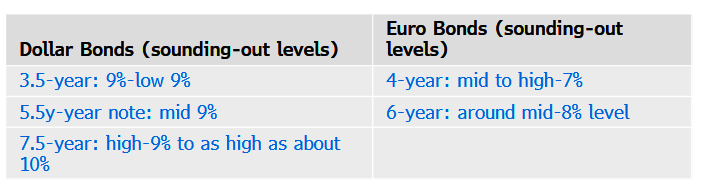
Those yields would all be records for SoftBank in those specific currencies and tenors if priced at those levels, according to data compiled by Bloomberg, though details in corporate note offerings often change before they are actually priced.
As Bloomberg notes, the latest deal adds to a flurry of recent activity by SoftBank, as it builds out its artificial intelligence financing capacity. The conglomerate entered into a $40 billion bridge loan in March to fund an additional investment in OpenAI, and recently repaid the outstanding balance of $25.9 billion on that facility.
SoftBank closed out last week with nearly $21 billion in potential fresh borrowings. The group increased a margin loan backed by shares of its chip unit Arm Holdings by $5 billion to $25 billion, people familiar with the matter said on Friday. And it recently secured an additional $450 million to an existing credit line, bringing the total to $6.5 billion.
In short, if OpenAi goes down it is absolutely dragging SoftBank with it.
Apollo Global is also in talks to boost the size of a loan to SoftBank by $3.6 billion to $9 billion to help it finance its investment in AI giant OpenAI. On top of that, the firm founded and led by billionaire Masayoshi Son secured an $11.87 billion loan, also to support its OpenAI investment.
As part of its funding campaign this year, SoftBank has sold almost $15 billion of notes across currencies, making it the biggest junk-rated borrower in bond markets so far in 2026, Bloomberg-compiled data show. There was also a $10 billion loan earlier this year backed by its OpenAI stake.
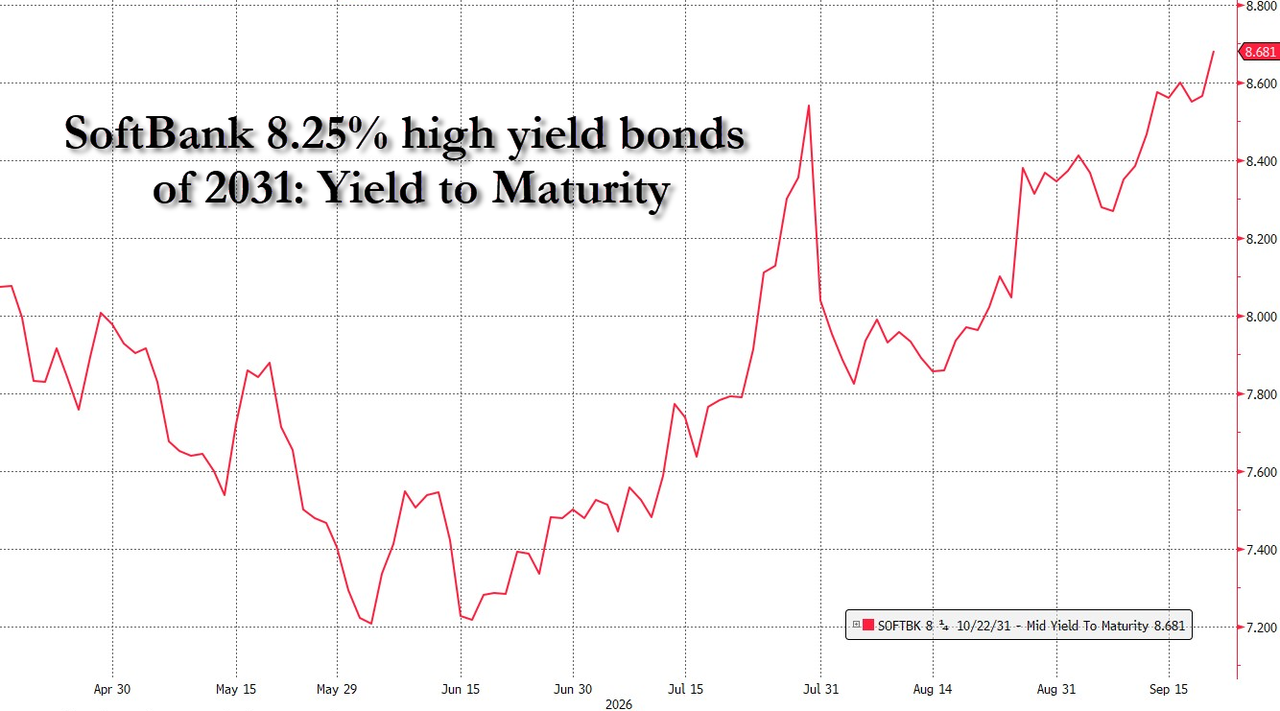
The deals come amid a broader increase across markets in borrowing costs, as most major economies grapple with inflation. The yield on SoftBank’s dollar bond maturing in 2031 climbed to 8.2% earlier this month, up from as low as 6.7% in January, as spreads have blown out and underlying Treasury yields have risen.
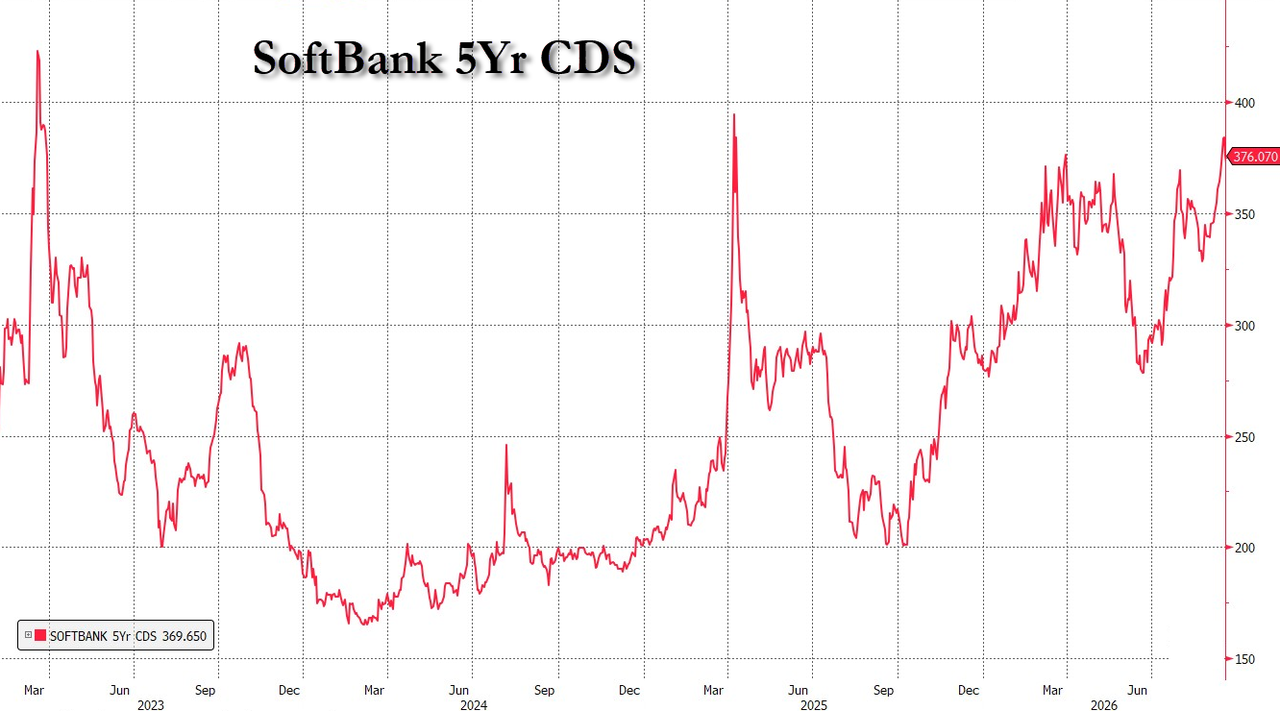
Recent calls by heads of some of the world’s biggest artificial intelligence platforms, including OpenAI, to slow AI advances on safety concerns, have introduced another layer of uncertainty. That contributed recently to an increase in the cost to insure SoftBank’s debt against default to the highest in three years.
In another hit to SoftBank, OpenAI CEO Sam Altman’s remarked that the company won’t go public this year - a move that would increase the liquidity of SoftBank’s investments - have been closely watched by investors.
Citigroup Inc. is acting as the lead bookrunner and a joint global coordinator, alongside Goldman Sachs Group, JPMorgan Chase & Co. and Morgan Stanley for dollar tranches. JPMorgan is the lead bookrunner for the euro-denominated notes and among the joint global coordinators, together with Goldman Sachs and Deutsche Bank.