Japanese Bond Yields Surge To 30 Year High On Report Tokyo May Hike Defense Spending To 3.5% Of GDP
Just in case Japan's bond yields weren't high enough already, Bloomberg reports that Japan is considering a new mid-term defense spending target of 3.5% of GDP in line with NATO and other US allies. Such a move would send a shockwave through financial markets concerned about Prime Minister Sanae Takaichi’s spending plans at a time when Japan is preparing to trim tax receipts even more by cutting consumption tax to 1%.
Japanese defense officials have already signaled a willingness to sharply increase defense spending in meetings with their US counterparts, Bloomberg reported. One scenario under consideration is to match a commitment made by South Korea to increase defense spending to 3.5% of gross domestic product over 10 years, while a lower target, such as 3%, is also possible, according to one of the people.
Responding to the news, Japanese Defense Ministry Press Secretary Kimihito Aguin denied that Japan had expressed an intention to the US to sharply raise spending to 3.5% of GDP, although that is likely explained by his fear how the bond market would react if another huge spending category is suddenly revealed.
“Japan’s defense buildup is something we undertake based on our own independent judgment, under the fundamental principle that we must defend our own country ourselves,” Aguin said at a press conference Tuesday. “It is also not a matter of starting with a predetermined spending figure. What matters is the substance of our defense capabilities.”
Well, the substance of Japan's defense capabilities is entirely dependent on how much is spent, so....
Like other US allies, Tokyo has been under pressure from the Trump administration to boost its defensive strength and reduce its reliance on the American military. Takaichi has already accelerated defense spending to almost 2% of gross domestic product in the financial year ended in March this year, two years ahead of schedule.
Until 2022, Japan had an informal cap on defense spending around 1% of GDP, an indication of how quickly thinking on defense has changed in recent years. A new five-year defense spending plan is expected at the end of this year. Committing to 3.5% could unsettle market players wary of large debt issuance, even though Takaichi has pledged to follow a “responsible, proactive fiscal policy.”
While US defense officials have largely avoided public pressure on Japan to commit to a 3.5% defense spending goal, they have made clear that they expect significantly more investment.
“We are anxiously looking for Japan to step up,” US Under Secretary of Defense for Policy Elbridge Colby said last month of Tokyo’s defense spending.
In June, Takaichi’s ruling Liberal Democratic Party noted that 3.5% had become a global standard for defense spending, but didn’t provide recommendations on how Japan could pay for such a level of outlays.
“We’ll review both spending and revenue across the board,” Finance Minister Satsuki Katayama said Tuesday. “While keeping a close eye on tax revenue, we’ll determine a level of fiscal spending — including, of course, defense spending — that is consistent with steadily bringing down the debt-to-GDP ratio.”
In meetings between defense officials from both nations, Japan has indicated it will most likely align with other US allies but it has avoided discussing details. Some Japanese officials have said they aren’t ready to make a formal pledge and would deny the existence of such a goal if it was made public, according to Bloomberg. In public, Defense Minister Shinjiro Koizumi has also said spending will be determined by military needs rather than monetary targets.
Behind Japan’s caution over specifying a goal is concern over the amount of funding needed to reach 3.5%. When Japan set its 2% goal in 2022 it said it would continue to measure spending in comparison to GDP that year. Koizumi said in April that defense spending and related expenditures for this fiscal year of ¥10.6 trillion ($68.8 billion) were equivalent to 1.9% of nominal GDP in 2022.
Measured against the Cabinet Office’s nominal GDP forecast for this fiscal year, spending would come to 1.5%, he said. A budget of 3.5% using that forecast would amount to ¥24 trillion, more than double the current amount.
Spending 3.5% of GDP on defense has become a global benchmark for US allies since North Atlantic Treaty Organization members pledged last June to reach that level by 2035. As a national security hawk and strong advocate of the US-Japan alliance, Takaichi has made clear she wants to further boost the military.
“Japan needs to proactively pursue a fundamental strengthening of its defense capabilities,” she said in parliament this year.
But she also has ambitious plans for the economy. This year Takaichi announced a growth plan targeting more than ¥370 trillion in combined public and private investment by 2040, a program that may strain the nation’s finances. Ramping up defense spending at the same time may test investors’ confidence in Japan’s ability to keep a lid on its debt. After lifting its informal cap on defense spending in 2022, Japan has made significant investments in long-range strike capabilities such as land and ship-launched Tomahawk missiles. In its budget request for the fiscal year starting next April, the Defense Ministry requested a record ¥8.9 trillion for the next fiscal year, up 0.9% from the current year.
But many items in the budget request haven’t been given a projected cost, meaning the final budget is likely to be much higher. Yen weakness has also eroded Japan’s spending power for weapons from overseas.
Even if Japan commits to 3.5%, it would lag behind NATO countries. For NATO, the target is for so-called “core” defense spending, such as weapons and troop salaries. Members have also pledged an additional 1.5% of GDP for defense-related spending, such as protecting critical infrastructure.
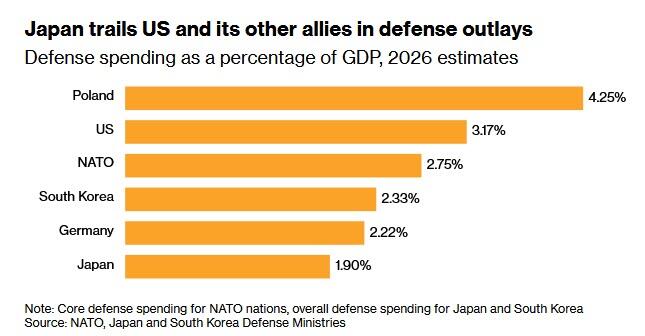
Japan bundles core and non-core spending in its defense budget, meaning that it would be spending less on its military as a percentage of GDP than NATO countries even if it raised defense outlays to 3.5% of GDP.
Robert Ward, Japan Chair at the International Institute for Strategic Studies, said the groundwork had been laid among policymakers and bureaucrats in Japan for a big jump in defense spending. It’s now mostly a matter of timing of when Japan goes to 3.5%, he said.
“Whether it’s over five years or 10 years, I don’t see any alternative given how important the US alliance is,” Ward said.
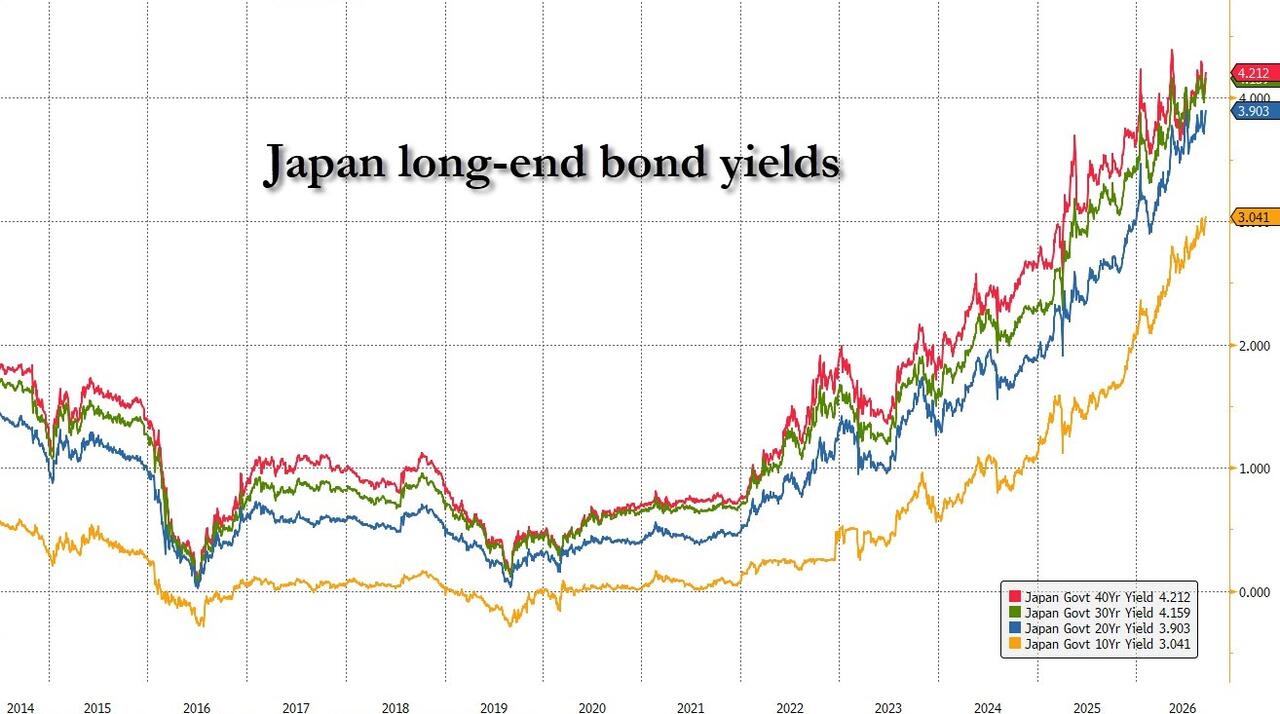
Japanese defense shares IHI Corp and Kawasaki Heavy Industries Ltd closed 1.8% and 0.9% higher in Tokyo, reversing earlier losses of more than 2%, after the report came out. The biggest impact was on Japanese government bonds extended their fall, with the benchmark 10-year yield rising to its highest level since 1996. The yen weakened as far as 155.24 to the dollar.
“There are fiscal concerns, as shown in the bond market reaction, so it’s difficult for investors to take news like this positively,” said Daisuke Aiba, an analyst at Iwai Cosmo Securities Co. “Plus, there are questions about whether Japan actually has the ability to expand its defense capabilities beyond their current limited scope.”
There was more: besides spending more, Japan is hell-bent on also collecting less (after all there are votes to be bought), and on Tuesday the Takaichi cabinet approved a plan to temporarily reduce the consumption tax on food, moving closer to delivering on a key campaign pledge ahead of February’s national election to ease the burden on households from the soaring cost of living by eliminating sales tax on food for two years.
The cabinet signed off on the annual tax reform plan, which calls for lowering the sales tax on food and beverages to 1% from 8% for two years starting in April. Under the proposal, the government won’t issue new debt to finance the roughly ¥5 trillion ($32.3 billion) measure, but... of course it will in the end. The government deferred until the end of the year a decision on how to fund the tax cut. The reason for the delay: there is no other way to fund the tax cut since no other part of the Japanese govt will agree to slashing its own expenditures.
“Tax revenue will likely rise, and also we will review various revenue and expenditures,” Finance Minister Satsuki Katayama said Tuesday during an appearance on Fuji TV, reiterating that the government will find ways to finance the measure without relying on new debt. She added that Japan’s version of the Department of Government Efficiency will step up efforts to review and eliminate redundant subsidies and spending.
“We will make sweeping cuts to wasteful spending from now on,” Katayama said, responding to criticism that ministries identified only three programs for possible cuts in voluntary reviews aimed at finding cost savings.
Oh yes, a Japanese DOGE. That should help slow down debt issuance in the most indebted country in world history.
Borrowing costs for the Japanese government were already elevated, with bond yields hovering near three-decade highs. The 10-year yield hit 3% earlier this month for the first time since 1996, driven by concerns over inflation and fiscal spending as well as expectations the Bank of Japan may need to raise interest rates more quickly. The yield was half that level around this time last year; it closed Tuesday at 3.04%, the highest since August 2016.