France Braces For Moody's Downgrade As OAT-Bund Spread Hits EU Crisis Level Highs
France faces a potential credit rating downgrade later today as social unrest, a deteriorating welfare state, a deficit crisis, political paralysis, and years of uncontrolled mass migration collide, forcing the government to repair its finances or risk sparking the next Eurozone crisis.
UniCredit fixed-income strategist Francesco Maria Di Bella told clients earlier, "Tonight, Moody's will review France's credit rating, which is currently at Aa3 with a negative outlook."

Di Bella outlined his expectations for Moody's upcoming ratings decision:
We expect the rating agency to downgrade French public debt as deteriorating fiscal indicators are compounded by political constraints that hinder efforts to place public finances on a more sustainable path.
With S&P and Fitch already placing the country's rating credit one notch lower, we think this move is broadly expected and should not lead to a further underperformance of French govies.
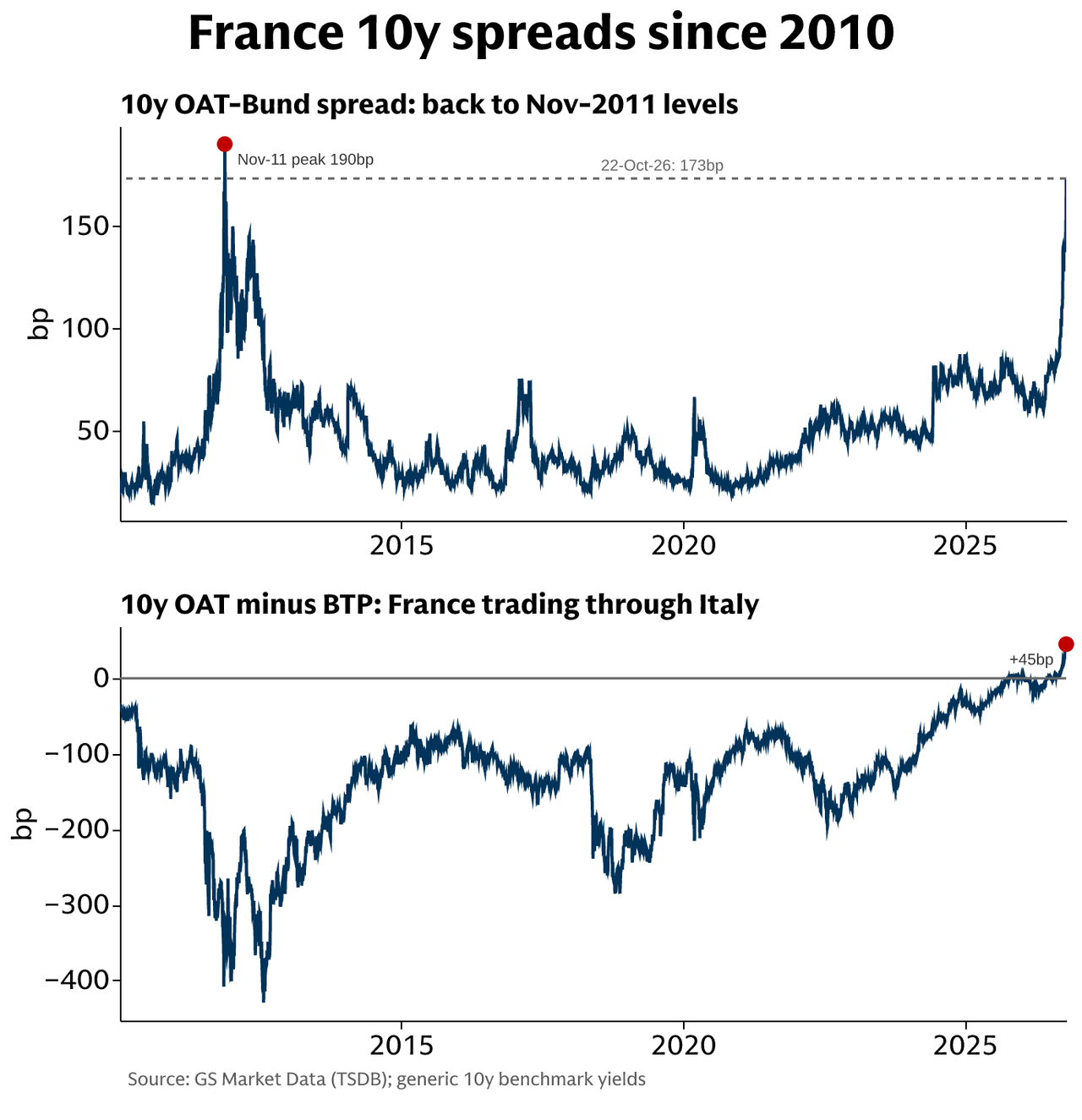
The 10Y OAT-Bund spread is currently trading at around 175bp, 90bp wider than at the beginning of September and at the highest level since its peak in November 2011.
That said, a rating downgrade would keep investor attention high on the political uncertainty and weakening economic fundamentals in France.
Next year's presidential election represents a source of concern not only for France but for the entire eurozone, and adds to other risk factors such as geopolitical tensions and elevated energy prices.
Bank of America co-head of global rates strategy Sphia Salim wrote in a note:
Attention is firmly on risk assets. The equity sell-off, wider credit spreads and OAT-Bund breakout increasingly reinforce one another, adding momentum to the duration rally alongside the continued short covering by CTAs & bid for receivers.
After close, we will also get Moody's rating decision for France. If Moody's doesn't deliver a downgrade and simply reaffirms the negative outlook, the decision could offer some reprieve to OAT-Bunds. Absent a stabilization in spread, the pressure will be on the ECB to deliver at least some verbal intervention (Rates - EU).
France's OAT-Bund spread widened to 175 bps Friday morning, approaching levels seen at the height of the eurozone sovereign debt crisis.
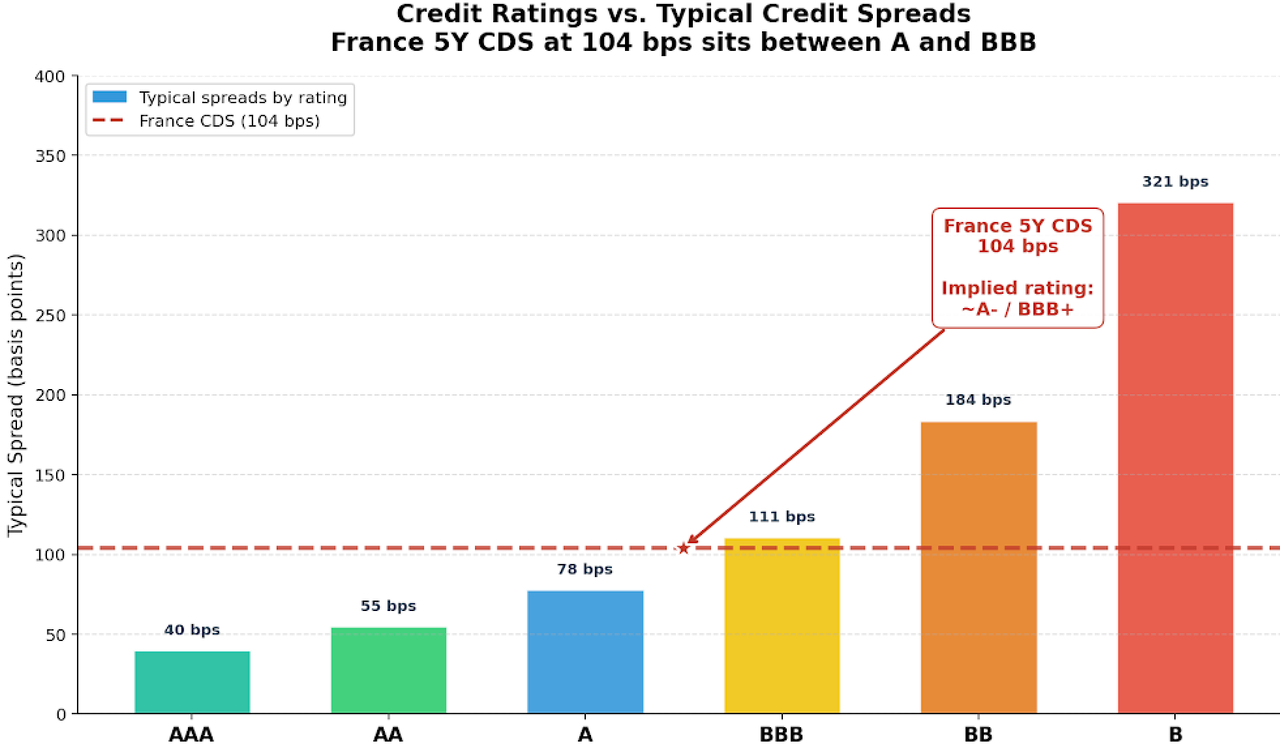
France's CDS spreads suggest investors are pricing its sovereign risk more like a low single-A or high-BBB credit.
Here's more commentary from Cosimo Codacci-Pisanelli and Rikin Shah via Goldman Sachs:
PRESSURE ON FRANCE BUILDS...
10y OAT-Bund closed at 173bp on Thursday, the widest since November 2011, and France now trades 45bp through Italy. The forced deleveraging of two weeks ago has stopped, yet spreads have gone well through the 12-Oct highs anyway. This is a fundamentals story, not just a positioning one.
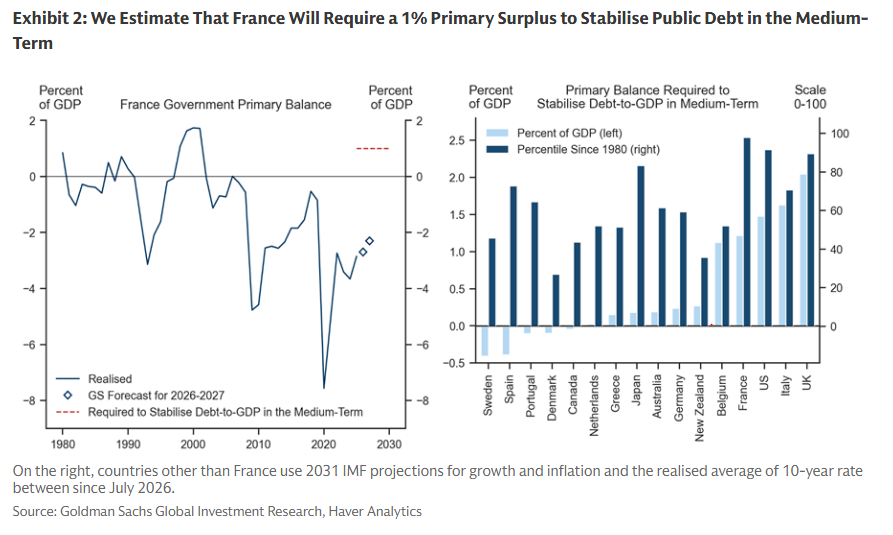
Last weekend's protests were the largest since the yellow vests and the 2019/2023 pension strikes, and a post-protest poll now puts Melenchon in the second round. The direct growth hit from the riots looks small, but it is another headwind to an already weak growth outlook: GIR have downside risks to their 2027 growth forecast 0.6% vs the government's 1.0%. Even in the constructive scenario, where the 5.0% 2027 budget deficit target passes by year-end, GIR expect the deficit to realise at 5.3% given their weaker growth forecast. The arithmetic is challenging and unforgiving. With an assumption of 1% real growth, 2% inflation and a 4% borrowing cost, stabilising the debt needs a primary surplus of ~1%, something France has rarely come close to (chart). If funding costs converge to where 10y OATs trade today, just above 5%, that requirement drifts towards 2%. The bigger takeaway from the protests is that this is not a society ready to accept that scale of adjustment, whatever the political will.
There is undoubtedly a market structure component to the moves too. Positioning in the front end has been reduced and changed hands at better levels in the recent sell-off, but is still long. Further out the curve, the most striking thing has been the lack of buying.. even fair value models screening OATs as ~60bp cheap, value alone hasn't brought real money in. So what turns buying momentum? An energy-relief-driven duration rally might help, as might lower vol. Really it needs some fundamental improvement in the outlook... and in the short term that looks challenging, with the calendar showing more potential headwinds than tailwinds: Moody's review today, more protests expected this weekend, downside risks to Q3 GDP (first print 30 Oct), strikes expected on 5th Nov and a the Melenchon rally on 6th Nov. It's hard right now to see a material trigger for a material reversal in spreads, with further widening at risk of becoming even more convex from here. The risk of such moves ahead of clear event risk is enough to deter fair value buyers for now.
France's lower house scrapped key savings measures from the 2027 budget this week, undermining efforts to bring the deficit down to 5% of GDP from 5.4% this year. Opposition parties have shown no appetite for compromise ahead of the presidential election, rejecting spending cuts while pushing for additional outlays.
"You want to wait and see how the narrative evolves over the next six months into the election. That's going to have a more meaningful impact on the spread," said Rushabh Amin, a portfolio manager at Allspring Global Investments.
Mike Bell of RBC BlueBay Asset Management expects it could get even uglier if Moody's, S&P, and Fitch all lower France's rating into the BBB category, the lowest investment-grade tier.