Gold At $155,000 An Ounce
Submitted by QTR's Fringe Finance
The fellas over at Zero Hedge put up a Tweet last week that floated a wild monetary thought experiment: they said Treasury Secretary Scott Bessent could theoretically “buy back” our roughly $40 trillion in U.S. government debt using cash from the Treasury General Account.
There would just be one small detail standing in the way…the government would first have to re-mark its gold reserves to somewhere around $155,000 per ounce.
If you’re not familiar with the concept, it probably sounds outright insane. But the basic idea is actually simple, and once you follow it through to its logical conclusion, things get interesting pretty quickly.

The United States owns roughly 261.5 million ounces of gold, giving it the largest official reserves in the world. Yet the government still carries that gold at a statutory price of just $42.22 per ounce, even though gold trades at about 100x that price.
At $42.22, the government’s entire gold hoard is officially valued at only about $11 billion. In the real world, it’s worth well north of $1 trillion. It’s roughly the equivalent of somebody who bought a Manhattan apartment for $25,000 decades ago insisting that it is still worth $25,000 today because that’s what the original paperwork says.
As a gold bull, naturally, I love the idea of finally marking this gold to market. But the attraction goes well beyond watching the government admit that gold is worth considerably more than $42. Revaluation could once again formally elevate gold’s importance as a monetary asset, something gold investors have been arguing for years could and should happen, while central banks around the world have quietly continued accumulating.
There’s also a practical reason Washington could eventually find the idea appealing. Treasury owns the gold and already has a mechanism for issuing gold certificates against it to the Federal Reserve. In exchange, Treasury can receive a credit to its account at the Fed. In other words, there is already plumbing in place that allows the government to monetize the value of its gold. The problem is that the current system is tied to that absurd $42.22 statutory valuation, meaning Congress would likely need to change the law before a major revaluation could take place.
A reasonable scenario would be relatively straightforward. Congress changes the valuation and brings Treasury’s gold much closer to something resembling reality. At $5,000 per ounce, America’s 261.5 million ounces would be valued at roughly $1.3 trillion. At $10,000, we’re talking about approximately $2.6 trillion.
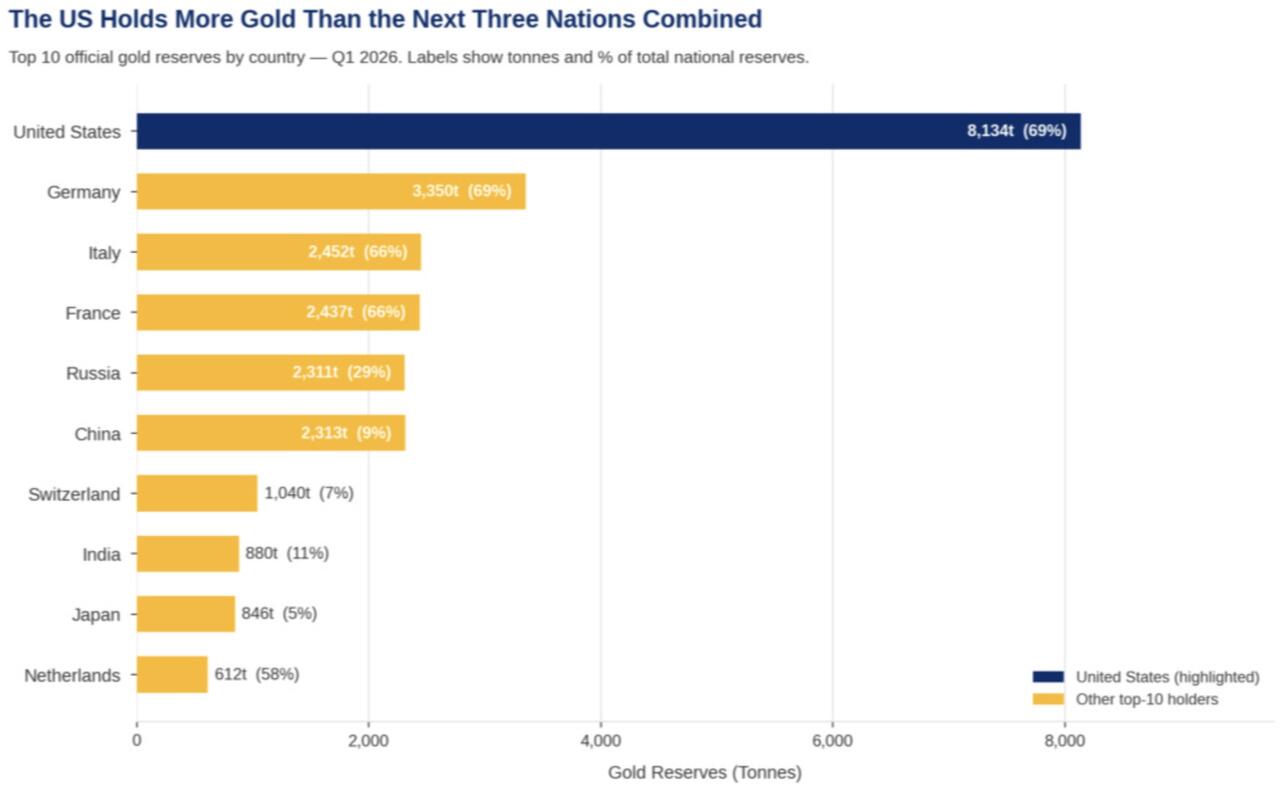
Suddenly, an asset officially carried at about $11 billion becomes a source of potentially trillions of dollars of balance-sheet capacity. Treasury wouldn’t have to load up trucks at Fort Knox either. The gold could remain exactly where it is while the government monetized some portion of the higher official valuation through the existing certificate framework.
The Federal Reserve has studied official reserve revaluations and looked at examples of governments around the world using gains on reserve assets for fiscal purposes. So while the specific details of how America might do it remain hypothetical, the broader concept isn’t unprecedented.
That’s the relatively sane version. Now for the Fringe version…
Suppose Washington doesn’t revalue gold to $5,000 or $10,000. Suppose policymakers decide they’re going to establish an entirely new official valuation for gold and pick something truly ridiculous. Say $100,000 per ounce. Or roughly $155,000 per ounce, which would put America’s gold reserves at around $40 trillion, roughly enough, on paper, to match the national debt.
At $100,000, America’s roughly 261.5 million ounces of gold would carry an official value of about $26.15 trillion. At $155,000, you’re north of $40 trillion. Now we’re talking about numbers Washington can actually get excited about.
Under a hypothetical legal framework allowing it, Treasury could issue vastly more gold certificates against that revalued gold, with the Federal Reserve crediting Treasury’s account in return. That’s essentially how the existing system already works, except today the certificates are limited by law to the hilariously outdated statutory gold price of $42.22 per ounce.
Taken to its extreme, you eventually arrive at the idea that sent me down this rabbit hole in the first place: could the United States use Fort Knox to retire a gigantic portion, theoretically even something approaching all, of the national debt?
🔥 85% OFF FOREVER IF YOU SUBSCRIBE TODAY: I am again offering an 85% discount to anyone that wants to become a Fringe Finance annual subscriber today. It’s a discount you can keep and stays applied for as long as you wish to remain a subscriber: Get 85% off forever
On paper, you can construct something resembling that scenario. Unfortunately, there’s one small problem: revaluing the gold doesn’t actually create $40 trillion of new wealth. What it could create is an enormous amount of new financing capacity for Treasury.
Changing the official price of an ounce of gold from $42 to $155,000 doesn’t give America more factories, houses, data centers, oil, electricity, farmland or productive capacity. We still have the same economy and the same 261.5 million ounces of gold. We’ve simply assigned an enormously larger number of dollars to that gold and, under this hypothetical framework, allowed Treasury to monetize that higher valuation.
If Treasury then started using that money to retire government debt, the Treasury securities could disappear, but the people and institutions holding them don’t disappear. They get paid. In effect, Washington would be replacing enormous quantities of interest bearing Treasury securities with money and other monetary liabilities in the financial system.
And that’s where the thought experiment gets really interesting, because the ultimate consequence could show up in the value of the dollar itself.
The act of revaluing gold wouldn’t automatically dump $40 trillion into the economy or instantly destroy the dollar. Treasury would first have a vastly larger balance at the Fed. The real monetary event begins as Treasury actually uses that money. And if Washington attempted to deploy tens of trillions of dollars to retire debt without the Federal Reserve somehow offsetting the resulting liquidity, we’re talking about monetary expansion on a scale that has essentially no modern American precedent.
You haven’t made America $40 trillion richer. You’ve potentially created an enormous number of additional dollars and dollar like claims against essentially the same underlying economy.
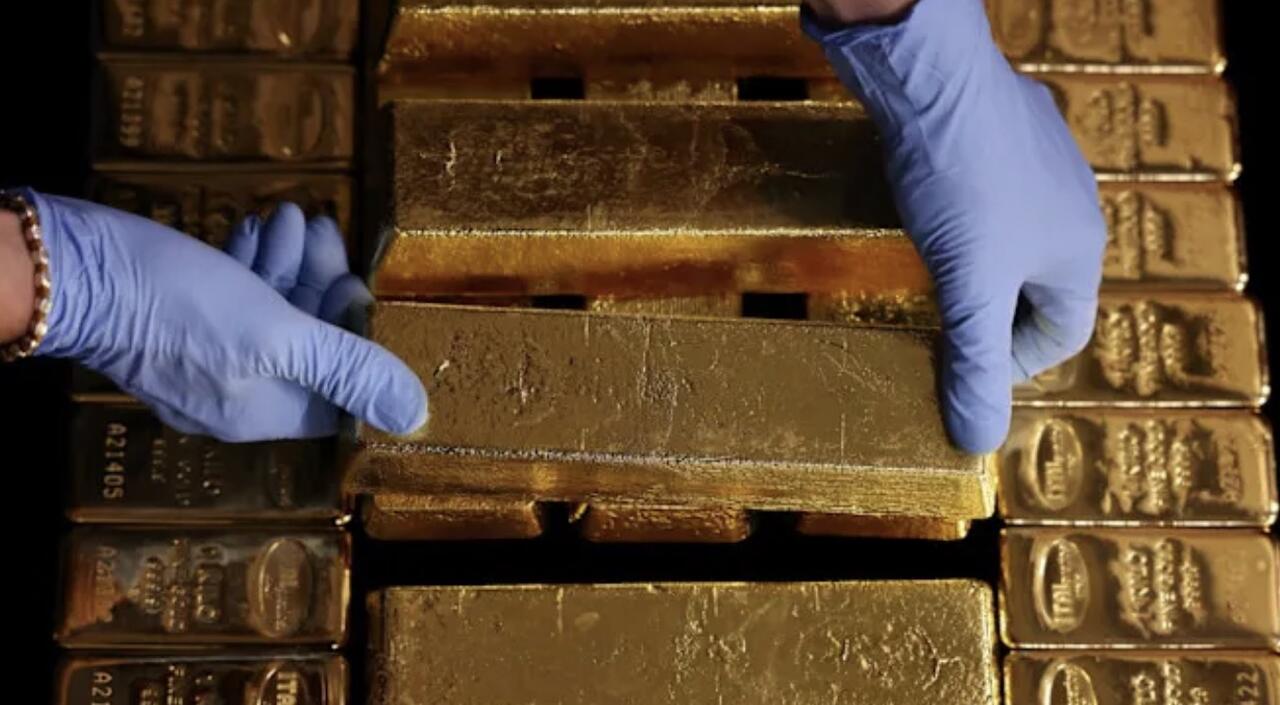
Maybe the best way to understand $155,000 gold isn’t that Washington has suddenly decided an ounce of yellow metal is magically 30 or 40 times more valuable. Maybe it’s that Washington has decided it now takes vastly more dollars to represent the same ounce of gold.
In other words, the crazy number may tell you as much about the dollar as it does about the gold.
And if trillions upon trillions of those newly available dollars were actually deployed, the adjustment could eventually appear through some combination of a weaker dollar, higher inflation, rising nominal asset prices, higher inflation expectations and changes in interest rates. The exact outcome would depend enormously on how the operation was structured and how aggressively the Federal Reserve responded.
So there’s no magic trick here. You can’t make tens of trillions of dollars of government obligations disappear without something changing somewhere else in the system.
That’s the part of this thought experiment that should make gold investors’ ears perk up. A $155,000 official gold price could be viewed less as Washington declaring that gold suddenly became extraordinarily valuable and more as Washington implicitly acknowledging that the dollar has become extraordinarily cheap relative to gold.
You could potentially retire an enormous amount of nominal Treasury debt this way. You could make the government’s debt statistics look dramatically better. You might even reduce future Treasury interest expense substantially…but you haven’t eliminated the underlying economic cost. You’ve changed the form in which that cost is expressed.
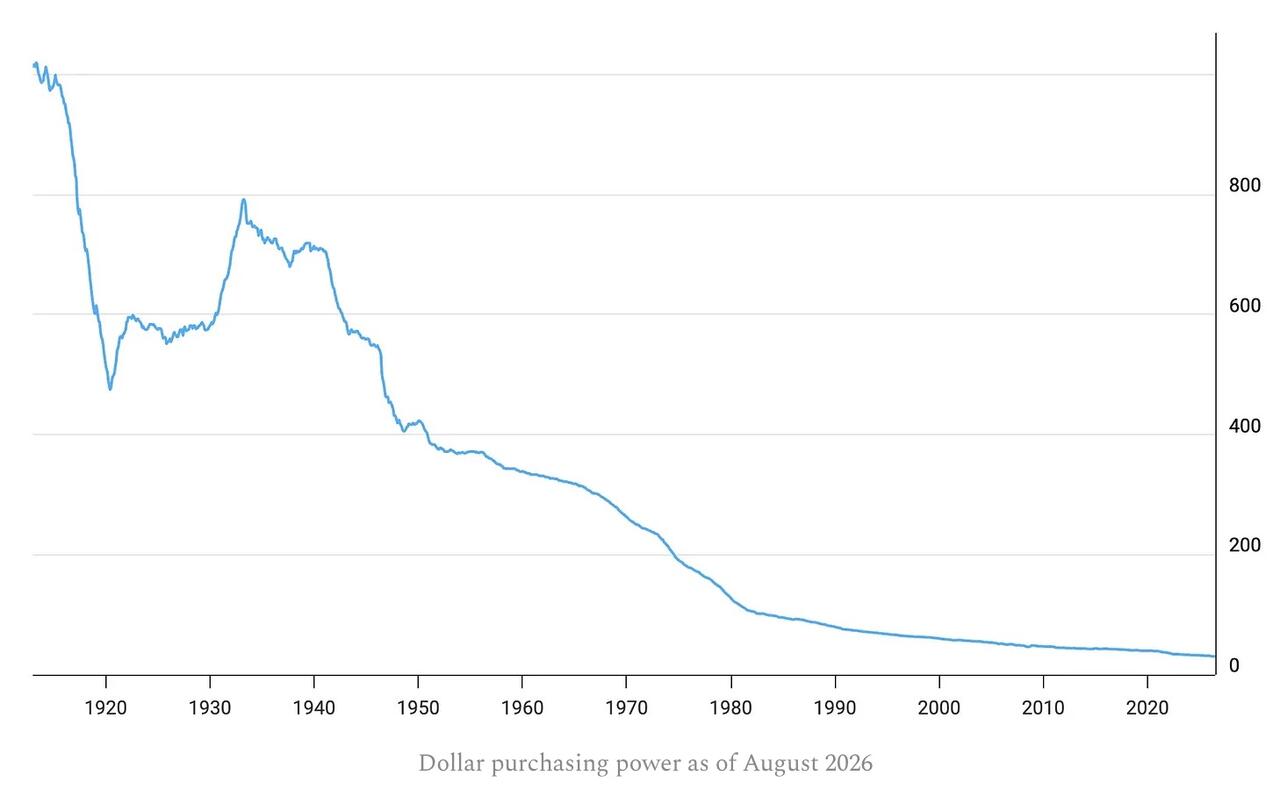
Instead of carrying tens of trillions of dollars of Treasury securities, you’ve potentially pushed some of the adjustment into the monetary system itself, into liquidity, inflation, interest rates, asset prices and, ultimately, the purchasing power of the currency. So the really crazy part of $155,000 gold isn’t necessarily imagining gold becoming that expensive. It’s imagining what a dollar might be worth in a world where Washington decided it needed gold to be worth $155,000.
The debt gets smaller, the number of dollars potentially gets much bigger…and then those dollars may buy a hell of a lot less.
And setting an official government price of $100,000 wouldn’t automatically force gold to trade for $100,000 in New York, London or anywhere else. The government can choose an accounting value, but it can’t simply order the global market to agree with it. The signal, however, would be impossible to ignore.
The country responsible for issuing the world’s primary reserve currency would essentially be announcing that gold was important enough to use as a tool for restructuring its own sovereign balance sheet. Every central bank, sovereign wealth fund and large institutional investor on Earth would immediately have to consider what that meant.
If the United States itself suddenly decided gold deserved a dramatically higher monetary valuation, why wouldn’t other countries want more of it?
And if you’re running a central bank somewhere, the question becomes increasingly uncomfortable: how much of your reserves do you want sitting in dollars and Treasury bonds versus the asset Washington itself just decided was valuable enough to help address its fiscal problems?
A sufficiently large revaluation could amount to an admission that gold never really left the monetary system in the first place. We just spent decades pretending it did while central banks continued stacking bars in vaults.
I’m not predicting $100,000 gold. That number is intentionally ridiculous because it demonstrates how powerful the mechanism becomes when taken to its extreme. But the current $42.22 valuation is arguably even more ridiculous in its own way.
Eventually, Bessent or somebody at Treasury is going to look at 261.5 million ounces of gold, look at the government’s fiscal situation and ask why one of America’s most valuable financial assets is still being carried at a price that hasn’t had anything to do with reality for more than half a century…especially at a time when we are desperate to clean up our fiscal house…
The interesting question isn’t whether $42 makes sense. It clearly doesn’t. The question is what price will Scott Bessent arrive at that does make sense.
More from QTR:
- Cathie Wood’s $10 Trillion SpaceX Fantasy
- This Is Where Things Get Nasty
- Dear Nike, Here’s How You Save Your Company
- Why The AI CEOs Really Want To Be Regulated
- 14 Stocks I’d Watch During A Market Selloff
--
QTR’s Disclaimer: Please read my full legal disclaimer on my About page here. This post represents my opinions only. In addition, please understand I am an idiot and very often get things wrong and lose money. I may own or transact in any names mentioned in this piece at any time without warning, meaning if I’m long I could sell or if I’m short I could cover at any time.
Contributor posts, guest posts and curated posts have been hand selected by me, but have not been fact checked and are the opinions of their authors. They are either submitted to QTR by their author or reprinted under a Creative Commons license with my best effort to uphold what the license asks, or with the permission of the author.
I cannot guarantee the accuracy of any or all facts and figures included in this article though I made an effort to get them right. I have been wrong before and will be wrong again, and encourage you to always double check, do your own research and speak to a licensed financial professional, which I am not.
This is not a recommendation to buy or sell any stocks or securities, just my opinions. I often lose money on positions I trade/invest in. I may add any name mentioned in this article and sell any name mentioned in this piece at any time, without further warning. None of this is a solicitation to buy or sell securities. I may or may not own names I write about and are watching. Sometimes I’m bullish without owning things, sometimes I’m bearish and do own things I’m bearish on. Just assume my positions could be exactly the opposite of what you think they are just in case. If I’m long I could quickly be short and vice versa. I won’t update my positions.
Starting in 2026, I have been attempting to no longer actively trade as much as I once did (read my story here). My goal is for my investing/saving to be done by recurring contributions mostly to sector ETFs and a few select equities, trusted third parties who oversee my accounts, and advisors. Such advisors or funds, through individual equities, options, index funds, mutual funds, ETFs, or other securities, may have positions in, exposure to, or holdings of names mentioned herein that I know nothing about. It is possible I could own, have exposure to, or not own anything, at any point. In an attempt to lead a healthier lifestyle, I’ve also excluded myself from fantasy sports, sports betting, online and in-person casinos and prediction markets.
Any of my positions can change immediately as soon as I publish, with or without notice and at any point I can be long, short or neutral on any position. You are on your own. Do not make decisions based on my blog. I exist on the fringe. If you see numbers and calculations of any sort, assume they are wrong and double check them. I failed Algebra in 8th grade and topped off my high school math accolades by getting a D- in remedial Calculus my senior year, before becoming an English major in college so I could bullshit my way through things easier. Hence, why I am a writer.
The publisher does not guarantee the accuracy or completeness of the information provided in this page. These are not the opinions of any of my employers, partners, or associates. I did my best to be honest about my disclosures but can’t guarantee I am right; I write these posts after a couple beers sometimes. Many times I edit after my posts are published because I’m impatient and lazy, so if you see a typo, check back in a half hour.
Also, again I just straight up get shit wrong a lot. I mention it multiple times because it’s that important you understand.