Are Bonds About To Crash The Stock Market?
Submitted by QTR's Fringe Finance
There. I’ve said it. I’ve gone from pussyfooting around and saying the AI bubble could pop in 6 to 10 months…which I still believe…to the very definitive statement that if the bond market keeps acting like this, the equity markets will get slaughtered. And I mean, wrath of God type shit.
This isn’t even a particularly sophisticated thesis. After all, if I’m delivering it, it can’t be. It’s just math.
Treasuries sold off hard on Wednesday, sending the 10-year yield up roughly 14 basis points to about 5.11%, after touching 5.14% intraday, its highest level since 2007.
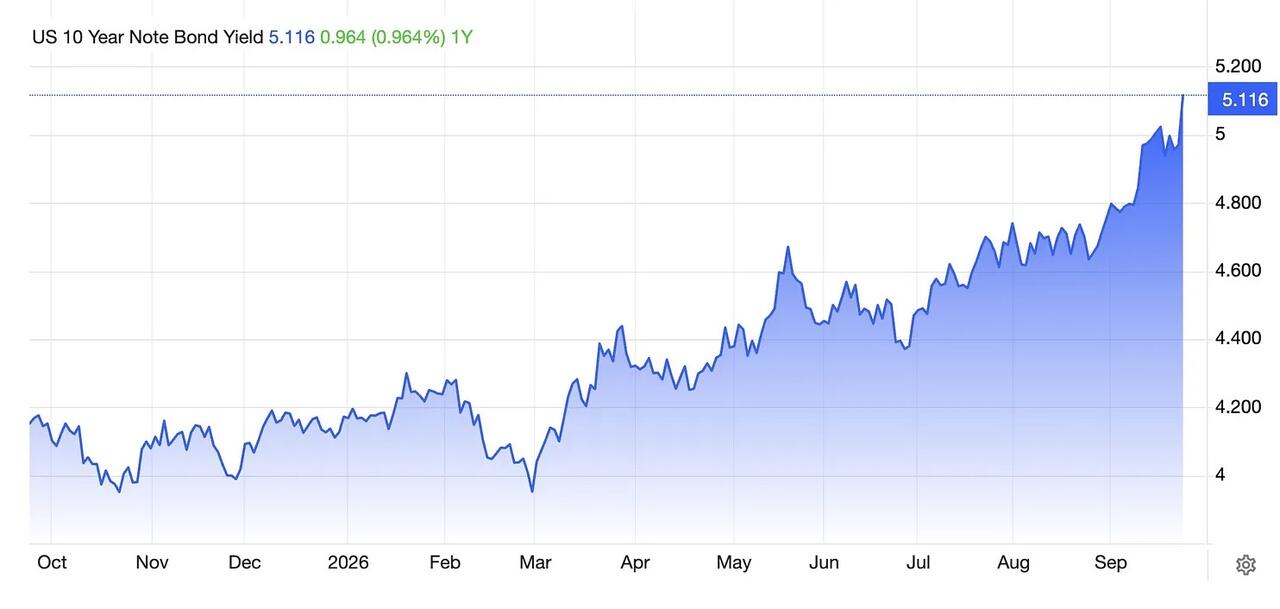
The 30-year climbed to roughly 5.4%, while the 2-year jumped to about 4.9%. This is the latest leg of a bond selloff that has been building for months, with the 10-year alone up roughly 35 basis points in September and long-term borrowing costs now pushing into territory we haven't consistently dealt with since before the Global Financial Crisis.
Inflation fears, pornographic government borrowing needs, spiking oil prices and expectations for additional Fed hikes are all feeding the move. In other words, the bond market keeps trying to tell everybody something, and equity investors keep sticking their fingers in their ears.
Well, the bond market isn’t the equity market. It can’t be gamed, f*cked around with using call options, it can’t be ignored and it can’t be rigged…at least, not without massive consequences. The equity markets in the U.S. are roughly $70 trillion in size, but they ultimately sit on top of the price of money established in the bond market.
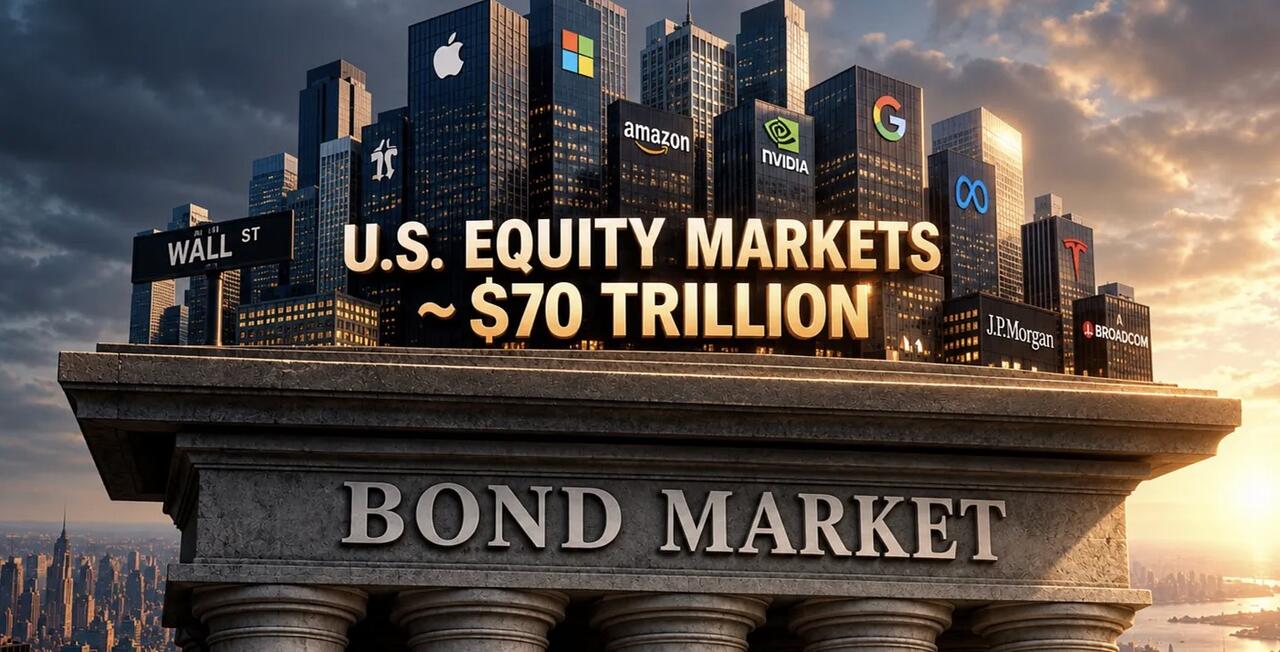
Treasuries alone are more than $30 trillion, and their yields help determine what mortgages cost, what corporations pay to borrow, what private equity can finance, what the government pays on its debt and, ultimately, what investors should be willing to pay for a dollar of future corporate earnings. Stocks can ignore that math for a while. They cannot ignore it forever.
It’s as simple as this: as long-term interest rates continue moving higher, virtually every important piece of financial math gets worse, all at the same time.
The discount rate used to value stocks rises, which makes future earnings worth less today. Mortgages get more expensive. Corporate borrowing gets more expensive. Private equity deals and private credit…much of which is already FUBAR but not showing it yet…become harder to finance. Leveraged companies have to refinance debt at higher rates. Consumers pay more to borrow and the federal government pays more to service its enormous pile of debt.
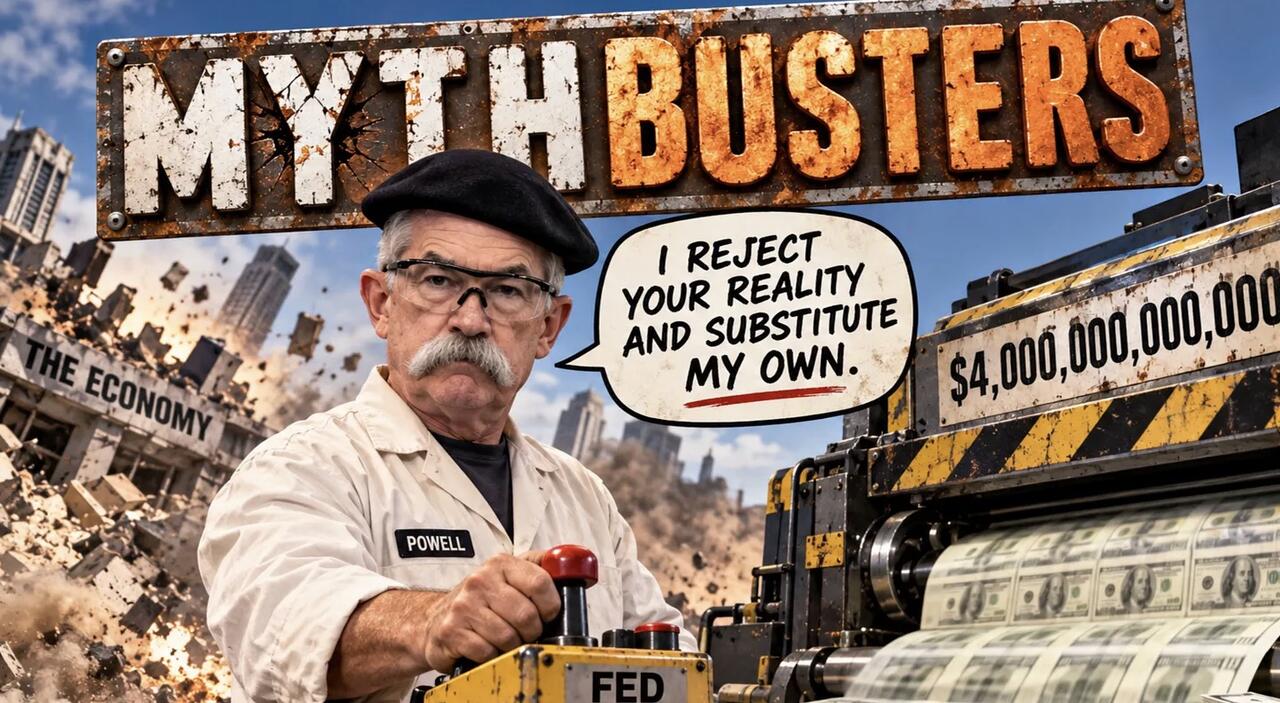
Rising rates are a slow, methodical wood chipper for anything built on cheap money. Anything like…oh, I don’t know…the entire f*cking economy of the last two decades—especially after the Fed went full MythBusters during Covid, rejecting the reality of the economy’s death, and substituting its own by papering over the whole thing with $4 trillion in freshly printed cash.
It’s also a real shit sandwich because bonds become increasingly attractive competitors to stocks. There isn’t a magic yield where a siren goes off and the stock market automatically crashes, but there is a point where enough pressure accumulates that something breaks. If things keep heading in the direction they are in, that point will come before the end of the year undoubtedly, in my opinion.
Lest we forget, we are entering this experiment carrying an almost comical amount of debt. Total U.S. federal debt has crossed $40 trillion. CBO expects the government to run roughly a $1.9 trillion deficit in fiscal 2026, with debt held by the public around 101% of GDP. Net federal interest expense is projected at roughly $1 trillion this year and CBO expects it to reach $2.1 trillion by 2036.
We are already borrowing enormous amounts of money, partly to pay interest on money we previously borrowed, while the rate at which that debt gets refinanced keeps rising. It’s just simple arithmetic.
The Federal Reserve says domestic nonfinancial debt reached roughly $84 trillion in Q2: $21.4 trillion of household debt, $24 trillion of business debt and $38.7 trillion of government debt. Every additional turn of the interest-rate screw matters when you’re applying it to numbers that large.
Then we get to Wall Street, where apparently the response to historically expensive stocks has been: what if we bought even more of them with borrowed money? FINRA margin debt was about $1.45 trillion in August, up roughly 37% from a year earlier, after reaching a record $1.50 trillion in June. Leverage works wonderfully until it doesn’t. Stocks rise, collateral values rise, investors borrow more and that borrowed money can buy still more stocks. Look at margin debt/GDP:
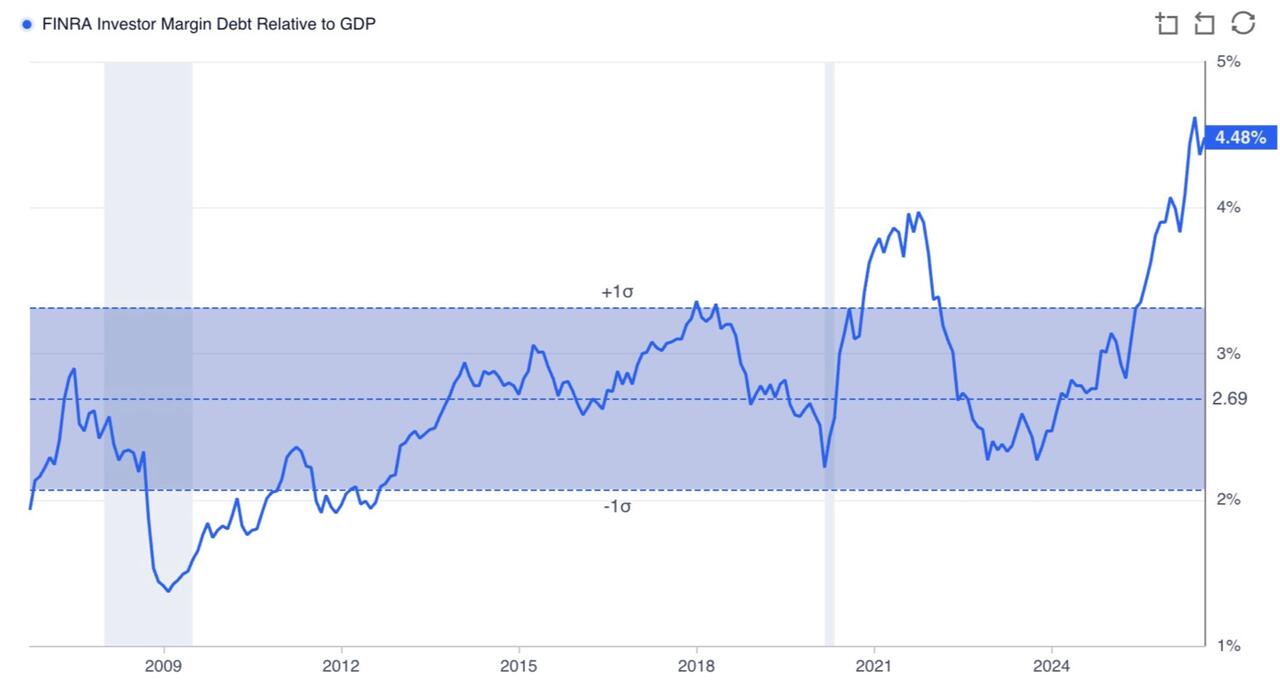
Now, reverse the arrows. Stocks fall, collateral values fall, margin requirements bite and people start selling because they have to. Selling creates more selling. That’s how leverage turns a correction into an avalanche.
And finally here’s where I think people may be making a much larger conceptual mistake. Everybody has spent the last 15 years assuming that eventually we simply return to the financial environment we became accustomed to after the Global Financial Crisis: zero rates, endless liquidity, cheap leverage and central banks standing behind asset prices.
What if we don’t? What if this is the reckoning?
QE1 began in 2008. Then came more QE, zero rates, negative rates overseas, COVID stimulus, trillions in fiscal spending and one of the greatest expansions of financial assets and leverage in history. For years, people like Peter Schiff and other monetary bears have argued that we weren’t eliminating the consequences of excessive debt, we were postponing them. Maybe the bill has finally arrived. Like Schiff says, maybe this will be “The Real Crash”.
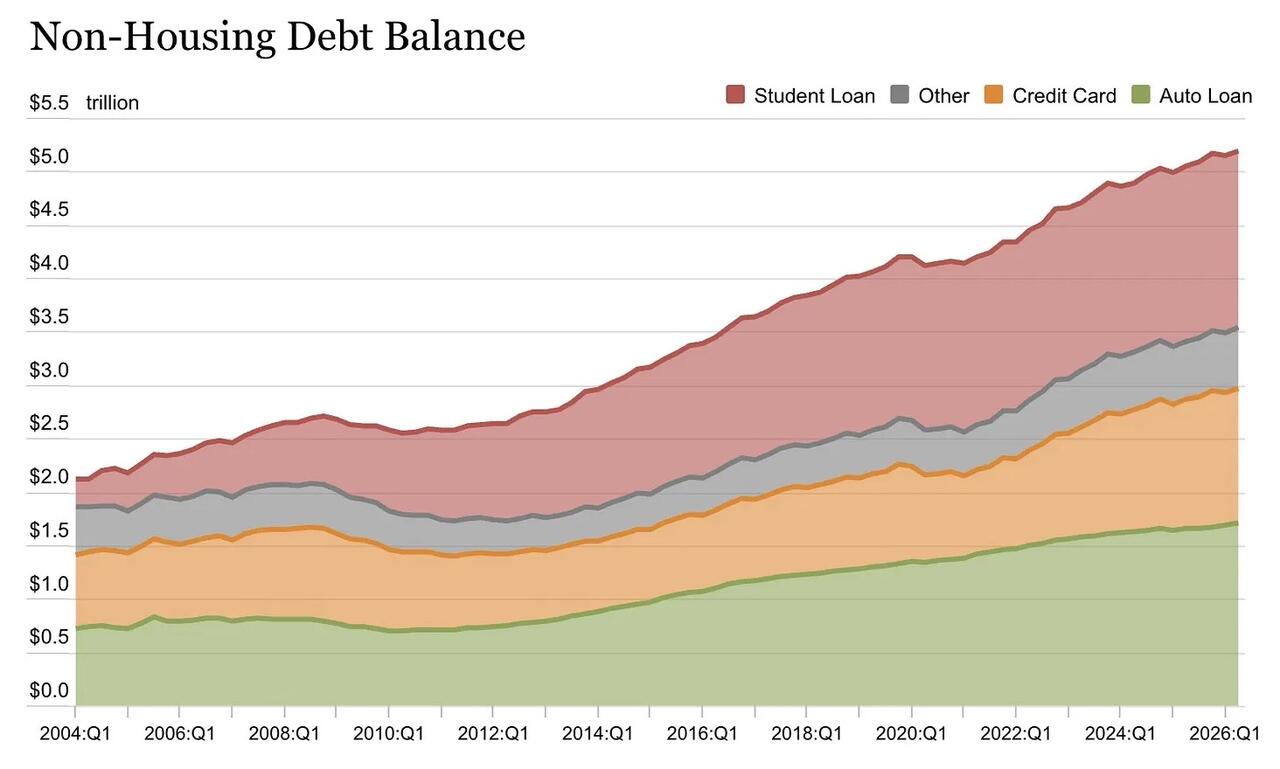
The private-credit market is already giving us little previews. Consumers aren’t exactly sitting on Fort Knox either. Americans have about $18.8 trillion of household debt, including $1.26 trillion of credit-card balances and $1.71 trillion of auto debt. Roughly 7% of current credit-card balances were transitioning into serious delinquency at an annualized rate in Q2. Now pour higher rates on top of that.
Yet somehow, against this backdrop, financial markets have decided this is an excellent moment to completely lose their minds.
AI infrastructure is increasingly being financed through enormous amounts of debt, leases, guarantees and special-purpose vehicles. Recent reporting has identified hundreds of billions of dollars of AI exposure supported by guarantees that can keep financing off Big Tech balance sheets, while broader estimates of off-balance-sheet obligations tied to the AI ecosystem run into the trillions.
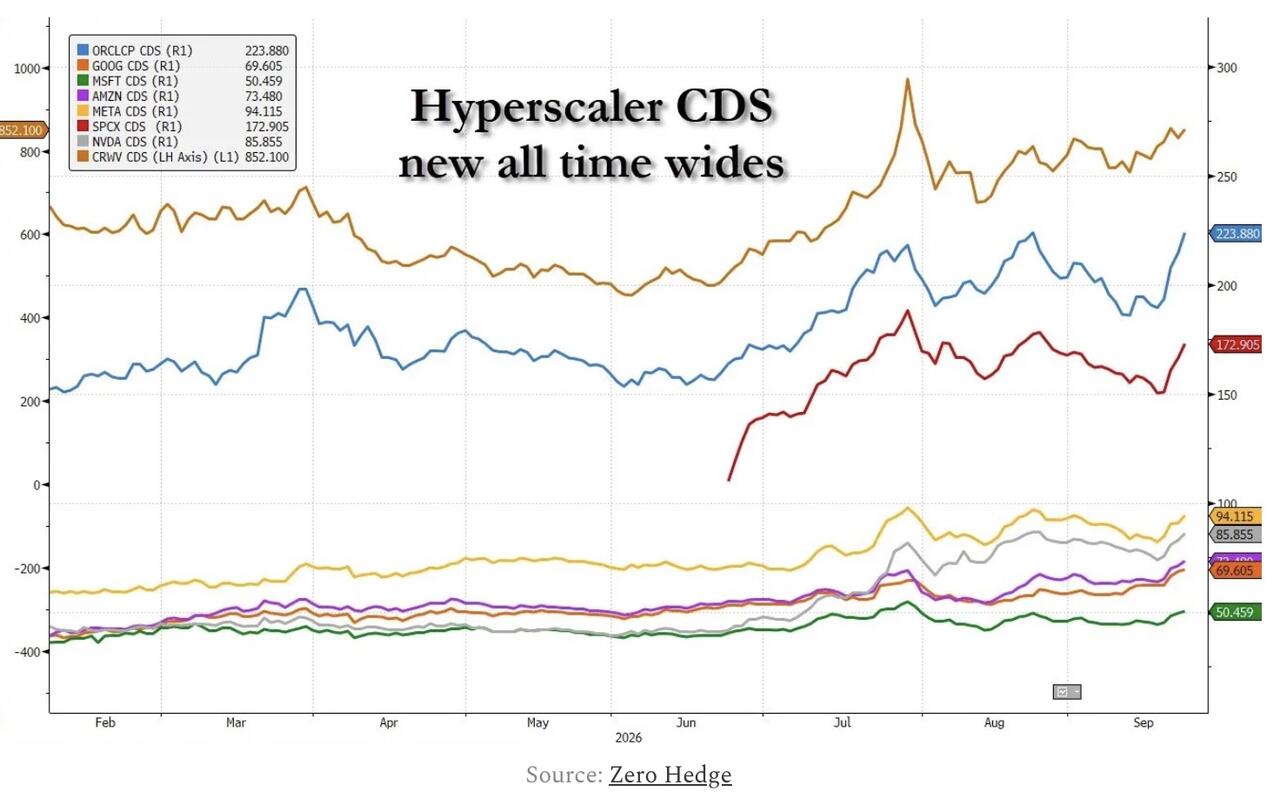
The bond market is already starting to notice. Zero Hedge wrote yesterday that hyperscaler credit default swaps at all new all time wides:
Meanwhile, SpaceX just went public at close to 100x sales. And then there’s crypto, an entire multi-trillion-dollar financial ecosystem whose necessity I remain unable to locate…and whose risks are multi-dimensional in ways I’m not sure everyone has considered yet.
That’s what scares me about the setup. We don’t have cheap stocks, low leverage and pristine balance sheets encountering slightly higher rates. We have enormous government debt, enormous consumer debt, enormous corporate borrowing, record margin leverage, stressed private-credit liquidity, speculative AI financing, crypto, gigantic valuations and investors who have been conditioned for nearly two decades to believe that every meaningful decline will eventually be rescued by the Federal Reserve.
Now raise the risk-free rate underneath all of it. And don’t stop doing raising it. Something has to…and will…give. In fact, if bond yields keep climbing, my view is that eventually a lot of things give at the same time.
This could become wrath-of-God-type stuff. Not because I’m predicting the apocalypse, but because there is an extraordinary amount of leverage sitting on top of asset prices that were built for a world where money was cheap, and the bond market is threatening to make money expensive again.
🔥 85% OFF FOREVER IF YOU SUBSCRIBE TODAY: I am again offering an 85% discount to anyone that wants to become a Fringe Finance annual subscriber today. It’s a discount you can keep and stays applied for as long as you wish to remain a subscriber: Get 85% off forever
There is, of course, one enormous caveat: bonds can recover. If inflation falls, economic growth slows and long-term yields retreat substantially, the pressure valve opens. Discount rates fall, refinancing fears ease and equity multiples become easier to defend. The whole process can be postponed again.
But if long rates continue grinding higher and the market starts believing 5%-plus Treasury yields aren’t an aberration but the new regime, I don’t see how the current structure survives.
It’ll be a massive wreck. Maybe a crash the likes of which we haven’t seen before. And then my guess remains that the ultimate destination is some form of yield-curve control or similarly aggressive intervention. If policymakers eventually cap Treasury yields while inflation and fiscal deficits remain problematic, I think gold could go absolutely berserk. My long-term $10,000 gold thesis would become considerably less ridiculous.
But people keep skipping over the important part: you don’t get the rescue until something requires rescuing. That means pain first. Potentially enormous pain.
My thesis has become remarkably simple. If the bond market calms down, we can have another conversation. If yields keep going higher from here, I think a massive stock-market crash becomes increasingly difficult to avoid.
Not because of doomsday saying or permabear “fearmongering”, or because Peter Schiff has been yelling about it for 20 years. Because eventually, no matter how much bullshit Wall Street invents, math still eventually wins.
--
QTR’s Disclaimer: Please read my full legal disclaimer on my About page here.