NSA Blocked Reports Of China Interference In US Elections From Reaching Trump: Declassified Docs
Authored by Travis Gillmore via The Epoch Times,
Newly declassified intelligence emails reveal that decisions were made by National Security Agency (NSA) leadership to block reports of Chinese influence in American elections from reaching President Donald Trump.
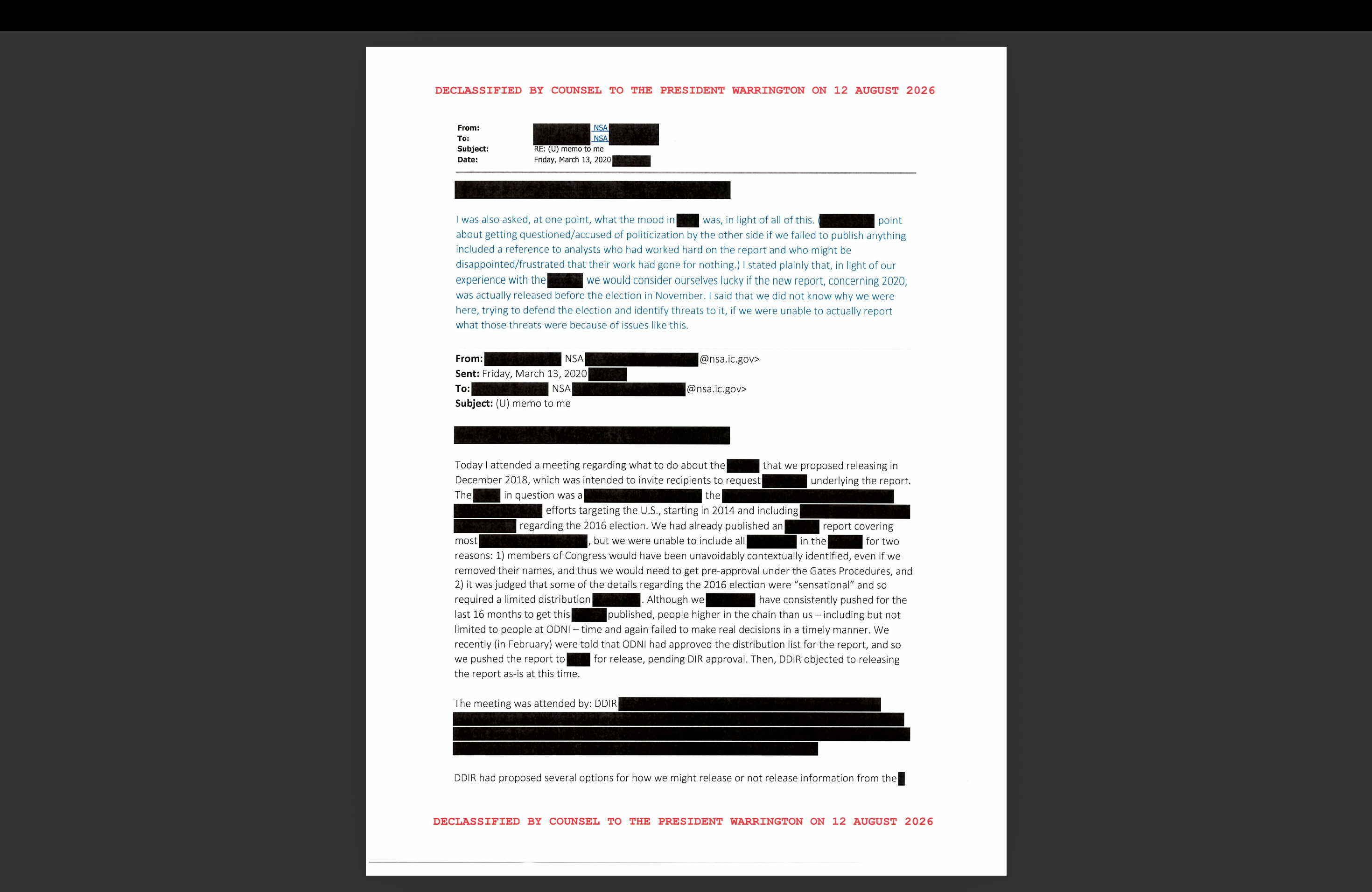
Four pages of emails, all dated March 13, 2020, were released on Aug. 18 by the White House Government Transparency Task Force.
According to one email—written by an unidentified NSA employee following a meeting about intelligence reporting foreign efforts to target the 2016 and 2020 presidential elections in the United States beginning in 2014—internal concerns were raised about the agency’s suppression of the reports.
“We did not know why we were here, trying to defend the election and identify threats to it, if we were unable to actually report what those threats were because of issues like this,” the NSA employee wrote.
According to another email, NSA analysts had proposed releasing the reports in 2018.
Task force officials are digging through files to determine why evidence of the Chinese Communist Party’s attempts to influence the elections was not passed on to the president, Congress, and some intelligence leaders, including then Director of National Intelligence John Ratcliffe, now CIA director.
Certain aspects of the reports on the Chinese election influence were censored because “it was judged that some of the details regarding the 2016 election were ‘sensational’ and so required a limited distribution [redacted],” an NSA analyst wrote, noting that colleagues tried for 16 months to get the information published.
“People higher in the chain than us—including but not limited to people at ODNI [Office of the Director of National Intelligence]—time and again failed to make real decisions in a timely manner,” they said.
Intelligence officers were told in February 2020 that the office approved the report, and analysts prioritized its delivery, but the NSA deputy director blocked its release, according to the documents.
George Barnes served as NSA deputy director from 2017 to 2023.
“[The deputy director] explained that he was concerned that releasing the [redacted] at this time—in the current political climate, with an acting [director of national intelligence (DNI)] who had been tasked … to ‘clean house’ in the intelligence community, and with an administration that is suspicious of the [intelligence community] and aggressive in removing anyone who stand in their way—would damage NSA’s credibility,” the analyst wrote, referring to Trump appointee Richard Grenell, who became acting DNI on Feb. 20, 2020.
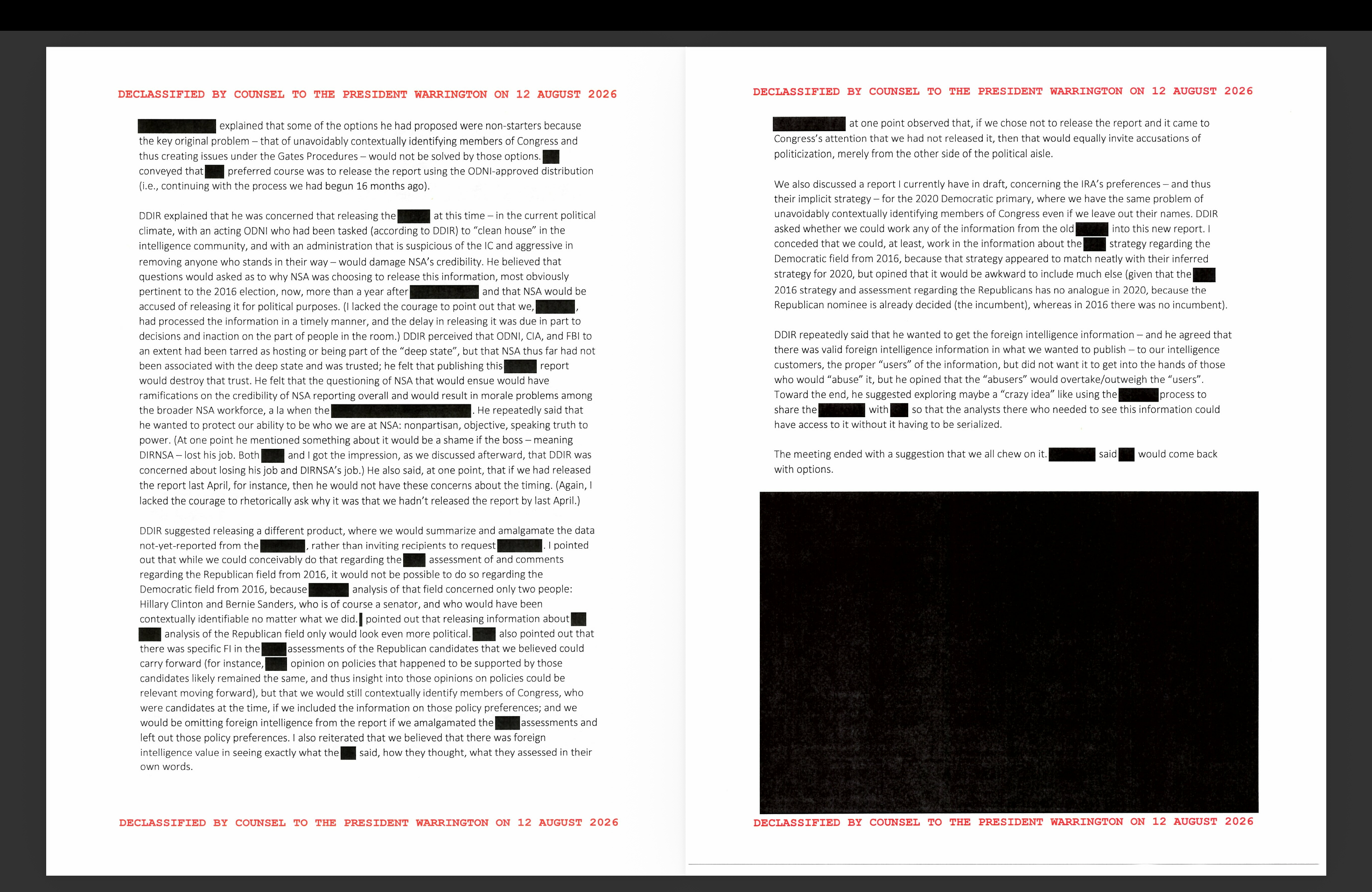
The analyst said the deputy director was concerned that releasing the information could be viewed as political in nature because of the two-year delay.
“I lacked the courage to point out that we, [redacted], had processed the information in a timely manner, and the delay in releasing it was due in part to decisions and inaction on the part of people in the room,” the analyst wrote.
According to the analyst, the deputy director also sought to keep the NSA’s reputation separate from the CIA, FBI, and ODNI—agencies he perceived “had been tarred as hosting or being part of the ‘deep state.’”
The analyst said the deputy director thought publishing the report would “destroy that trust.”
“He felt the questioning of NSA that would ensue would have ramifications on the credibility of NSA reporting overall and would result in morale problems among the broader NSA workforce, a la when the [redacted],” the analyst wrote.
Other elements of the gathered intelligence were excluded from reporting because it would have been impossible to conceal the identity of members of Congress, the analyst said. Such cases require special approval, as dictated by the “Gates Procedures,” established by Robert Gates, former director of Central Intelligence, in 1992.
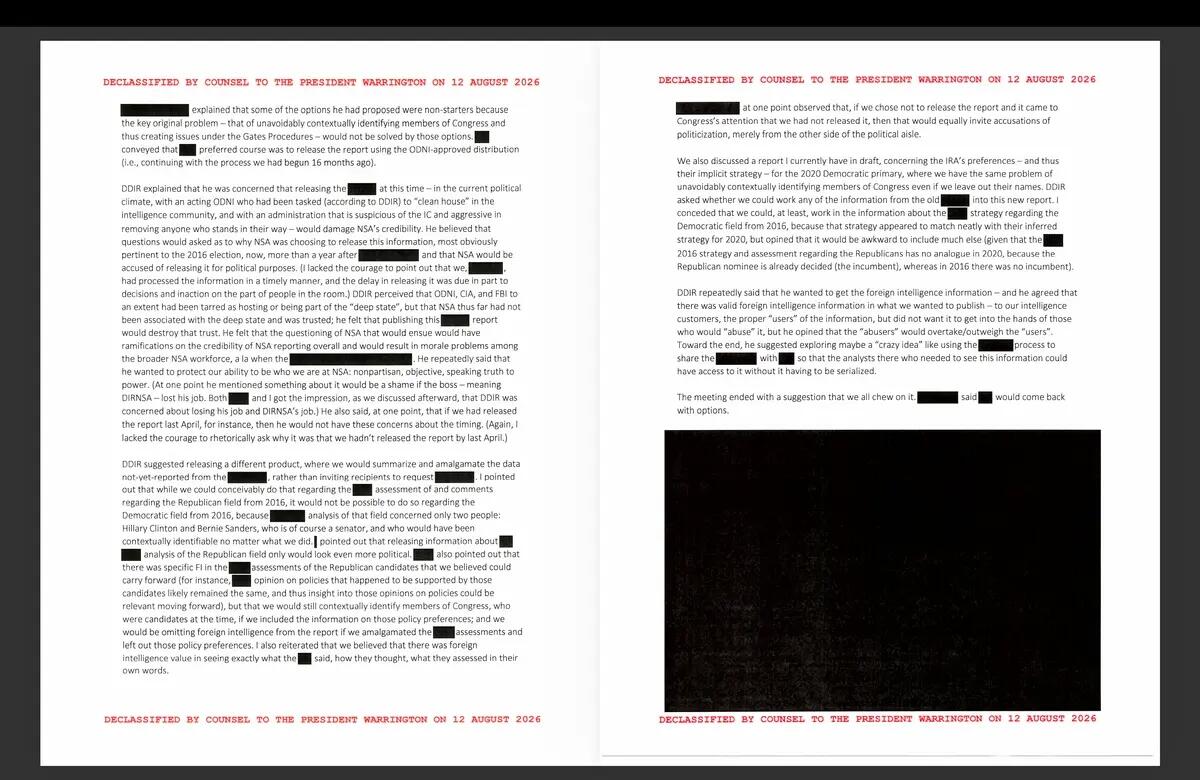
Newly declassified National Security Agency documents include emails between intelligence officers about decisions made at higher levels to not share information with President Donald Trump, released by the White House Government Transparency Task Force on Aug. 18, 2026. Courtesy of the White House
Given the circumstances of the discussion, the other analyst deduced that disclosure was unlikely, writing in the memo: “In light of our experience with the [redacted], we would consider ourselves lucky” if new intelligence reporting regarding the 2020 election was distributed before election day.
The meeting concluded with the deputy director suggesting “exploring maybe a ‘crazy idea’ like using” an unidentified redacted process to share intelligence “so that the analysts there who needed to see this information could have access to it without it having to be serialized.”
Politicized Intelligence
A senior White House official briefed a small group of reporters, including The Epoch Times, on Aug. 16 about the upcoming release, emphasizing the politicization of intelligence gathering and reporting revealed by the documents.
“It shows that a very high-ranking official, a deputy director of the NSA at the time, made clear he wasn’t intending on sharing some of the intelligence about China and other election threats because of various political statements,” the official said.
“That’s the highest official thus far we have seen mentioned, who seemed to have some awareness that information would not be being sent to the president and to Congress and to policymakers about election interference or election security and election vulnerabilities.”
The internal emails came to light because they were forwarded to a civilian ombudsman tasked with overseeing intelligence community shortcomings.
Investigations Continue
More documents are under scrutiny by task force members, and new releases are expected soon, according to the administration official.
He said that in a few months, the task force is expected to release a “full body of evidence” detailing that there was “extensive intelligence about the vulnerabilities of the election system” gathered by U.S. intelligence agencies during the period between 2019 and 2021-22.
“But for some reason … the intelligence agencies just made a decision not to brief it to the people who could potentially implement policies that would address the vulnerabilities,” the official said.
Voting machine integrity was also of concern to the intelligence community, according to the official, with five foreign nations found to be capable of hacking U.S. election machines.
“The notion that we would go six years without fixing a known vulnerability is something that we’re all eager to solve,” he said.
The task force expects to release more details about some of the vulnerabilities in the coming weeks.
Prior revelations related to the suppression of intelligence reports include evidence that information was intentionally kept out of presidential daily briefings and declassified FBI documents. Then-FBI agent Nikki Floris wrote to a colleague that she “was basically running a shadow government across the FBI at one point” after successfully blocking the release of certain reports.
The Epoch Times reached out to the NSA for comment but did not receive a response by publication time.