Beijing Moves Down The AI Stack: After GPUs, China Is Coming For Broadcom's Switches
Xi Jinping lands in Washington for a state visit today, but as Bloomberg sums up the mood in one line: the two leaders "may find common ground on AI safety, but neither is willing to give ground in the technology race." And right on schedule, the FT reports that Beijing has started counting Broadcom switches.
According to the FT, China's State-owned Assets Supervision and Administration Commission (SASAC), which oversees the country's state-owned companies, has spent recent weeks surveying how much Broadcom switching gear is installed in state-controlled data centres. The count came back... high: "The survey found that the penetration rate of Broadcom switches among state-owned companies could be as high as 90 per cent, one of the people said."
The exercise supports Beijing's "domestic chips for domestic use" campaign. The initial findings could lead SASAC to issue "informal guidance" telling state data centres to cut back on Broadcom. In Beijing, informal guidance tends to carry the weight of a formal order.
Why switches, and why now
Switches get little attention in the AI boom, but they decide whether 10,000 accelerators work together as one training cluster or sit around as 10,000 very expensive heaters. Broadcom's merchant Ethernet silicon dominates that layer worldwide. Nvidia and Huawei also sell high-end switches in China, but Nvidia is already barred from state-backed data centers. That leaves Broadcom as the last major American supplier embedded in China's state AI build-out.
SASAC is also looking at how Broadcom sells, not just how much. Per the FT, the agency is checking whether Broadcom used its market lead to bundle products or require purchase commitments of up to tens of thousands of switch chips. Those terms allegedly limited how much H3C and Ruijie Networks could buy from other vendors such as Huawei. H3C and Ruijie are the preferred vendors on the procurement lists behind billions of dollars in annual public-sector IT spending. If that line of questioning sounds familiar, Beijing used the same approach last year when it found Nvidia had breached antimonopoly law over its Mellanox deal. Mellanox is, notably, a networking business.
Two caveats from the FT story:
- Private operators are exempt. ByteDance and Alibaba are not covered, so the rule doesn't reach the companies doing most of China's frontier training.
- Nothing gets ripped out. Existing gear stays in place. One rack-maker sales rep described the policy as "part of a broader policy to 'nationalise the supply chain'." In practice, that means a replacement cycle rather than a purge.
The stakes for Broadcom
According to its latest 10-K, 17% of Broadcom's FY2025 revenue (about $10.9bn of $63.9bn) came from shipments to China including Hong Kong. That was down from 20% a year earlier. Much of that figure is ship-to accounting for contract manufacturers assembling gear for non-Chinese customers, so true Chinese end-demand is smaller. AVGO rose about 0.5% on the headline, which suggests traders don't see much damage. Sure enough, while the near-term P&L hit is modest but the strategic cost is bigger: switching is set to become a multibillion-dollar market inside China, and it is being set aside for domestic suppliers.
The bigger picture: Goldman's numbers on China's self-reliance push
Goldman's recent research shows how quickly the domestic stack is filling in:
- The demand side is large. Goldman's desk points out that China's domestic AI chip market is "quietly gearing up for a staggering 69% compound annual growth rate through 2030." GS Research's CHIPS IV forecasts China semiconductor capex rising +13% / +15% / +15% in 2026–28, driven by memory and advanced-node capacity.
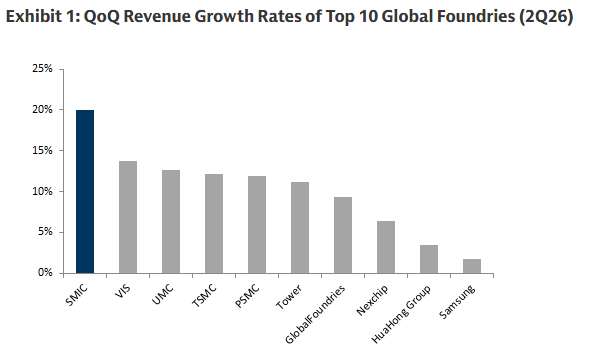
- The foundry is full. In the SMIC note (available to pro subs here), Allen Chang says SMIC grew revenue 20% QoQ in 2Q26. That was the fastest among the global top-10 foundries, whose aggregate growth was 11.5%. Chang attributes it to "China's strong AI demand and customers diversifying their suppliers to better secure capacity." Utilization is expected to stay above 95% through 2H26, new wafer pricing takes effect in 3Q26, and 54–71% of capex goes to 7nm and advanced nodes. Goldman expects no ASP declines because there's no spare capacity to discount.
- The private sector is localizing without being told to. In the Alibaba note after the Apsara conference (available here for pro subs), Golman analyst Ronald Keung forecasts capex of Rmb209bn / 243bn / 260bn for FY27–29E and a cloud power footprint of 20GW by 2032, supported by "unique cost advantages from its custom T-head silicon." Alibaba is exempt from the SASAC push, yet it is building its own chips anyway.
- Policy points the same way. Goldman chief China economist Hui Shan writes that policymakers are "focused on advanced manufacturing rather than broad-based easing." So while consumers deal with a housing slump, the fabs keep getting funded.
Put Goldman's research next to the policy timeline and the pattern is clear:
- August 2025: New data centers told to source at least 50% of chips locally.
- September 2025: Big tech told to stop buying Nvidia's China-specific chips, and regulators issued the Mellanox antitrust finding.
- November 2025: State-funded data centers banned from using foreign AI accelerators (Reuters).
- June 2026: A reported ~2 trillion yuan ($295bn) national compute plan through 2028 with an 80% domestic-content target (TechTimes).
- September 2026: The survey of switches, one of the last foreign-made layers left.
On the supply side, Huawei used last week's Huawei Connect to lay out an Ascend roadmap of the 960 in 2027, 970 in 2028 and 980 in 2029. It also showed an Atlas 960 SuperPoD that links 4,096 NPUs over its proprietary UnifiedBus interconnect, which means its networking is in-house too (Irish Times). DeepSeek reportedly plans to deploy at least 160,000 Ascend 950DTs. Huawei has raised 950DT prices by 60%, citing "tight component supply," which suggests pricing power is not an American monopoly either.
The catch: domestic gear costs more to run
Industry experts told the FT that Huawei's switches are less energy-efficient than Broadcom's, which means higher power bills for users. That matches Goldman's SMIC work: with utilization above 95% and no price cuts coming, "domestic" currently also means "capacity-constrained and not cheap." China's workaround is to build power generation faster than anyone else, which they've done this admirably.
And unlike the US, China has the electrical capacity to build all of this. China has 4000GW of total power generation and growing 20%. The US is at 1200GW and flat (with PJM and ERCOT nearing capacity) https://t.co/mEwD3LzvXs pic.twitter.com/p0xFKqeEAB
— zerohedge (@zerohedge) September 23, 2026
Bottom line
Export controls were meant to keep China a generation or two behind in AI hardware. They did slow progress in places, but they also gave Beijing both a reason and the political cover to replace every layer of the stack: accelerators, foundry, memory, interconnect and now switches. Each layer runs slower and hotter than its US counterpart, but it is Chinese-made. The market Broadcom has lost is small this year and likely to shrink further. Goldman's 69% CAGR figure describes a market growing quickly, and US suppliers are increasingly shut out of it.