J-50 Designers Reveal "Leapfrog" Technology For China's Next-Gen Stealth Fighter
China’s next-generation combat aircraft will be able to fly by themselves if a pilot loses consciousness, navigate without satellite signals and operate in self-reorganising large drone formations. That is the plan laid out by researchers from the Shenyang Aircraft Design & Research Institute, a top Chinese military aircraft design organisation, in a paper last month, the SCMP reported.
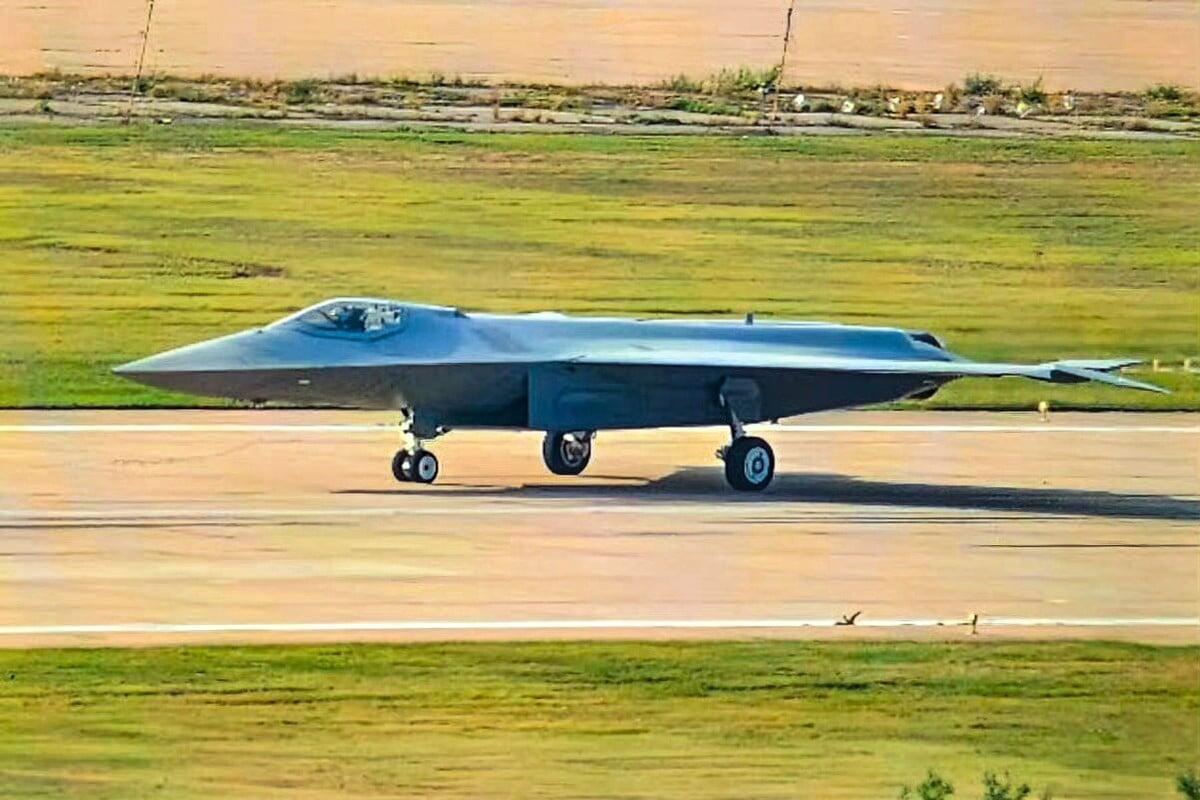
The institute is associated with the development of the Chinese next-generation aircraft commonly referred to as the J-50, which first appeared in flight-test imagery in December 2024, although the paper does not mention the J-50 by name or confirm that the aircraft will incorporate any of the described technologies.
China’s future fighters, including the J-50 and J-36, are considered rivals to the US Air Force’s sixth-generation main fighter programme, the F-47, being developed by Boeing.
The lead researcher is chief flight-control designer Zhang Dong at the institute, and his team’s paper – rare for its public details – was published in a peer-reviewed journal Aircraft Design in August.
China’s next-generation stealth fighter programs were undergoing a “leapfrog transformation from being able to fly steadily to being able to win in combat”, wrote Zhang and his colleagues.
Zhang’s study presents a future of pilots handing over control during periods of extreme workload or incapacitation, quantum navigation technologies supporting operations in satellite-denied environments and crewed fighters coordinating attack, reconnaissance and protection missions with reconfigurable wingman drones.
The team’s institute is part of the state-owned Aviation Industry Corporation of China, which oversees much of the country’s aircraft research and development.
Its subsidiary, Chengdu Aircraft Industry Group, is also developing the J-36 fighter, widely regarded as another candidate for China’s next-generation sixth-generation combat aircraft.
In 2025, an investigation by defence news website, The War Zone, using satellite imagery found that the Chengdu J-36 and the Shenyang J-50 aircraft were both based at an experimental military airfield near Lop Nur, a highly secretive site for aerospace test flights that has often been compared to the United States’ Area 51.
Their simultaneous presence at the same base suggested that China’s military was actively supporting the parallel development of the two programmes.
Zhang’s paper presents a rare technological road map for future combat aircraft, describing a fundamental restructuring of the flight-control system from a device concerned mainly with flight quality into a core enabler of collaborative engagement, intelligent manoeuvre and mission effectiveness.
The change reflected what the authors described as three successive eras of air combat.
In the earlier “energy manoeuvrability” era, victory depended heavily on physical manoeuvring performance in close-range combat, while flight-control systems were largely closed and centralised, with specialised hardware and software designed mainly to keep the aircraft stable, controllable and responsive to pilot inputs.
The rise of long-range radar, stealth shaping and precision-guided weapons shifted combat towards “information manoeuvrability”, where detecting, tracking and attacking an opponent before being detected became increasingly important.
Fifth-generation aircraft such as the F-22 and J-20 use full-authority digital fly-by-wire systems and increasingly integrate flight control with fire-control and propulsion systems through high-speed data links.
The authors argued that the next phase was “cognitive manoeuvrability”, in which artificial intelligence, autonomous systems and distributed networking allowed air combat to move from platform-versus-platform competition towards system-level contests involving manned-unmanned formations.
This changes what flight control is expected to do.
“The functional positioning of the flight control system is undergoing a fundamental restructuring – from a platform controller merely pursuing flight quality to a core enabler of collaborative engagement management, intelligent manoeuvre decision-making and closed-loop mission effectiveness,” Zhang and his co-authors wrote.
The first major capability is autonomous flight control.
Instead of making pilots constantly turn high-level battle plans into precise stick movements, the new system would let on-board intelligent algorithms do that job automatically, translating tactical orders into smooth, continuous flight actions while keeping the aircraft safely within its physical limits, even during extreme manoeuvres.
The aircraft would constantly monitor its own health by fusing data from sensors such as inertial navigation, airspeed indicators, control-surface positions and engine performance.
This would allow it to assess its flight state, estimate remaining manoeuvrability and detect potential problems before they develop into emergencies.
The system could then automatically adjust control settings and redistribute on-board resources while strictly enforcing safety boundaries to avoid stalls, loss of control or stuck control surfaces.
In particularly stressful situations, the aircraft could take over from the pilot.
The paper proposes allocating control authority between humans and autonomous systems so that pilots can spend less effort on low-level aircraft handling and more on battlefield assessment and tactical decisions.
During periods of excessive workload or if a pilot loses the ability to control the aircraft, the system could take control and continue executing the intended tactical task while prioritising flight safety.
The second major change concerns navigation.
Future combat aircraft may need to operate when satellite navigation is jammed, disrupted or unavailable, prompting the researchers to identify quantum inertial navigation, visual navigation, geomagnetic navigation and terrain matching as potential technologies for passive autonomous navigation.
The paper proposes combining data from various sensors to reduce errors and prevent failures caused by the degradation or loss of any single sensor under severe electromagnetic interference.
Quantum inertial navigation is therefore presented as part of a broader effort to give aircraft an independent sense of movement and position, rather than as a replacement for GPS.
The study framed these technologies as areas requiring further engineering research and implementation, rather than saying a quantum navigation system had already been deployed on a Chinese fighter.
The biggest shift, however, may come from the way multiple aircraft work together.
Future formations could pair crewed fighters acting as command nodes with uncrewed wingmen assigned to reconnaissance, attack and protection roles. Flight-control systems would coordinate their positions, routes, electromagnetic spectrum use and weapons-launch windows while dynamically allocating tasks between aircraft.
The authors saw this as more than a traditional formation controlled by a single leader.
If an aircraft suffered a malfunction or combat damage and left the formation, the remaining aircraft could automatically reorganise, replace the missing node and redistribute its unfinished tasks.
The system used consensus-based coordination and a dynamic “virtual leader” replacement mechanism to maintain autonomous operation without relying on a permanent central node.
Zhang and his team said single-aircraft autonomous control guaranteed survival in complex environments, while swarm coordination delivered multiplied combat effectiveness.
The paper pointed towards a more heterogeneous air-combat network rather than a simple arrangement of one crewed fighter and several identical drones.
It further highlighted large collaborative wingmen alongside various aircraft and autonomous platforms, suggesting a future architecture in which crewed fighters, larger unmanned aircraft and smaller autonomous systems could perform different functions within the same network.
Aircraft such as the Chinese Y-20 transport aircraft, the J-20 fighter and even the H-20 stealth strategic bomber, which is believed to be under development, could potentially form part of such a combat network.
However, Zhang and his team did not say whether the “combat group”, or the crewed “lead aircraft” and unmanned wingmen, would consist mainly of large numbers of drones or a combination of the larger aircraft described above.
The Shenyang Aircraft Corporation and the paper’s authors did not respond to a request for comment.
Based on the paper’s publicly available discussion, the researchers suggested retaining conventional systems engineering as the safety backbone while using intelligent tools for tasks such as parameter optimisation, test expansion, automated testing and defect detection, with early trials conducted on lower-cost uncrewed platforms before broader adoption in major aircraft.
But the researchers do not advocate handing the aircraft’s most safety-critical functions directly to artificial intelligence (AI).
Instead, they identified a basic engineering conflict between intelligence and flight safety.
Data-driven algorithms can be difficult to explain and verify, and they might not apply in every situation, especially in extreme scenarios.
Applying such systems directly to the innermost control loops could therefore introduce unpredictable risks.
The proposed solution was a layered architecture.
“Engineering practice widely adopts a hybrid architecture with a closed core and open periphery,” the team wrote, allowing high-reliability, real-time functions to remain tightly controlled while more flexible software functions could be upgraded and connected across different platforms.
Under this model, the inner loop would retain conventional, highly deterministic controls for functions such as attitude stabilization, control-surface actuation and hard flight-envelope protection.
AI would operate mainly in the outer loop, handling tactical decision-making, trajectory optimization, multi-aircraft coordination and payload adaptation, while rigid safeguards would constrain its commands so that its recommendations remain inside a safe operating envelope.
The researchers called for further work on open layered architecture, verifiable intelligent flight control and cross-domain cooperative control, supported by large-scale simulation and flight-test data to improve the robustness and verifiability of intelligent models.