CENTCOM Claims US Military Has Escorted A Billion Barrels Of Crude Out Of Hormuz
Brent crude futures eased toward $103 a barrel by the end of the week as mixed Iran headlines and hopes for renewed diplomacy around next week's United Nations General Assembly weighed on energy markets.
On Saturday morning, CENTCOM commander Adm. Brad Cooper said the US had escorted 1 billion barrels of oil and more than 2,000 commercial vessels out of the Persian Gulf over the past couple of months.
Hostilities at the Hormuz chokepoint continued into Friday, as CBS News reported that two vessels were hit by projectiles. Iran claimed responsibility for striking one over an alleged "illegal crossing."
President Trump said Thursday he would soon make a "big decision" on whether to launch a major assault to "annihilate" the Iranian regime. "It's a big decision," the president told Axios ahead of a planned meeting with Persian Gulf leaders next week. "Anything could happen to me."
We suspect any major action against the Iranian regime could come after the midterm elections, whether kinetic, securing or neutralizing Kharg Island, or a next phase of expanded sanctions that could include not just Tehran but also China.
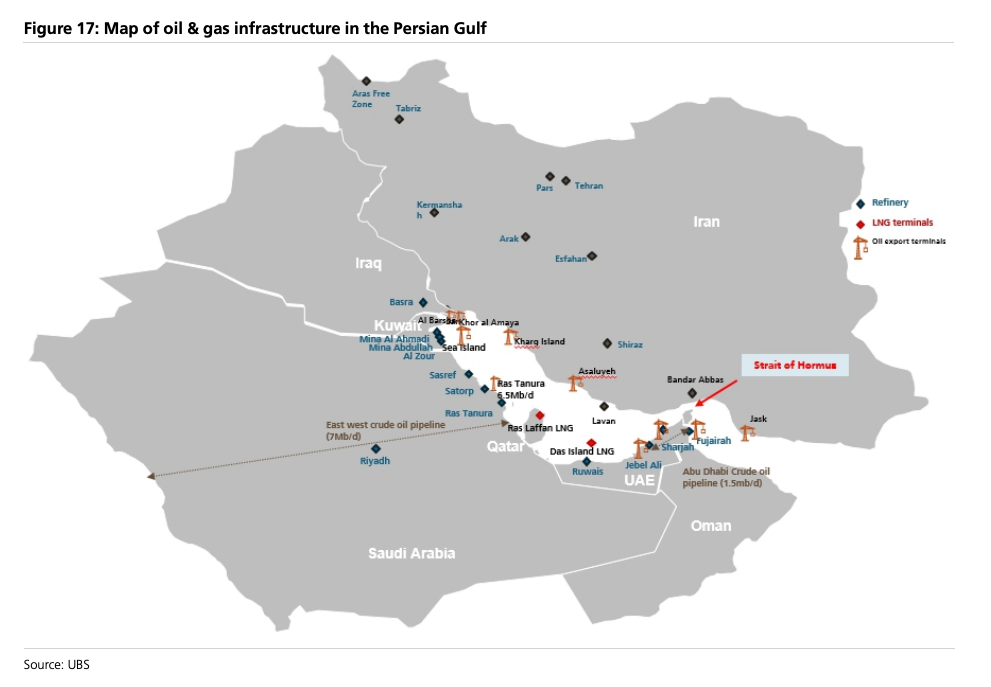
Middle East oil exports have stayed resilient despite the Saudi East-West pipeline disruption, largely because flows have been rerouted through Hormuz.
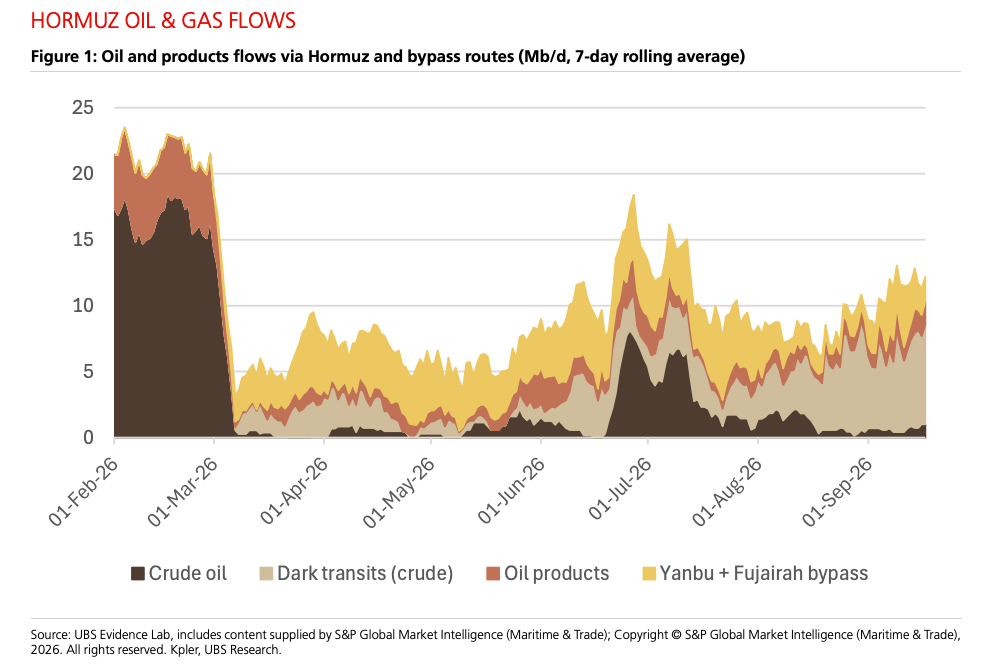
UBS oil and gas analyst Henri Patricot wrote in a note that combined crude and petroleum-product exports through the critical waterway and alternative routes reached about 14 million barrels a day in the two days preceding Friday. He said the weekly average remained around 12 million barrels a day, compared with more than 20 million before the conflict kicked off in late February.
That still leaves global oil markets with a deficit of more than 8 million barrels from these export routes on a weekly basis. This only shows the scale of the disruption that continues ahead of the Northern Hemisphere winter, as Saudi Arabia told major refineries in Europe that crude loadings would be halted next month due to ongoing disruptions to the East-West pipeline.
Patricot said the increased shipments through the Hormuz chokepoint continue to be driven by "dark transits":
Reduced concerns on near-term flows, same uncertainty on resolution
A pick-up in flows via the Strait of Hormuz in recent days has eased some of the concerns around near-term crude supply, impacting prices. More reports indicate that Aramco will raise exports from Oman over the next few weeks. Flows will reportedly be going to Asia. US President Donald Trump said that the is nearing a decision over whether to restart attacks on Iran. He is due to meet GCC leaders next Tuesday. Meanwhile attacks on vessels in the Strait of Hormuz have reportedly continued.
Flows going up in the past couple of days, despite Yanbu interruption
We estimate total crude oil and oil product exports via Hormuz plus volumes diverted to the bypass routes were up to 14Mb/d in the past couple of days, despite the drop in Yanbu. Total flows remain at 12Mb/d on a weekly basis vs. the >20Mb/d preconflict. The increase continues to be driven by dark transits via Hormuz as visible volumes in the latest UBS Evidence Lab data. Another LNG carrier left the Gulf yesterday, the second one we have seen exiting this month. Flows via the Bab el Mandeb Strait remain within the recent range.
Gulf loadings ramping up Gulf
Gulf crude loadings ex-Iran rose to >10Mb/d over the past 2 days and are near their highest level since the start of the conflict at 8.1Mb/d over the past week vs. the August average of 5.5Mb/d. This is driven by higher Saudi and Iraqi exports. There is still no fresh Iranian crude loading on the other hand . Including Fujairah, loadings on the bypass routes averaged 2.5Mb/d in the past 2 days and are at 4.9Mb/d so far in September vs. 3.4Mb/d in August and 6.4Mb/d in July. Oil product loadings in the Gulf are also bouncing back slightly, above 1.5Mb/d vs. sub-1Mb/d for most of the conflict.
Separately, JPMorgan's head of global markets strategy, Dubravko Lakos-Bujas, told clients, "Middle East oil exports have stayed unexpectedly resilient despite the Saudi East‑West pipeline disruption, largely because flows have been rerouted through Hormuz."
Brent crude futures settled around $103.87 a barrel on Friday, while the US diesel crack spread closed around $112.60 a barrel, suggesting the crisis is less about crude and more about refining (read Goldman's diesel report), specifically diesel.