Frenemies: "China May Be Exporting Two Pandas, But It Would Much Rather Export Millions Of Cars"
By Molly Schwartz, cros-aset macro strategist at Rabobank
Frenemies
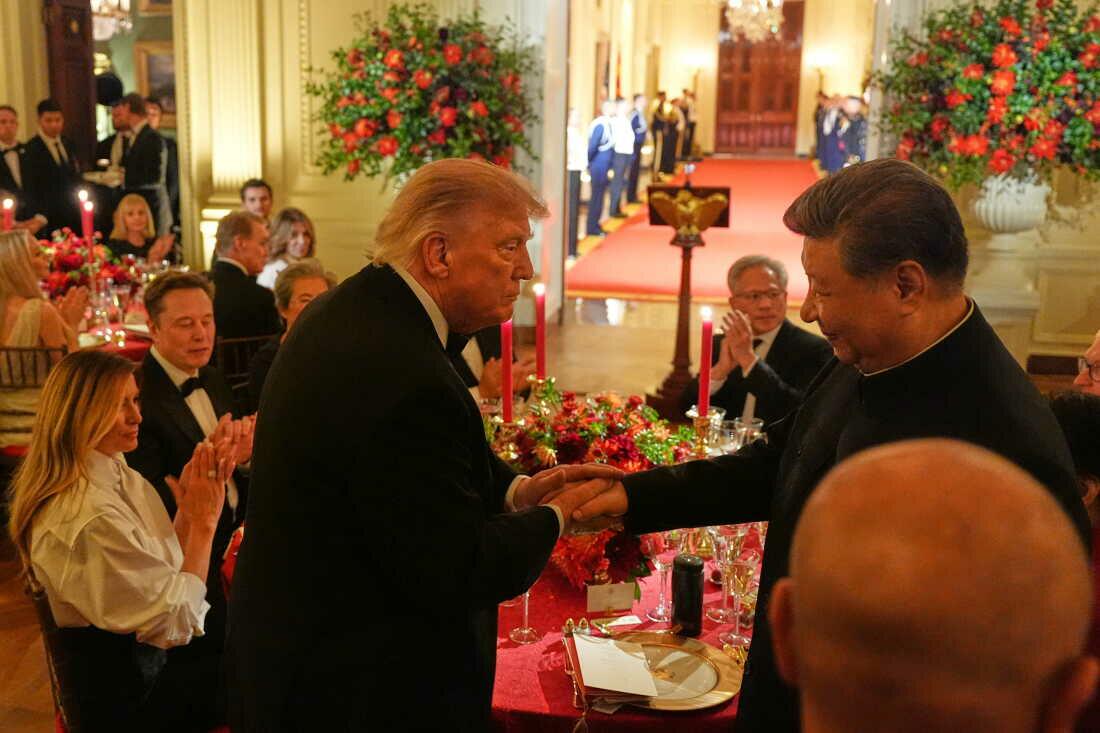
The US-China summit officially began after Xi arrived in Washington, DC, late on Wednesday. Topics including trade, the Strait of Hormuz, and the AI (AGI?) races are expected to arise, but little tangible progress is anticipated.
After all that, Trump and Xi agreed to... rename AI to SI https://t.co/gLaNhLT18I pic.twitter.com/YZ9s2pvGBA
— zerohedge (@zerohedge) September 25, 2026
Instead, the goal is to “prevent something very bad from happening.” Frenemies, Xi and Trump, hailed “healthy competition,” rather than competition “in which one wins and one loses.” In a show of friendship (frenemyship?), China is sending two giant pandas, Ping Ping and Fu Shuang, to Zoo Atlanta. According to Politico, “one person close to the White House” said: “Trump likes to be like, ‘oh, we get along great,’ and it’s like, okay, well, at the same time, these guys are a massive threat to us. We’re in an AI race with them. They’re supplying Iranians with intelligence and weapons…He’s missing the message here. No one cares whether you’re friends with the guy or not… are you advancing [the US’] objectives or not?”
But a friendly veneer is unlikely to temper the tensions simmering below the surface. Although Trump and Xi may have a “personal rapport”, their respective objectives are diametrically opposed. China may be exporting two pandas, but it would much rather export tens of thousands of Chinese-made electric vehicles. For now, the US-China trade-war truce has been extended to January 10, 2027, but what follows remains unclear.
Moreover, the trade-war truce still accommodates a slew of US and Chinese trade barriers, including legacy Section 301 tariffs related to Chinese forced labour from 2018, new Section 301 tariffs, and broad-based Section 232 tariffs. Meanwhile, China continues to enforce its own 10% retaliatory tariff on US goods, alongside barriers affecting American agricultural products.
A similar pattern emerged in the AI discussion: both leaders again emphasized cooperation over confrontation, but few are convinced that either will slow the development of their respective AI capabilities.
The UN General Assembly is still under way in New York City. Some question the organization’s effectiveness in fulfilling its stated mission, which includes “saving succeeding generations from the scourge of war.” Scourge or not, brent has continued to surge, rising another $5 after gaining $5 the previous day, to close at $107/bbl.
After briefly diverging yesterday morning, with the 2-year yield edging lower and the 10-year yield creeping higher, both were again pulled into line with intraday moves in Brent crude. The 2-year yield has struggled to break above resistance at 4.90% but remains near Wednesday’s two-year high, while the 10-year yield continues to reach levels not seen since 2002, most recently at 5.16%. With Brent still climbing and little currently pushing back against inflation expectations, the OIS curve suggests investors are pricing a 68% probability of a hike at the October meeting and more than 93bp of tightening by October next year.
By extension, the USD is the best-performing G10 currency for a second consecutive day. The Brent crude à higher yields à stronger USD pipeline was in full swing, sending EUR/USD to 1.13—its lowest level since late July. The 14-day RSI suggests EUR/USD is somewhat oversold, and nearby support at 1.1325 indicates that a reversal may be imminent. Rabobank’s head of FX strategy, Jane Foley, recently revised her EUR/USD forecast and now expects the pair to trade sideways around 1.14 over a one-month horizon before retracing to 1.16–1.17. Read more here.
The Danish Defence Intelligence Service published a report yesterday stating that there is a “low but growing risk that Russia will launch a limited military attack against one or several NATO countries bordering Russia,” although it remains “highly unlikely that Russia will launch an invasion.” The report also highlights an intensification of Russian cyber and drone attacks, including “the foiled drone attack on Leipzig/Halle Airport, which…had been planned by Russia over a period of several months.” Meanwhile, reports indicate that an AI agent hacked into an Australian government health-data portal in June. As the AI race continues, the risk of hybrid warfare across both land and fibre-optic networks is growing rapidly.
Banxico held the overnight policy rate at 6.50% yesterday but adjusted its statement. Previously, the Bank had indicated that it was satisfied with the reference rate; however, the Fed’s decision to hike a few weeks ago has put Banxico in an uncomfortable position. Banxico has historically followed the Fed to some extent, and diverging policy paths could have significant consequences for USD/MXN, which is quickly approaching 17.8. The peso is particularly sensitive to interest-rate differentials because of its status as an attractive carry currency. Three-month USD/MXN implied volatility has risen from 9% to 10.3%, which is the highest level since April. Elevated volatility, combined with expectations of rapidly narrowing interest-rate differentials between Mexico and both the US and Japan, could point to USD/MXN moving above the 18-handle. However, Rabobank is currently maintaining its forecast of USD/MXN predominantly trading between 17 and 18. Read more here.