Bank Stocks Slide On Resurgent Agentic Fears
It used to be software that was the first casualty of fears of AI disruption. Today, it's the banks.
In a generally flat (and higher for tech stocks) market landscape, banks are conspicuously underperforming today, prompting questions what's the reason for the underperformance.
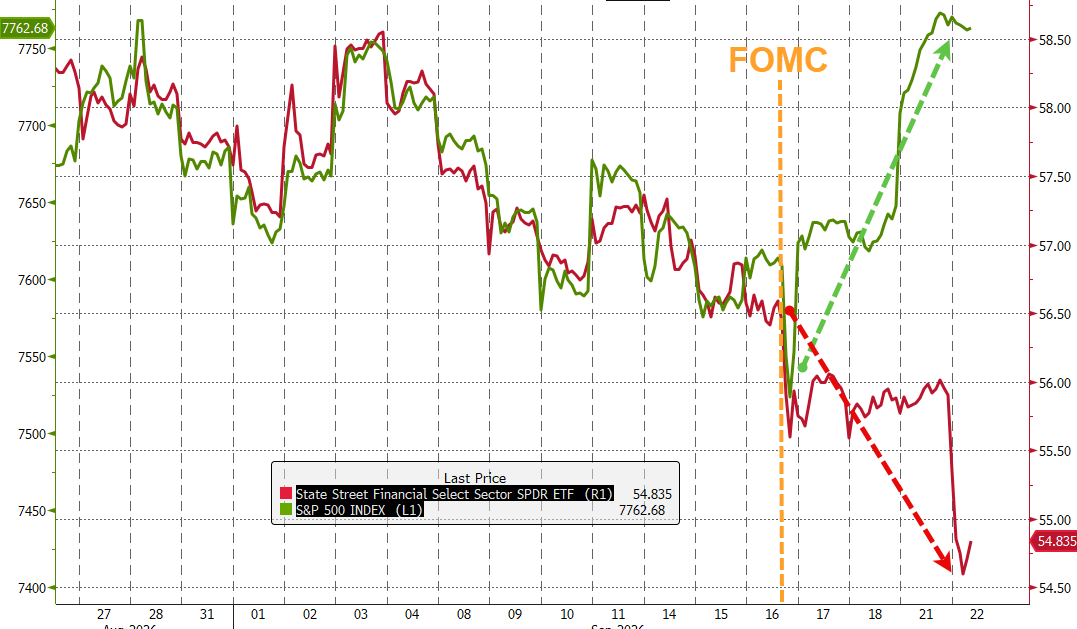
According to some traders, the reason is the market's newfound obsession with the latest shiny agentic models that are taking the world by storm.
As Goldman trader Gaelle Jarrousse writes, she is noting the agentic hit on bank and insurance stocks. She lays it out as follows:
I took a close look at INSTINCT, the ready to use personal agent with simple chat interfaces incl what's app integration. The other one is MUSE in the US. You can ask INSTINCT pretty much everything you want from find a bottle of wine and buy it for you, gym class, restaurants bookings, travel bookings but also find an insurance products and buy it for you, ie this is a one step ahead vs Moneysupermarket for example as INSTINCT does everything for you (5 min process vs a few hours). It is like having a personal assistant. And it will find the best available deal on the market.
She notes that the pushback is do you trust it to give your email address and credit card details to buy things but as time goes by, trust will increase especially with arrival of Muse.
One month ago, the WSJ did a profile on Instinct, calling it the "Latest Viral AI Assistant Rocketing Across Silicon Valley."
A new AI assistant is rocketing across Silicon Valley.
Months after OpenClaw, the viral AI-powered assistant, captured the attention of the technology industry, a company called Instinct appears to be gaining traction among early-adopting techies.
The startup began testing Instinct in private beta in February and quickly generated substantial interest among venture capitalists, who are among its earliest users. Its popularity surged earlier this month, as users began posting about what they saw as a highly capable AI assistant that worked fairly seamlessly, a goal technologists have long considered a holy grail.
Users of Instinct can call or text the AI bot and ask it to respond to emails, manage calendars, book a ride to the airport, arrange a handyman and more. Some users have reported using it to shop for homeowners insurance or order custom merch for a wedding.
“We saw someone buy a house on the platform. A lot of our younger users are using it to find apartment rentals,” Shinn said. “It’s a one-stop shop to do almost everything.”
Going back to Goldman, Jarrousse writes that we saw some early sell off in Telcos on the theme at the end of last week and we are seeing US banks and insurers down on the same theme today. I will pay attention to this and i started to get questions yesterday as a potential trigger for some profit taking in insurance esp when looking at the high valuation of Allianz which is a sector proxy.
She shares some additional color below:
See table below, which is our best estimates based on company data, of Motor and non-motor exposure. The Nordics screen the highest on P&C exposure with Sampo, Tryg and GJEN at the top of the table. Admiral is the one of the pure play on the theme although we can argue that the UK is already very competitive. Amongst the multi liners Generali is at the top given retail P&C exposure followed by Allianz.
Looking at banks, KBC is the biggest P&C with about 20% of insurance revenues. Caixa and Intesa have 3-4% of P&C insurance exposure and I would argue that Italy and Spain are ripe for disruption on other products as well from deposits to asset management given high upfront fees, low betas. Historically the Irish have been weak each time agentic/ deposits competition kicks in and ING can come in the debate too given high L/D, deposits structure, positioning and NII expectations. Outside of agentic, I am also bearish on Caixa given risk of short term NII disappointment due to deposits repricing vs time lag in asset repricing and a valuation at 2.5x P/TE. So overall I will be cautious on rates sensitive banks here and Greece and Lloyds/ Natwest are now my only longs. On the Platforms, we have some constructive feedback from Italian trip and Munich conference on FINECO and FLATEX (see below) and I feel less concerned about those from an agentic disruption angle as they are the disruptors to incumbents and cash sitting on those platforms is meant is to be deployed/ invested.
For now software, where shorts got badly burned after the recent surge, is insulated but as agents make a fresh push for attention - and disintermediation of traditional applications, how long before the pain returns?