France's Debt Alarm Gets Louder: Fitch Cuts Outlook To Negative In Surprise Warning
One week after Moody's maintained France's Aa3 sovereign credit rating with a negative outlook, Fitch Ratings revised its outlook to negative in what Bloomberg described as an "unscheduled move," citing softer economic growth, rising borrowing costs, a widening budget deficit, political fragmentation, and a challenging social backdrop.
"The Negative Outlook reflects a deterioration since our August 2026 review comprising weaker growth, higher borrowing costs and a wider deficit. Taken together, these worsen debt dynamics from an already weak starting point. Persistent political fragmentation and a challenging social backdrop increase the difficulty of delivering sustained fiscal consolidation," the ratings agency wrote in a statement on Friday evening.
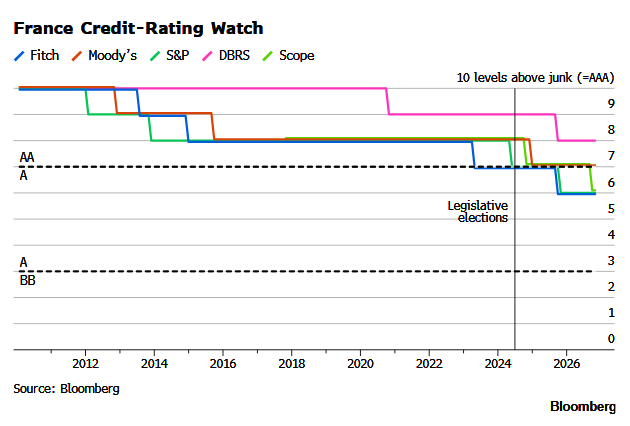
Fitch wrote in the "key rating drivers" section of the statement that French government debt is now forecast to reach about 124% of GDP in 2028, up from 115.7% in 2025 and above Fitch's previous projection of 122.7%.
"We estimate the cumulative fiscal adjustment needed to stabilize debt has risen to around 3.5% of GDP, from 3.0% in August," Fitch said.
Translation: France's years of deficit spending to fund its welfare state have brought it to a so-called fiscal brick wall. The country must introduce common-sense fiscal discipline, such as spending cuts, lower transfers to the EU and reduced migrant spending, measures that presidential candidate Marine Le Pen already offered in a proposed "shadow budget" in early October.
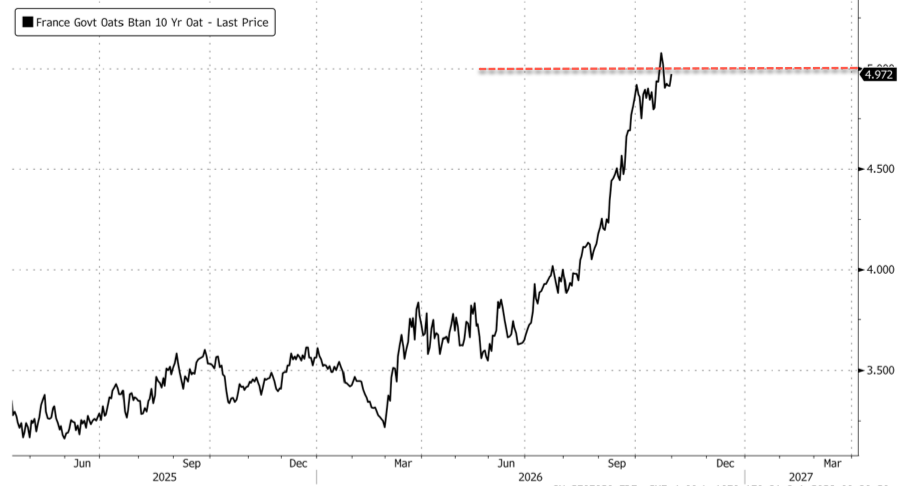
Meanwhile, rising debt-service costs have added immense fiscal pressure. France's 10-year government bond yield climbed above 5% in recent weeks and, as of Friday, stood at around 4.92%.
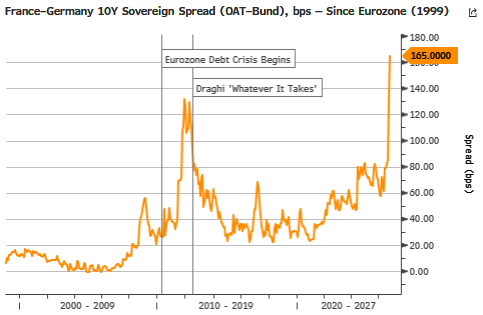
The French 10-year OAT-Bund spread, which measures the difference between France's and Germany's 10-year government borrowing costs, has blown out over the last two months, briefly topping 175 basis points.
A widening spread means investors demand a larger yield premium to hold French debt, signaling greater risk around France's finances, political stability or debt outlook. That spread is the highest since the eurozone crisis nearly two decades ago.
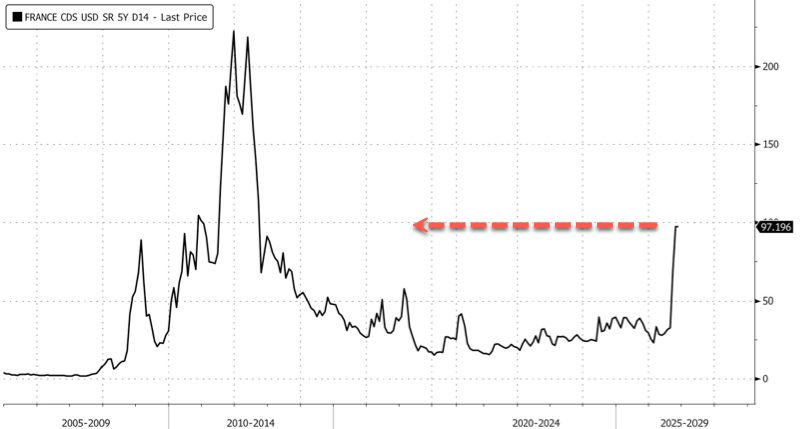
France's failure to correct its debt binge, or a further deterioration in medium-term growth, could trigger a downgrade. Credit risk is surging, with five-year credit default swap hitting levels not seen since the EU sovereign debt crisis.
Fitch forecasts economic growth of .5% this year and .9% in 2027, with further downside risks from social unrest, weak investment and potential energy shocks.
Perhaps the social unrest from far-left groups makes even more sense given that handouts and a generous welfare state are set to be dialed back. Le Pen's odds of becoming the next president are rising, and she has warned that social spending will have to be reduced or France could face a sovereign debt crisis if Macron's policies continue.
Macron is ending his term amid an embarrassing crisis as fiscal troubles, unfettered mass migration, and a cracking welfare state all collide at once.