Beijing Threatens To Cancel Trump-Xi Summit If US Approves New Arms Sales To Taiwan
Chinese President Xi Jinping used today's 18th BRICS Summit to push for a greater diplomatic role in Gulf affairs. The move appears to be transforming the bloc's economic weight into geopolitical influence, really positioning it as a counterweight to US foreign policy.
Beijing's leverage also rests on its control over rare-earth and other critical-material supply chains, as it maintains a "quasi-monopolistic" grip on the industry that will persist through the end of the decade.
Keeping that leverage in mind, Japanese news outlet Kyodo News reported that Beijing threatened earlier today to cancel the summit with President Trump in Washington if the US approves new arms sales to Taiwan.
Kyodo stated:
China has told the United States that it intends to cancel a planned meeting between their leaders later this month if Washington approves any new arms sales to Taiwan by then, multiple sources familiar with bilateral ties said Saturday.
U.S. President Donald Trump, apparently eager to showcase some diplomatic achievements ahead of November's midterm congressional elections, places great importance on holding the summit with Chinese President Xi Jinping.
While preparing for Xi's upcoming trip, China has restated its position that the Taiwan issue is a "red line" in bilateral relations, sources said.
The report comes ahead of Xi's planned summit with Trump at the White House on September 24. The threat is another obstacle for the administration as it seeks to maintain an already fragile diplomatic and trade truce amid worsening relations over the Gulf conflict.
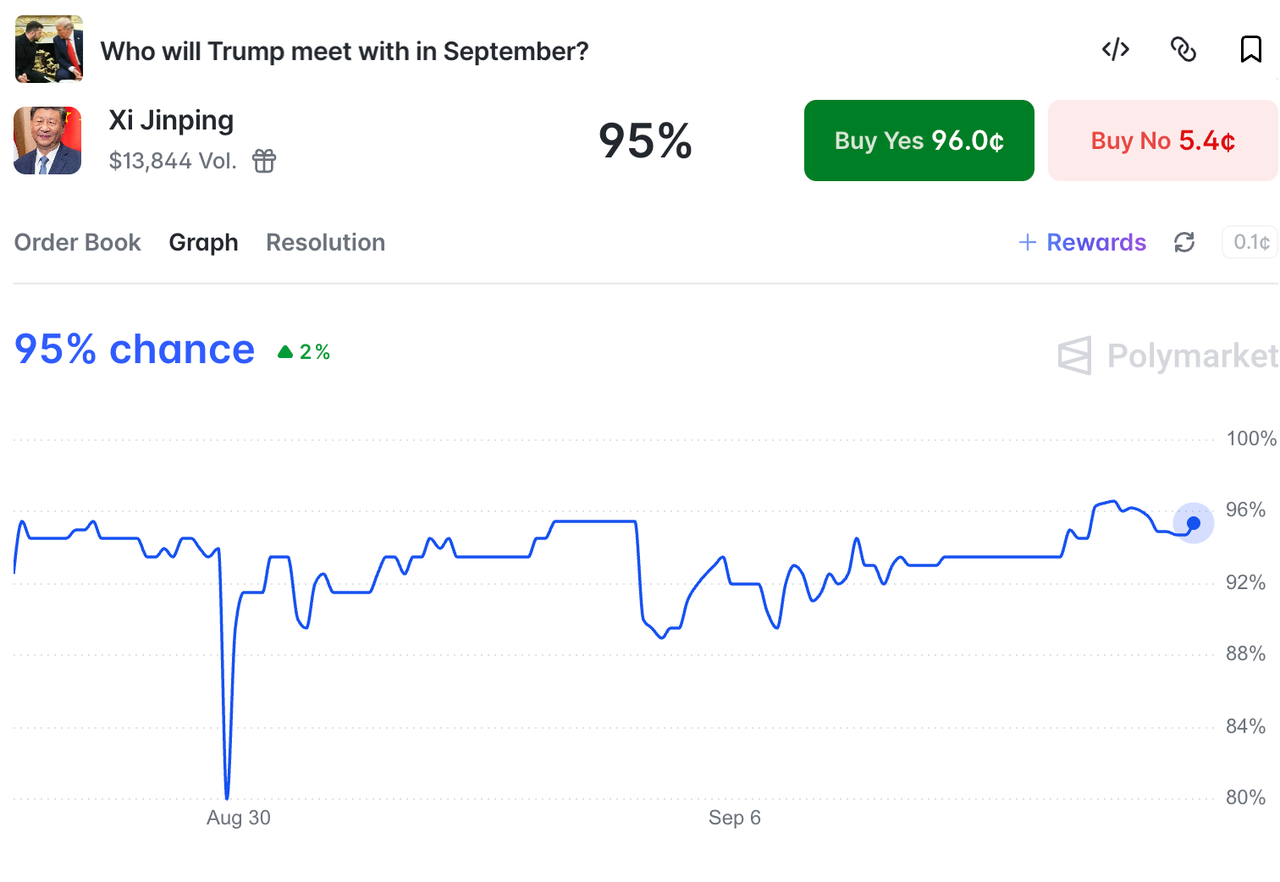
Polymarket traders appear unfazed by the Kyodo report, with Xi still leading the "Who will Trump meet with in September?" market at 95% and odds showing little reaction to the reported threat.
Taiwan arms sales have already emerged as a critical focal point for both superpowers. After meeting Xi in May, Trump declined to commit to approving another weapons package, while Beijing warned that mishandling Taiwan could spark a conflict.
A late-August report cited by Taiwan's main English-language daily newspaper, the Taipei Times, said that China had deployed a record 244 coast guard, research, and other government vessels around the island amid mounting fears of a blockade next year.
"Might be the first in history to see a power play coming from China when it comes to this. Not because they want, but because they can. One of the main reasons would be because of the control they have over critical minerals US has to pick which front to focus on- China or Iran," Teo Sinamin, who runs a Substack focused on rare earths, wrote on X.
Might be the first in history to see power play coming from China when it comes to this.
— Teo (@Teo_Sinamin) September 12, 2026
Not because they want,but because they can.
One of the main reasons would be because of the control they have over critical minerals
US has to pick which front to focus on- China or Iran https://t.co/VIyOSuHaOp
Sinamin continued ...
Greenest Monday ever for critical minerals https://t.co/tgxwyZj1jo
— Teo (@Teo_Sinamin) September 12, 2026
A further deterioration in US-China relations could trigger tighter export licensing or renewed restrictions on critical materials, intensifying pressure on Western industrial and defense supply chains. This issue resurfaced earlier this month when Reuters reported that some Chinese rare-earth suppliers refused shipments to US customers for fear of repercussions from Beijing.
The ongoing disruption supports the bullish investment case for reducing dependence on China, with junior miners and established producers offering alternative supplies. That is certainly the talk among private equity and hedge funds to date. Further escalation could push the decoupling theme to the forefront across the investing world, as these critical-material supply chains are the building blocks for AI data center buildouts, electrification upgrades, reindustrialization, and the upcoming rearmament cycle.
The strongest beneficiaries would likely be companies that can deliver ex-China supplies at scale in time to ease Western shortages as demand soars for the reasons mentioned above.