Apollo Puts A Multi-Trillion-Dollar Price Tag On America's Industrial Comeback
Apollo’s head of thematic investing, Rob Bittencourt, says US reindustrialization is already “underway,” driven by efforts to reshore critical supply chains, rebuild domestic industrial capacity, expand data centers, restart the rearmament cycle, and power up the grid for the next evolution of the modern economy.
Rebuilding the industrial base could require trillions of dollars in additional investment, Bittencourt explained. The effort reflects a broader push to reduce dependence on foreign suppliers, including China, in sectors where disruptions carry significant economic and security consequences, as previously learned during the supply-chain madness of the Covid era.
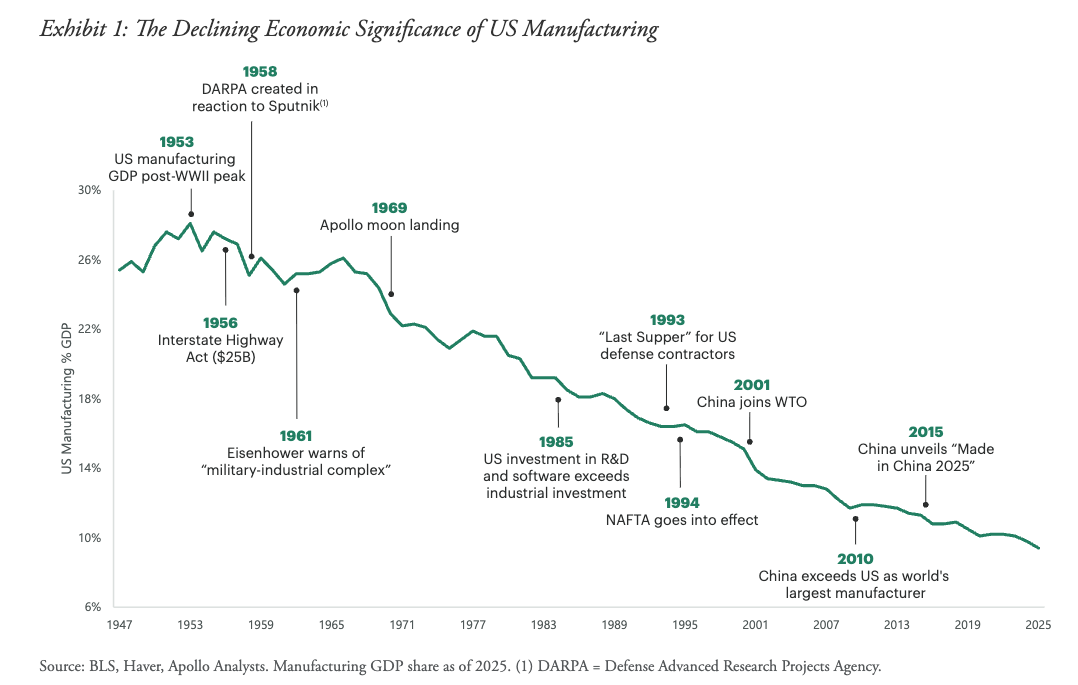
The Trump administration has made reviving domestic production a national priority. Manufacturing's share of US GDP has fallen from about 28% in the 1950s to an alarming 9%, as investment shifted toward services, software, and other asset-light activities.
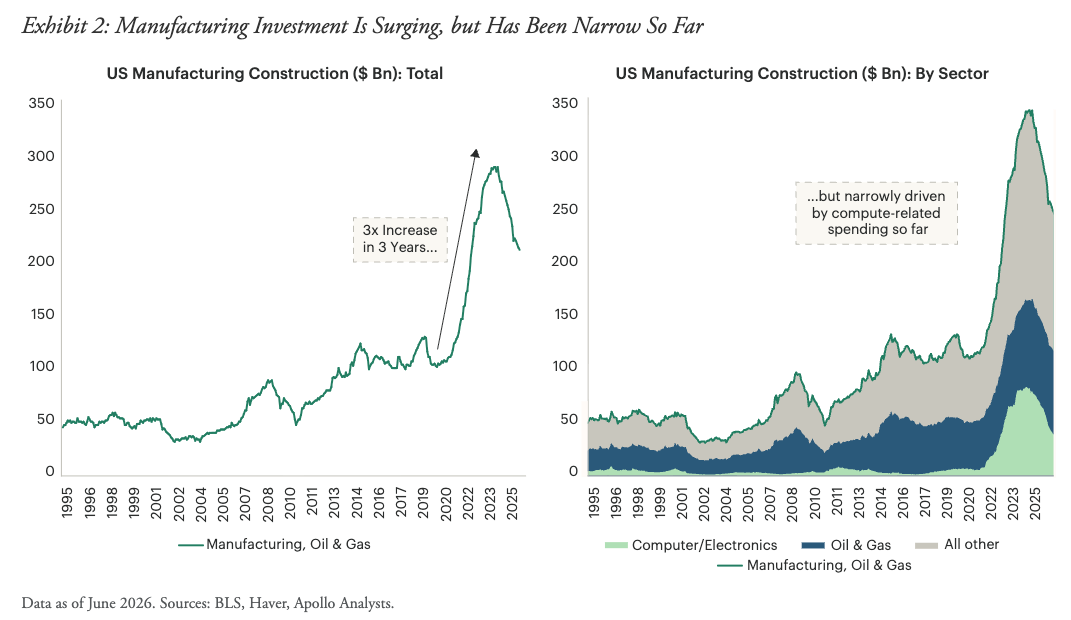
Semiconductor chip plants, data centers and supporting energy infrastructure are now attracting the most capital, but Bittencourt cautions that the recovery remains concentrated in tech-related industries. A broader manufacturing revival will require sustained investment flows, highly skilled labor and broadening domestic supplier networks.
Bittencourt's price tag for restoring the combined US manufacturing and defense industry to its share of GDP in the 2000s would require $2 trillion in incremental investment. Returning to 1980s levels would require a staggering $6.5 trillion.
However, Bittencourt raised some important concerns about the reindustrialization underway, including elevated labor costs, lengthy permitting processes, shortages of skilled workers, and power constraints that threaten to delay projects or raise costs.
Let's not forget that Democrats are hell-bent on imposing data center moratoriums and jeopardizing the whole buildout that has been a driver of economic growth. It has become increasingly odd that one political party would want to halt reindustrialization trends that rebuild the core. But given that Democratic Socialists of America leaders say, in their own words, that they want to destroy the nation from within, none of the moves that Democrats in their "big tent" party should be surprising.
Back to Bittencourt, he said, "Reindustrialization should not be confused with the goal of complete economic self-sufficiency. In our view, the US is unlikely to rebuild every supply chain domestically, nor would doing so make economic sense," noting, "The more realistic objective is strategic self-sufficiency: increasing capacity where supply disruptions carry the greatest economic or national-security consequences. That points toward priority sectors including energy, semiconductors, aerospace and defense, rare earth minerals, pharmaceuticals, and the technologies that enable advanced manufacturing."
He continued, "What emerges, we believe, will look very different from the industrial economy of the 1950s: more modern, more automated, and more resilient, built to support the technologies and security priorities of the 21st century."
And Bittencourt concluded, "This rebuilding is part of a much broader Global Industrial Renaissance."
Professional subscribers can read the full note here at our new Marketdesk.ai portal.