McDonald's Sinks To Four-Year Low As Deutsche Bank Sours On Turnaround Hopes
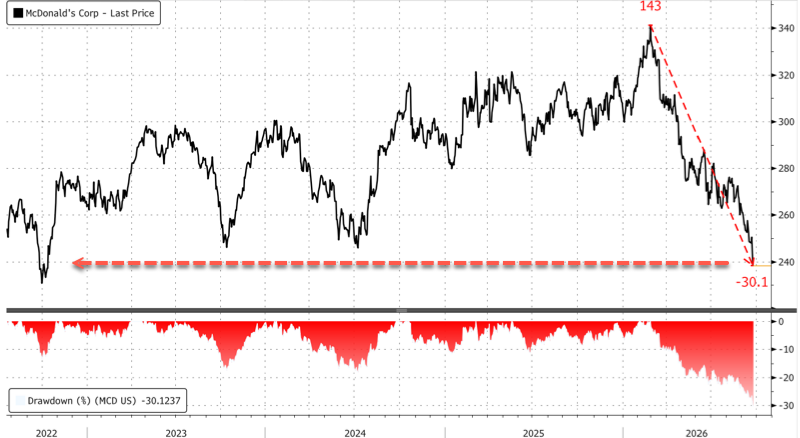
McDonald's shares tumbled as much as 5.9% on Wednesday, the sharpest intraday decline since the early-2020 Covid selloff, before closing down 4.8% at their lowest level since 2022.
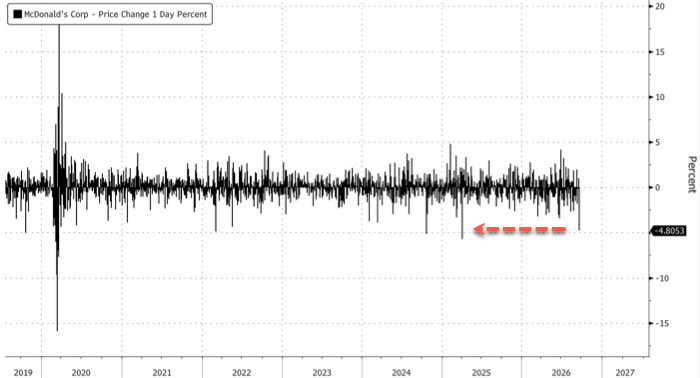
The Big Mac quick-service restaurant chain's investor day heightened Wall Street concerns that softening US sales, coupled with plans for massive investments across restaurant locations, could pressure cash flow and shareholder returns, weighing on the stock for the foreseeable future.
McDonald's held its investor day at its Chicago headquarters on Wednesday. CFO Ian Borden said the burger chain expects its US business to be "slightly negative" in the third quarter, leaving Wall Street analysts at the event fretting over the cost of a multibillion-dollar, multiyear overhaul against a darkening demand outlook that shows no signs of a promising near-term turnaround.
McDonald's unveiled an $8.5 billion support package for franchisees over a decade as its NEXT overhaul will be costly. Management is forecasting higher productivity and corporate operating margins in the low-to-mid-50% range by 2030.
Shares have tumbled into a bear market this year, down 22% and nearing a four-year low.
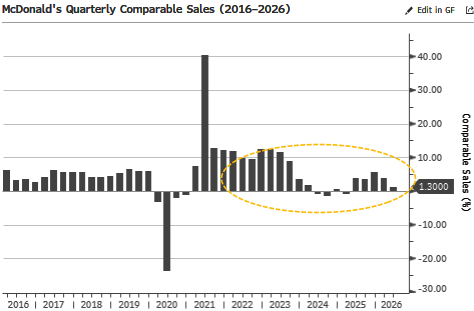
The chain missed second-quarter US sales growth estimates last month, citing execution missteps that hampered efforts to bring back working-class consumers. Newly appointed US business head Skye Anderson admitted at investor day that restaurant operations still needed improvement.
"We expect industry traffic growth in our wholly owned markets will be flat while inflation remains elevated," CEO Chris Kempczinski told the analysts. "The winners will be the companies that create more demand and deliver it more efficiently."
Deutsche Bank's Lauren Silberman told clients on Thursday morning that McDonald's turnaround is still unproven: "We believe the event likely does little to settle the debate on a US SSS inflection (which is key to the bull case)."
Silberman's key quotes from her initial takeaways from investor day:
- US sales remain weak: "US SSS were slightly negative in July and August, and while September should be positive, 3Q SSS are expected to be slightly negative given the slow start to the quarter."
- Fourth quarter caution: "We suspect 4Q US SSS will likely remain sluggish, in part due to a tough comparison."
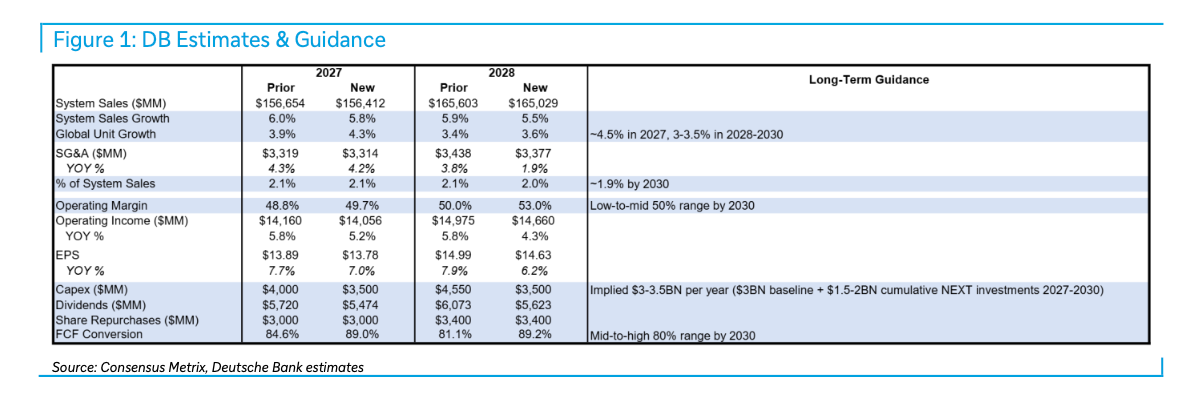
- Forecast cuts: "We are lowering our 3Q/4Q US SSS to -0.5%/-1% (from flat)."
- The capex bill: "We estimate the total system investment for NEXT will cost ~$19BN, implying MCD will contribute ~45%."
- AI and productivity upside: "We walk away with increased conviction in the company's ability to improve unit economics by unlocking productivity through the implementation of its ArchIQ technology platform."
However, she defended the stock: "We think yesterday's reaction was overblown (our 2027/2028 EPS comes down just 1-2%) given the stock is already trading at trough levels."
Separately, UBS equity trader Mark Paski recently warned in a note that Wall Street has turned its backs on consumer stocks.
"While part of the recent weakness can be attributed to higher crude prices and rates, the sharp selloff across apparel, retail and restaurant names suggests investors are looking beyond those factors. Feedback from the conference circuit pointed to a common theme: persistent macro uncertainty, ongoing cost pressures and little evidence of a near-term demand inflection. Management teams broadly flagged pressure from inflation, transportation costs, fuel prices and cautious consumer behavior, reinforcing the view that earnings recovery may take longer than previously expected," Paski said.
Paski noted that consumer companies' share of S&P market capitalization has tumbled to just 13.5%, a record low, from about 31% in 1992. That decline shows the sector is becoming less relevant to investors.