"High Crimes And Misdemeanors": Massie Forces House Vote To Impeach Defense Secretary Pete Hegseth
Rep. Thomas Massie (R-KY) on Tuesday introduced privileged articles of impeachment against Secretary of Defense Pete Hegseth, accusing him of waging an unauthorized war in Iran, ignoring a congressional directive to end it, conducting extrajudicial killings at sea, retaliating against a U.S. senator, seizing Venezuelan leader Nicolás Maduro without legal authority, and launching unauthorized operations in Yemen.
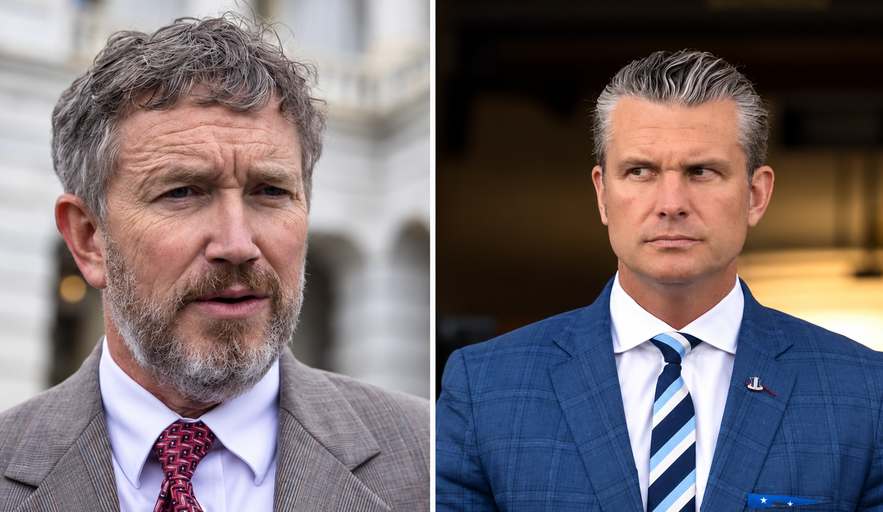
Massie read the resolution on the House floor for more than an hour, pushing the day's first vote series to 4 p.m. and a later series to 9:30 p.m., and filed it as a privileged measure, which under House rules requires a vote within two legislative days. Politico reports the resolution's nature forces a vote this week, the House's last before it leaves for the midterms. Republicans can table the resolution. In a GOP-controlled House, it is widely expected to fail.
BREAKING: Rep. Thomas Massie has just moved to impeach Secretary of War Pete Hegseth for "high crimes and misdemeanors."
— Andrew Kolvet (@AndrewKolvet) September 15, 2026
🤯 pic.twitter.com/TCnZ6sb4VD
The move is unprecedented: a Republican member of the House Judiciary Committee attempting to impeach a Cabinet secretary in a Republican administration. Massie is a lame-duck lawmaker. He lost his May primary to Trump-backed challenger Ed Gallrein after a public feud in which Hegseth traveled to Kentucky to campaign against him.
"By engaging in hostilities in Iran for more than 90 days without congressional authorization, Secretary Hegseth is breaking the law and must be held accountable," Massie said in a statement. "Secretary Hegseth's constitutional violations extend beyond the illegal war in Iran. He is abusing the power of his office to ignore congressional war powers resolutions, to kidnap foreign leaders, and to intimidate critics of the Trump administration by retaliating against them for exercising free speech."
The full text is posted on Massie's official House site. The resolution refers to Hegseth as "Secretary of Defense (also referred to as Secretary of War by the administration)."
The eight articles
Massie's resolution lists eight charges. The first three concern the Iran war and the 1973 War Powers Resolution. The remaining five cover other operations and alleged abuses of office.
Article I - Waging war in contravention of War Powers Resolution §2(c)
Massie charges that Hegseth directed U.S. forces into hostilities against Iran on February 28, 2026, without a declaration of war, specific statutory authorization, an attack on the United States, or an imminent threat. The article cites §2(c) of the War Powers Resolution (50 U.S.C. §1541(c)), which limits the president's power to introduce forces into hostilities to those three circumstances. It quotes a March 17 resignation letter from then-National Counterterrorism Center Director Joe Kent: "I cannot in good conscience support the ongoing war in Iran. Iran posed no imminent threat to our nation." The article argues the war was unlawful from its first day.
Article II - Waging war in contravention of War Powers Resolution §5(c)
This article focuses on Hegseth's refusal to obey H. Con. Res. 86, which both chambers passed in June directing the president, under §5(c) of the War Powers Resolution, to remove U.S. forces from unauthorized hostilities with Iran. The House approved the concurrent resolution 215-208 on June 3; the Senate agreed 50-48 on June 23. Massie was the only House Republican cosponsor. Four House Republicans voted yes: Massie, Tom Barrett (Mich.), Warren Davidson (Ohio), and Brian Fitzpatrick (Pa.). The White House treated the measure as nonbinding and did not withdraw forces.
Article III - Waging war in contravention of War Powers Resolution §5(b)
Section 5(b) requires the president to terminate unauthorized hostilities within 60 days of notification to Congress, with a possible 30-day withdrawal window. Hostilities began February 28; the 60-day mark was about May 1. The administration argued that an April 7 ceasefire "terminated" hostilities and reset or paused the clock. Massie calls that a legal fiction and says Hegseth treated mandatory statutory deadlines as discretionary. Operations, blockades, and later strikes continued.
Article IV - Ignoring laws that minimize civilian casualties
The article accuses Hegseth of disregarding statutes and rules intended to limit civilian harm in Iran and elsewhere. Democratic articles filed in April by Rep. Yassamin Ansari (D-Ariz.) had cited the February 28 bombing of a girls' school in Minab, Iran, and large-scale destruction of civilian infrastructure. Massie's version is framed more generally as a failure to apply civilian-protection law.
Article V - Extrajudicial killings
This charge concerns Operation Southern Spear, the campaign of lethal strikes on suspected drug boats in the Caribbean and eastern Pacific that began September 2, 2025. Massie says Hegseth replaced maritime law enforcement with unauthorized military targeting, resulting in at least 221 deaths. The article also alleges denial of quarter, secondary strikes on survivors, failure to rescue shipwrecked persons, and the invention of "artificial legal authorities" for the campaign. The administration says the boats belong to designated "narco-terrorist" groups and that the United States is in an armed conflict with cartels. Human Rights Watch, WOLA, and U.N. experts have called the strikes extrajudicial killings.
Article VI - Suppressing free speech
Massie accuses Hegseth of using Defense Department authority to retaliate against Sen. Mark Kelly (D-Ariz.), a retired Navy captain and astronaut, for a November 2025 video in which Kelly and five other Democratic veterans told service members they may refuse illegal orders. Hegseth issued a formal letter of censure in January 2026, entered it into Kelly's personnel file, and opened a process that could reduce Kelly's retired rank and pension. Trump called the video "seditious" and suggested the lawmakers should be arrested. Kelly sued the Pentagon. Massie frames the censure as intimidation of constitutionally protected speech.
Article VII - Kidnapping of a sovereign foreign leader
This article concerns Operation Absolute Resolve, the January 3, 2026, raid in Caracas that seized Nicolás Maduro and Cilia Flores and extracted them to U.S. custody aboard USS Iwo Jima. The administration described the mission as a law-enforcement apprehension on existing narco-terrorism indictments, not a war. It involved more than 150 aircraft, special operations forces, and supporting strikes. Massie charges that Hegseth directed the operation without constitutional or statutory authority to seize a sitting head of state. Venezuelan and Cuban casualties were reported; seven U.S. service members were injured.
Article VIII - Unlawful war in Yemen
The last article charges Hegseth with initiating Operation Rough Rider without congressional authorization or an imminent threat to the United States, violating war-powers reporting rules, and conducting strikes that killed civilians and hit rescuers and other protected persons.
Each article concludes that Hegseth "will remain a threat to the Constitution if allowed to remain in office" and warrants impeachment, trial, removal, and disqualification from future office.
How we got here: the Iran war and the 60-day clock
The legal core of Massie's case is the War Powers Resolution of 1973, enacted over President Nixon's veto after Vietnam. In brief:
- The president must notify Congress within 48 hours of introducing forces into hostilities.
- Absent a declaration of war or specific statutory authorization, those forces must be withdrawn within 60 days (plus up to 30 days to extract them).
- Congress may also direct removal at any time by concurrent resolution under §5(c).
U.S. and Israeli strikes on Iran began February 28, 2026, under what the Pentagon called Operation Epic Fury. The administration filed a 48-hour report acknowledging that date. There was no declaration of war and no Authorization for Use of Military Force aimed at Iran.
On April 7, President Trump ordered a ceasefire. On May 1 the White House told Congress that "the hostilities that began on February 28, 2026, have terminated," arguing the 60-day clock had been satisfied. Critics in both parties said a naval blockade in the Strait of Hormuz, forward-deployed forces, and later strikes showed the war had not ended. A brief April pause collapsed. Further U.S. strikes followed in June and July. The administration later treated later bombing as a new set of hostilities with a new clock. Massie has called that "an absurd ruse" and said the Pentagon was "pretending there have been two Iran wars separated by a brief cease-fire."
Congress voted repeatedly. Most early war-powers measures failed by slim margins. Then H. Con. Res. 86 passed both chambers in June - the first time since 1973 that both houses used §5(c) to direct removal from an unauthorized conflict. The White House said a concurrent resolution has no force of law and would not reach the president's desk. Operations continued. Hegseth has publicly described the Iran campaign as necessary, defensive of shipping and U.S. forces, and consistent with the president's commander-in-chief power.
Massie has been on this ground for more than a year. In June 2025 he and Rep. Ro Khanna introduced a bipartisan war-powers resolution to bar unauthorized hostilities in Iran. He has voted for later Iran withdrawal measures and has argued that Article I, not Article II, holds the power to start wars.
This is not the first attempt to impeach Hegseth
Massie's filing is the most procedurally serious because it is privileged and filed by a sitting Republican. It is not the first.
- In December 2025, Rep. Shri Thanedar (D-Mich.) introduced two articles (H. Res. 935) focused on alleged murder in an early Caribbean boat strike - including a reported follow-up strike on survivors - and mishandling of classified information in a Signal chat about Yemen operations. The resolution went nowhere in committee.
- On April 15, 2026, Rep. Yassamin Ansari (D-Ariz.), an Iranian American freshman, filed six articles (H. Res. 1177) with more than a dozen Democratic cosponsors: unauthorized war in Iran; violations of the law of armed conflict and targeting of civilians (including the Minab school); reckless handling of sensitive military information; obstruction of congressional oversight; abuse of power and politicization of the armed forces; and conduct bringing disrepute on the United States. Progressive groups endorsed it. It was referred to Judiciary and never received a floor vote.
Massie's eight articles overlap those earlier efforts on Iran, civilian harm, boat strikes, and Kelly, and add the Maduro raid and Yemen as standalone counts.
Impeachment of a Cabinet officer is rare. The House has used the power against a Cabinet secretary only twice in U.S. history, William Belknap in 1876 and Alejandro Mayorkas in 2024. Conviction in the Senate requires two-thirds. Even if the House adopted Massie's articles, a Republican Senate would be extremely unlikely to convict.