The Fed Rate-Hike Won't Fix The Inflation It Targets
Authored by Lance Roberts via RealInvestmentAdvice.com,
The Fed did what the bond market dared it to do. This past week, in a unanimous vote, the FOMC raised the target range for the federal funds rate by 25 basis points to 3.75%-4.00%, the first Fed rate hike since 2023. The stated reason was “price stability.” Yet this is a Fed whose own chairman has spent the past year insisting that real growth does not cause inflation, and that the drivers of this one sit largely outside the central bank’s reach. As we argued in prior Bull Bear Reports on the debt-and-inflation problem, that tension is not a footnote; it is the entire story of the Fed rate hike, and something worth exploring more deeply.
Make no mistake, it was the bond market that forced the issue. Such is interesting when you consider that Kevin Warsh wants the market to create the signal. Well, he got what he wished for. The 10-year Treasury yield pushed to roughly 5.01% around Wednesday’s decision, a level not seen in 19 years, while the 30-year cleared 5.35%. In other words, the market’s message was clear: “Raise rates, or we will.”
What The Fed Rate Hike Actually Does
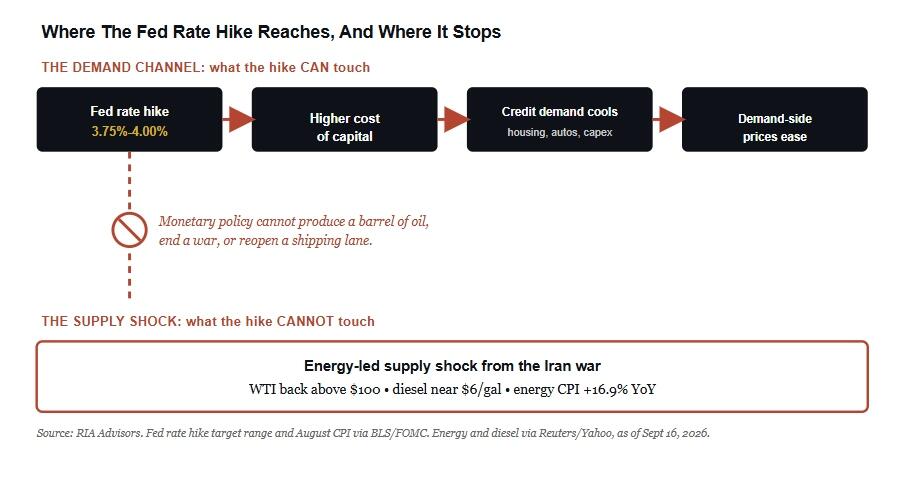
However, what gets lost in transmission is what the Fed is actually trying to achieve through interest rate policy. The mechanism behind rate hikes or cuts is a demand story, nothing more. Raising the policy rate raises the cost of money across the system. Credit-financed demand cools first, mortgages, auto loans, capex, anything that lives or dies on the cost of borrowing. As that demand softens, the economy loses some of its power to bid prices higher, and the pace of increase eases. “Price stability,” in the Fed’s own framing, is really “expectations” stability.
Now, notice what the Fed’s tool never touches, and this was mentioned by Warsh on Wednesday. A higher Fed funds rate does not drill a well, end a war, or reopen the Strait of Hormuz. The Fed rate hike works on one side of the ledger, and one side only: the demand side. Such is the design, and such is also the limit. When the inflation in front of you is a supply problem, a demand lever pulls on the wrong rope.
What Warsh Means By “The Fed Can’t Fix Prices”
However, this is where most of the mainstream commentary gets sloppy. The Warsh school separates two things that the word “inflation” quietly blends together.
- There are relative prices, set in the real economy by supply and demand for actual goods, and then
- There is the monetary unit, the purchasing power of the dollar itself.
An iPhone gets cheaper because of globalized production. Oil prices rise because of a war that threatens supply lines. No policy rate produces either outcome.
When Warsh implies the Fed cannot fix prices, the defensible version of that claim is narrow and correct. Monetary policy cannot repair a supply-driven, relative-price shock. It can only compress demand until something breaks. Milton Friedman’s line, that inflation is “always and everywhere a monetary phenomenon,” is usually quoted, incorrectly, to argue the opposite. However, read that carefully, because it makes Warsh’s point. Friedman described the slow erosion of the currency over the years (driven by a general rise in inflation amid economic growth), not the price of gasoline during a Gulf conflict. The Fed owns the monetary unit, but does not own the oil market.
Look at the composition of the number the Fed is fighting.
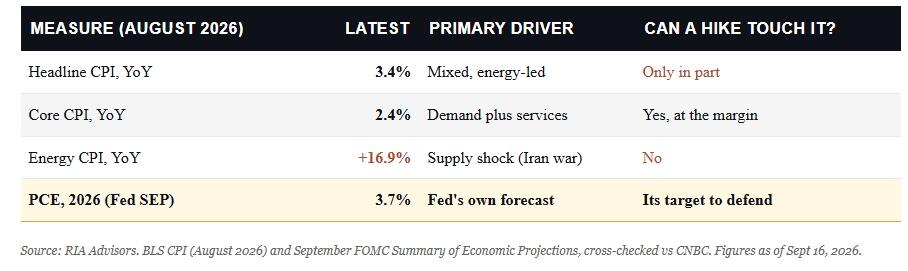
Headline ran 3.4% in August, but energy alone ran 16.9%. Strip the war out, and the overheating story gets much harder to tell. That is not a demand economy running too hot. That is a supply line on fire.
Then Why Hike Into A Supply Shock?
Fair objection. If the Fed cannot produce a barrel of oil, the Fed rate hike looks like “theater.” It is not, and the reason is CREDIBILITY. A central bank tightens into a supply shock for three defensible reasons, none of which involve lowering the price of crude.
- To keep inflation “expectations” anchored, so a one-off energy spike does not get built into wages and contracts and turn into the self-sustaining spiral of the 1970s.
- To protect the institution’s word after the “transitory” humiliation of 2021, when the Fed looked through a shock and watched it metastasize.
- Because the cost of being wrong twice dwarfs the cost of over-tightening once.
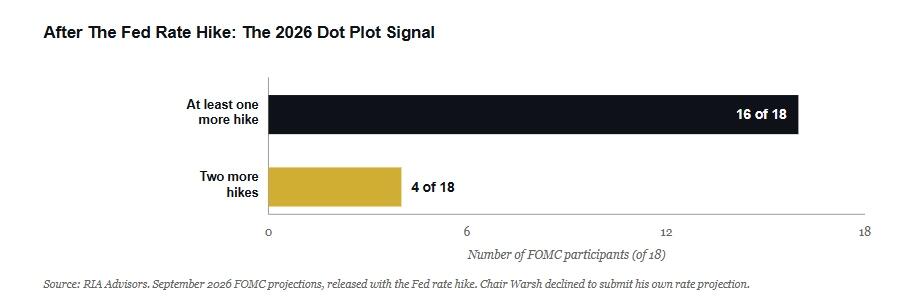
The dot plot shows the committee has made that trade. Sixteen of eighteen officials now see the possibility of at least one more hike this year, and four pencil in two.
“Inflation remains elevated. Today’s policy action will support a timelier return to the Committee’s 2 percent goal.” – FOMC statement, September 16, 2026
Read that quote once again. The committee expressly said that it can steer prices with rates. However, history tells us more precisely that the Fed can reliably steer demand only. Those are not the same claim. Fighting a supply shock with a demand tool is the textbook recipe for stagflation, slower growth, and higher unemployment without curing the thing that lit the fire. Such is the box Warsh is in, the same Volcker-versus-Burns dilemma, now his to own.
Here is a clearer way to see the potential danger that Warsh is walking into. The same dot plot that pins the neutral rate at 3.1% now has the funds rate at 3.875% and climbing toward a 4.1% median by year-end. Once you strip away the language, the Fed is already about 90 basis points into restrictive territory, with more to come, even as Warsh insists conditions are not “broadly restrictive.”
That setup leaves the Fed with absolutely no margin for error. In the current environment, the Fed is hiking rates to offset an oil price spike. If energy costs continue to weigh on growth and the Fed continues to tighten, it will accelerate the deterioration. If oil reverses, the inflation impulse fades quickly, and the Fed’s hikes accelerate the economic bite. Both roads end at the same address, a Fed caught in a policy mistake, scrambling to fix the overshoot.
What Usually Happens To Stocks After A Hike, And Why This Time Is Different
The bulls have a comforting statistic ready for this week, and it is a real one. Going back to the late 1980s, the S&P 500 has slipped only modestly immediately after a first Fed rate hike, roughly 2% over the first three months, then recovered to average gains of nearly 9% over the following year, according to Goldman Sachs. LPL Financial puts the average 12-month gain at 6.7%, with a median of 10.7%. The tidy conclusion is that rate hikes are buying opportunities.
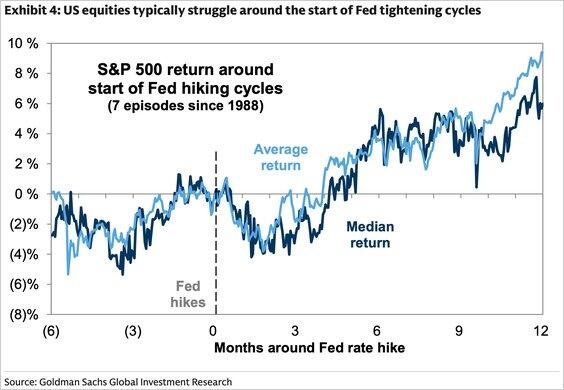
However, as is always the case, beware of “averages,” which in this case may well be lying to you. The reason I say that is due to the composition. The Fed almost always hikes into a strong, demand-driven expansion. It rarely hikes into a supply shock. When it has, the record is far uglier, and the damage tends to arrive late, once the energy spike feeds inflation and the tightening starts to bite.
After the 1973 oil embargo, the S&P fell 11% in a month and 41% over the next year. Another, more recent example, was when the Fed tightened amid the energy-and-inflation shock of 2022. During that period, the index lost roughly 19% for the year and remained underwater well past 12 months. Every “hikes are bullish” study carves 2022 out as the exception. Today, it is most likely not the exception, but the template.
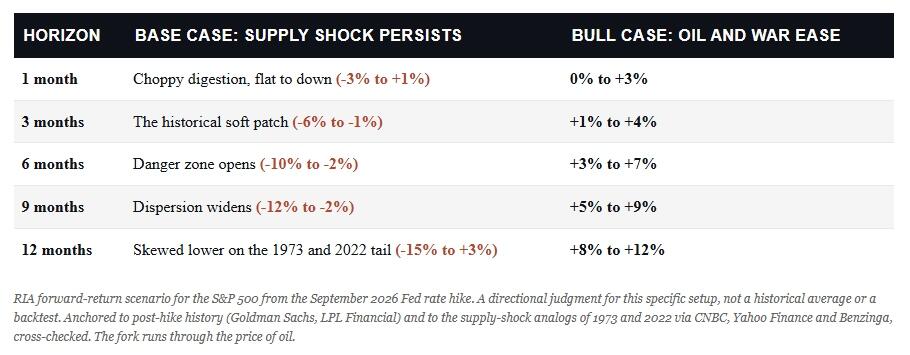
One thing that matters is the pace of the Fed rate hikes. Charles Schwab’s strategists found that the S&P returned 10.5% over the year following slow tightening cycles and lost 3.6% after rapid ones. So what should you actually expect over the next year, hiking into a war-driven supply shock with the 10-year near 5%? Our read sits below. It is a judgment anchored in that history, not a backtest.
In the current market, the leadership is not subtle. When the Fed hikes amid an energy shock, money tends to flow to where inflation is a benefit rather than a hindrance. For example, in 2022, as shown below, energy led the market up by about 48%. This suggests that investors, today, like then, should favor energy, materials, and defensives with real pricing power, as well as staples and health care. On the other side, underweight long-duration assets such as technology and communication services, as well as rate-sensitive discretionary and real estate names. However, there is always a caveat. If oil breaks and the shock fades, that map inverts, and today’s laggards lead the way back.
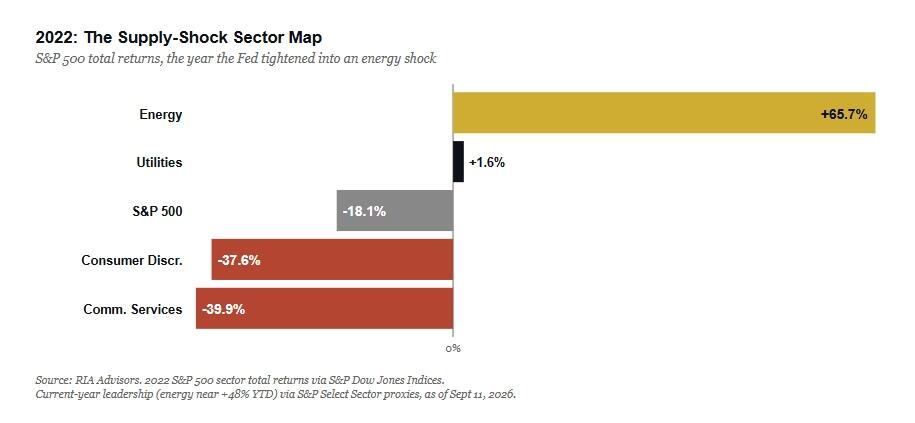
Such is the danger of leaning on a historical average built almost entirely on the wrong kind of hike.
What This Means For Markets Over The Next Few Months, And How To Navigate It
So how do you navigate it? Rates are “higher for longer,” and the committee has told you plainly it is willing to go again. The 30-year above 5.35% and the 10-year near 5.01% raise the bar that every equity, especially long-duration growth, has to clear to justify its multiple.
The forecasters are already marking that reality. Ed Yardeni cut his year-end S&P 500 target to 7,900 from 8,400 on the decision, flagging the risk of a downturn over the next three to six months as yields climb on energy. We would take the warning seriously without treating it as gospel.
Let’s focus on the bond market, which is the harder call right now, and the argument cuts both ways.
The bull case is a good one.
“The term premium has expanded to levels that historically pay investors to own duration, and a hike that slows the economy is the classic tailwind for long Treasuries. If Warsh restores “credibility” and growth cools, the long end rallies, and this past week’s high yields will look like a gift.”
The bear case, however, also has teeth.
“The 30-year sits at a 19-year high for a reason: relentless issuance against a $40 trillion debt, layered on top of supply-driven inflation. Rate hikes can not fix that. That tail does not disappear either just because the Fed moved a quarter point. So, this argues that investors should take exposure at the point where the term premium is best paid for the risk. That is in the belly of the curve, with 5-7 year durations.”
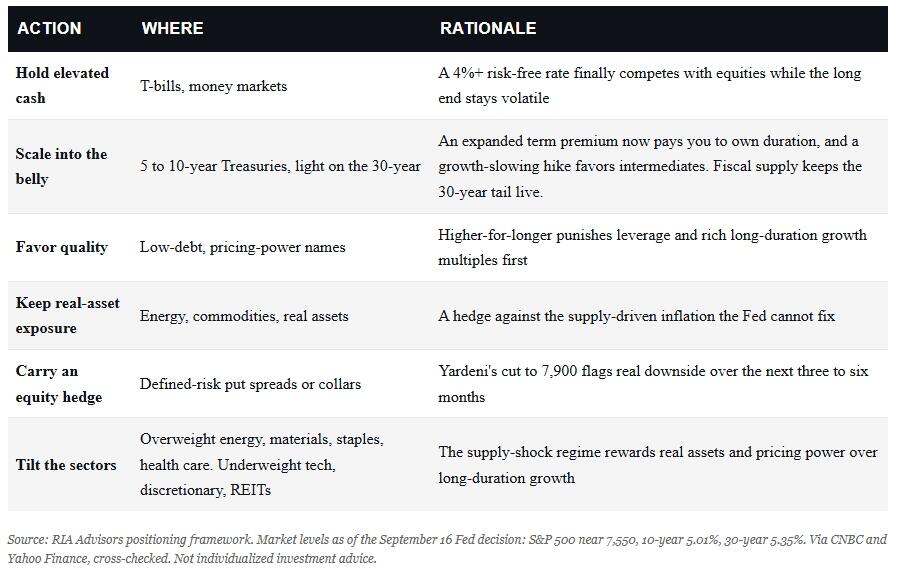
Crucially, none of this argues for abandoning equities. It argues for respecting a market regime in which the risk-free rate finally competes with everything else. It is an environment where the biggest driver of “price stability,” the Fed cited, is a war it can’t control. The deeper problem lies one level down. The deficits and debt that we repeatedly flagged are the real long-run engine of price stability. Monetary policy sits downstream of all of it.
The Fed can raise the price of money. It cannot lower the price of a war. Size the portfolio for the difference.