US Firms Account For 75% Of Chips Powering Russia's New Jet Drone
Building on our earlier notes mapping out the supply chain behind the Russian one-way attack drone, a new report from a Ukrainian defense news outlet claims that a whopping "three-quarters of the Geran-4's onboard computer consists of electronic components manufactured by American companies."
Militarnyi's supply-chain intelligence investigation into Russian Geran-4 drones identified 80 components from US companies among 105 cataloged parts, suggesting how heavily Russia relies on foreign technology despite severe sanctions from Western governments.
An engineering unit with Ukraine's 1230th Athena Engineering and Technical Regiment examined the chips, recovered from recent Geran-4 drone wreckage with most internal components intact, allowing investigators to inspect markings and serial numbers to identify manufacturers.
Here's what they found:
After comparing board descriptions and manufacturer lists, the researcher was able to identify 105 electronic components. Of these, at least 80 are from American companies, accounting for 76.19% of the total.
Countries are determined based on the parent company's place of registration. Under this approach, Intersil components are classified as products of the Japanese company Renesas, while Zetex components are classified as products of the American company Diodes Incorporated.
Texas Instruments dominates the list of manufacturers by a wide margin. Together with National Semiconductor, which it acquired in 2011, the two companies account for 61 components, or 58.1% of the list. These include, in particular, TMS320F28335PGFA processors for data processing and control of onboard systems, VP230 CAN transceivers for data exchange between modules, MB3238I multichannel transmitters, and PS767D301 voltage regulators. The boards also feature REF3020 reference voltage sources, which provide a stable voltage for measurement circuits.
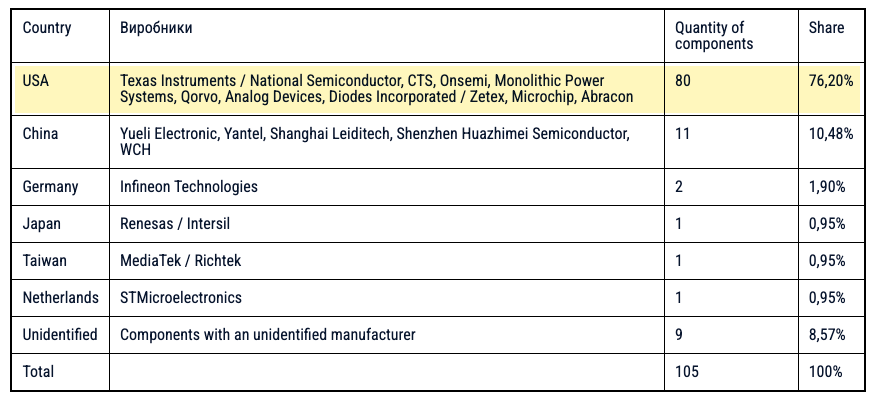
Militarnyi concluded the report:
With a production rate of 3,000 units per month, this dependence creates a need for more than two million components from Texas Instruments and National Semiconductor combined each year. This indicates a lack of an effective mechanism for monitoring compliance with sanctions, both at the level of the companies themselves and at the government level.
These new findings build on a separate report from Radio Free Europe/Radio Liberty, a US government-funded international news organization, that tore down a Geran-4 drone and found the jet's brain was powered by Texas Instruments chips. They also found many other foreign-made components, much of which came from China.
RFE/RL takes apart a Russian Geran-4 drone to uncover what makes the jet-powered unmanned aerial vehicle (UAV) faster, harder to intercept, and capable of operating deep inside Ukraine -- from its turbojet engine and advanced camera to foreign-made communications and navigation components. @cxemu @radiosvoboda
— Radio Free Europe/Radio Liberty (@RFERL) September 25, 2026
It remains unclear how and when these chips entered Russia. The recovered chips could have come from inventories stockpiled before sanctions, subsequent purchases through third-country intermediaries or shell companies, or a combination of the two.
The takeaway we have here is how heavily Russia depends on foreign components to power its new one-way attack drone.